Yao Gui-Ying, Luo Yan-Yan, Zhao Zhi-Min, Zhu Bo, Gao Min
School of Nursing, Xinxiang Medical University, Xinxiang, China.
School of Nursing, Henan University Minsheng College, Kaifeng, China.
Front Psychol. 2021 Oct 18;12:713271. doi: 10.3389/fpsyg.2021.713271. eCollection 2021.
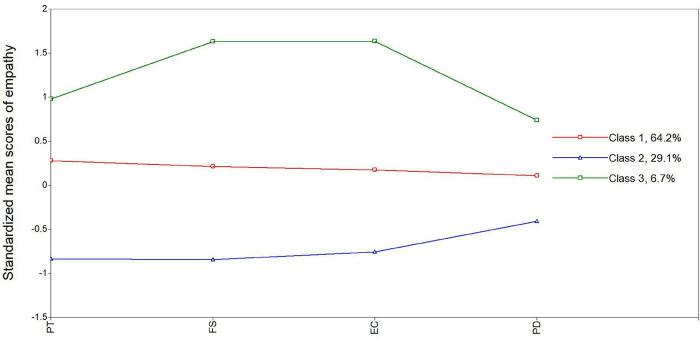
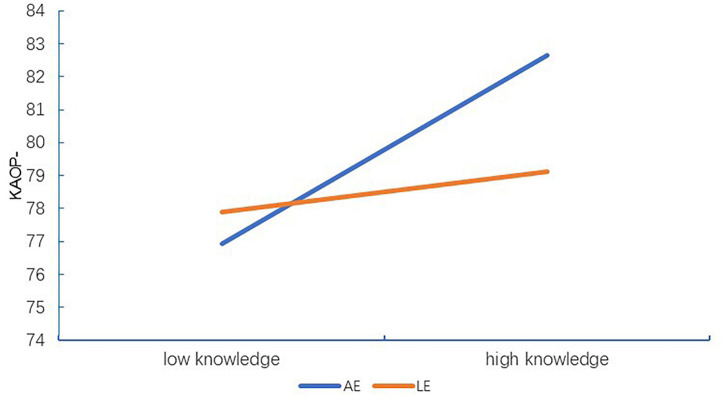
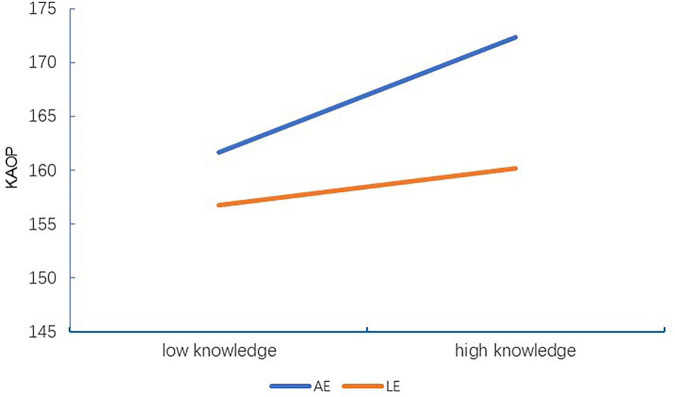
Knowledge about aging (KA) and empathy affect nursing students' attitudes toward older adults. However, little is known about the mechanisms underlying this phenomenon from an integrated, person-centered perspective. The purposes of the present study were (1) to identify empathy profiles based on the Interpersonal Reactivity Index (IRI) among Chinese nursing students and (2) to explore whether these latent empathy profiles moderate the association between KA and attitudes toward older people. A cross-sectional survey design was used, and a battery of questionnaires - including those on demographic information, the Chinese version of Palmore's Facts on Aging Quiz (C-FAQ), the Chinese version of Kogan's Attitude Toward Older People Scale (C-KAOP), and the IRI - was filled in by 622 Chinese nursing students ( 21.76; SD = 1.33). The mean total scores on KAOP and C-FAQ were 164.96 ± 18.32 and 10.436 ± 3.015, respectively, indicating relatively positive attitudes toward older people but low KA among Chinese nursing students. Latent profile analysis was used to identify a three-profile solution characterized by distinct levels of four dimensions of empathy, namely average empathy (AE, = 399), high empathy (HE, = 42), and low empathy (LE, = 181). Subsequent linear regression analysis revealed that the LE rather than the HE profile predicted positive attitudes toward older adults. It is worth noting that the LE profile played a remarkable moderating role in associations between KA and negative attitudes toward older adults after controlling for covariant variables. Both the identification of distinct empathy profiles and the interplay between the LE profile and KA are of significance in reducing negative attitudes toward older adults among Chinese nursing students. Nursing educators should combine improving nursing students' levels of KA and fostering greater empathy to reduce negative attitudes toward older adults. Such training should give priority to nursing students with LE.
关于衰老的知识(KA)和同理心会影响护理专业学生对老年人的态度。然而,从综合的、以人为主的角度来看,对于这一现象背后的机制我们知之甚少。本研究的目的是:(1)基于人际反应指数(IRI)确定中国护理专业学生的同理心概况;(2)探讨这些潜在的同理心概况是否会调节KA与对老年人态度之间的关联。采用横断面调查设计,622名中国护理专业学生(平均年龄21.76岁;标准差=1.33)填写了一系列问卷,包括人口统计学信息问卷、中文版帕尔莫尔衰老知识测验(C-FAQ)、中文版科根对老年人态度量表(C-KAOP)以及IRI。C-KAOP和C-FAQ的平均总分分别为164.96±18.32和10.436±3.015,这表明中国护理专业学生对老年人的态度相对积极,但KA水平较低。采用潜在剖面分析确定了一个三剖面解决方案,其特点是同理心的四个维度具有不同水平,即平均同理心(AE,n=399)、高同理心(HE,n=42)和低同理心(LE,n=181)。随后的线性回归分析表明,预测对老年人积极态度的是LE概况而非HE概况。值得注意的是,在控制协变量后,LE概况在KA与对老年人消极态度之间的关联中发挥了显著的调节作用。识别不同的同理心概况以及LE概况与KA之间的相互作用对于减少中国护理专业学生对老年人的消极态度具有重要意义。护理教育工作者应将提高护理专业学生的KA水平和培养更强的同理心相结合,以减少对老年人的消极态度。这种培训应优先针对具有低同理心的护理专业学生。