EPIUnit - Instituto de Saúde Pública da Universidade do Porto, Rua das Taipas, n° 135, 4050-600 Porto, Portugal.
Departamento de Ciências da Saúde Pública e Forenses e Educação Médica, Faculdade de Medicina da Universidade do Porto, Alameda Professor Hernâni Monteiro, 4200-319 Porto, Portugal.
J Nutr Sci. 2021 Oct 7;10:e89. doi: 10.1017/jns.2021.61. eCollection 2021.
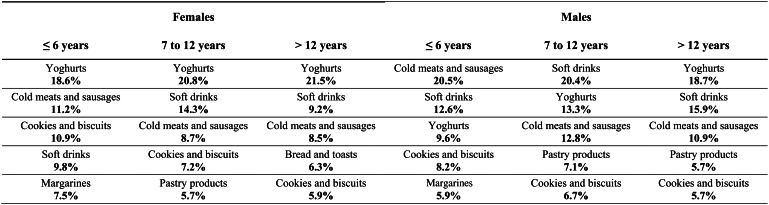
Ultra-processed foods (UPFs) are common worldwide and associated with poorer health outcomes. This work aimed to explore the UPF consumption associated factors and its main dietary sources, by sex, in Portugal. Participants from the National Food, Nutrition and Physical Activity Survey (IAN-AF) 2015-2016, aged 3-84 years, were included ( 5005). Dietary intake was assessed through two 1-day food diaries/24 h recalls. UPFs were identified using the NOVA classification. Associations were evaluated through linear regression models. Median UPF consumption was 257 g/d (10⋅6 % of total quantity; 23⋅8 % of total energy). Adolescents were those with higher consumption (490 g/d). Compared to adults, younger ages were positively associated with UPF consumption (e.g. adolescents (-females: 192, 95 % confidence interval (CI): 135, 249; -males: 327, 95 % CI: 277, 377)). A lower educational level was associated with lower UPF consumption (-females: -63; 95 % CI: -91, -34; -males: -68; 95 % CI: -124, -12). Also, a lower UPF consumption was observed in married males/couples compared to singles (: -48, 95 % CI: -96, -1). Furthermore, female current/former smokers were associated with a higher UPF consumption never smokers (: 79, 95 % CI: 41, 118; : 42, 95 % CI: 8, 75, respectively). Main UPF sources were yoghurts, soft drinks and cold meats/sausages differing strongly by sex, age and education level. Yoghurts containing additives were the main contributors to the UPF consumption in children and adult females from all education (~20 %). Soft drinks were leaders in adolescents (females: 26⋅0 %; males: 31⋅6 %) and young male adults (24⋅4 %). Cold meats/sausages stood out among low-educated males (20⋅5 %). Males, younger age groups, higher education, children with less-educated parents, married/couple males and smoking females were positively associated with UPF consumption.
超加工食品(UPF)在全球范围内很常见,与较差的健康结果有关。本研究旨在探讨葡萄牙不同性别与 UPF 消费相关的因素及其主要饮食来源。研究对象为 2015-2016 年国家食品、营养和身体活动调查(IAN-AF)的参与者,年龄在 3-84 岁之间(5005 人)。通过两天的食物日记/24 小时回忆来评估膳食摄入量。使用 NOVA 分类法来识别 UPF。通过线性回归模型评估关联。UPF 的平均消耗量为 257 克/天(占总摄入量的 10.6%;占总能量的 23.8%)。青少年的消耗量最高(490 克/天)。与成年人相比,年龄较小与 UPF 消费呈正相关(例如,青少年女性:192 克,95%置信区间(CI):135-249;青少年男性:327 克,95%CI:277-377)。较低的教育水平与较低的 UPF 消费相关(青少年女性:-63 克,95%CI:-91-34;青少年男性:-68 克,95%CI:-124-12)。已婚男性/夫妻的 UPF 摄入量也低于单身者(-48 克,95%CI:-96-1)。此外,女性当前/以前吸烟者与 UPF 消费较高有关(从不吸烟者:79 克,95%CI:41-118;以前吸烟者:42 克,95%CI:8-75)。主要的 UPF 来源是酸奶、软饮料和冷肉/香肠,其在性别、年龄和教育水平方面存在显著差异。含添加剂的酸奶是儿童和所有教育水平女性成年人群中 UPF 消费的主要贡献者(约 20%)。软饮料在青少年(女性:26.0%;男性:31.6%)和年轻男性成年人(24.4%)中占据主导地位。冷肉/香肠在受教育程度较低的男性中尤为突出(20.5%)。男性、年龄较小的群体、较高的教育水平、父母受教育程度较低的儿童、已婚/夫妻的男性和吸烟的女性与 UPF 消费呈正相关。