Basawarajappa Shantala Gowdara, Rangaiah Ambica, Venugopal Shwetha Jinnahalli, Varun Chakrakodi N, Nagaraj Vijay, Padukone Shashiraja, Shankar Sathyanarayan Muthur
Department of Microbiology, Bangalore Medical College and Research Institute, Bengaluru, Karnataka, India.
State Level VRDL, Department of Microbiology, Bangalore Medical College and Research Institute, Bengaluru, Karnataka, India.
Nepal J Epidemiol. 2021 Sep 30;11(3):1053-1062. doi: 10.3126/nje.v11i3.37712. eCollection 2021 Sep.
Dengue virus (DENV) continues to be an epidemic with high mortality rates. The clinical features, especially in the early phase of infection, are nonspecific and there is no single marker that can be reliably deployed for diagnostics. Further, serotype and genotype diversity is not clearly understood. This study was conceived to understand the performance characteristics of various diagnostic markers; serotype and genotype distribution is thus a vital requirement.
A subset of blood samples was obtained for all the clinically suspected Dengue cases during the period January to December 2017. The samples were tested for IgM and IgG antibodies and NS1 antigen by both ELISA and rapid tests. Real-time PCR, Conventional PCR and sequencing was performed based on the serology results. Correlation of the data with demographic and clinical details was used to analyze the performance characteristics of various tests.
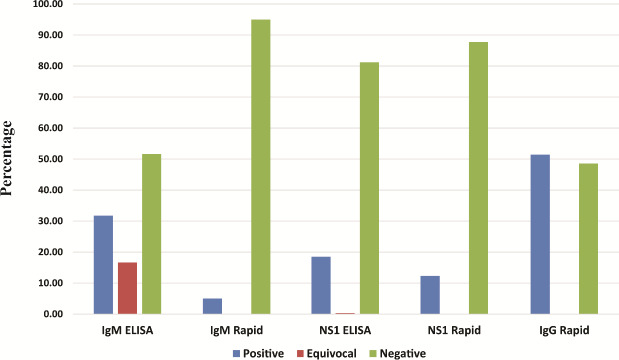
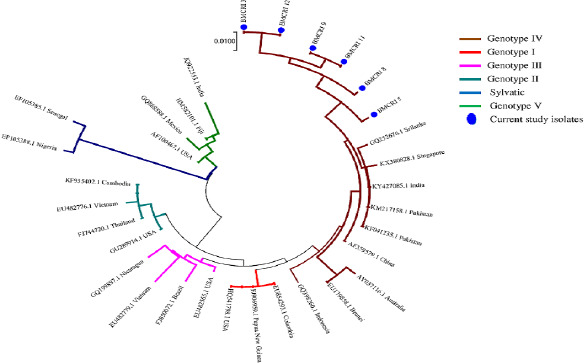
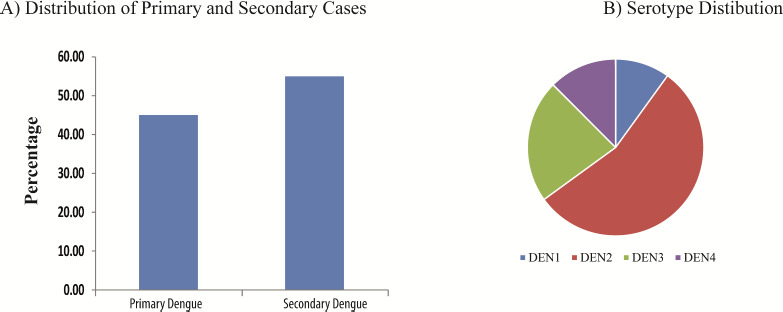
Clinical signs and symptoms could not predict dengue positivity due to lack of specific symptoms. The performance of IgM rapid test was found to be lower than the ELISA method (53.5% agreement). The NS1 rapid and NS1 ELISA tests were comparable (89.2% agreement). Majority of the infections were caused due to DEN-2 serotype and phylogenetic analysis revealed all the sequenced DEN-2 serotypes belong to Genotype IV. Three sequences were deposited into NCBI GenBank (GenBank accession number MW583116, MW579054 and MW579053).
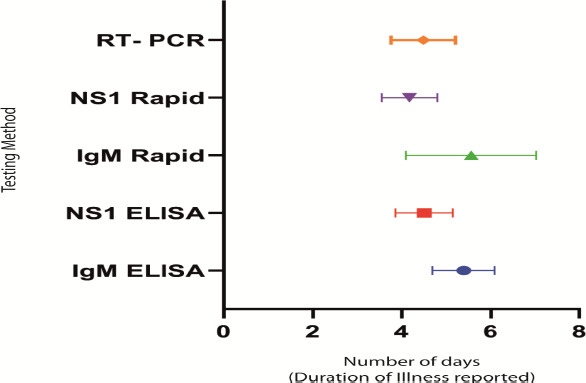
Our comprehensive data suggests that NS1 ELISA and PCR are best used in the early phase of dengue infection (< 5 days post-onset of fever), whereas IgM antibody detection is reliable only in the late phase. We also highlight the unreliable performance of rapid tests.
登革热病毒(DENV)仍然是一种具有高死亡率的流行病。其临床特征,尤其是在感染早期,是非特异性的,并且没有单一标志物可可靠地用于诊断。此外,血清型和基因型多样性尚未得到清晰的了解。本研究旨在了解各种诊断标志物的性能特征;因此血清型和基因型分布是一项至关重要的要求。
采集了2017年1月至12月期间所有临床疑似登革热病例的一部分血液样本。通过酶联免疫吸附测定(ELISA)和快速检测法对样本进行IgM和IgG抗体以及NS1抗原检测。根据血清学结果进行实时聚合酶链反应(PCR)、常规PCR和测序。将数据与人口统计学和临床细节进行关联分析,以评估各种检测方法的性能特征。
由于缺乏特异性症状,临床体征和症状无法预测登革热阳性结果。发现IgM快速检测的性能低于ELISA方法(一致性为53.5%)。NS1快速检测和NS1 ELISA检测具有可比性(一致性为89.2%)。大多数感染是由DEN - 2血清型引起的,系统发育分析表明所有测序的DEN - 2血清型均属于基因型IV。三个序列已存入NCBI基因库(基因库登录号MW583116、MW579054和MW579053)。
我们的综合数据表明,NS1 ELISA和PCR最适用于登革热感染的早期阶段(发热发作后<5天),而IgM抗体检测仅在后期可靠。我们还强调了快速检测的不可靠性能。