Liu Chenyong, Zhao Yanan, Qin Shan, Wang Xiaoqiu, Jiang Yuanyuan, Wu Wenzhong
Jiangsu Province Hospital of Chinese Medicine, Affiliated Hospital of Nanjing University of Chinese Medicine, Nanjing, China.
Institute of Acupuncture and Moxibustion, China Academy of Chinese Medical Sciences, Beijing, China.
Ann Transl Med. 2021 Sep;9(18):1426. doi: 10.21037/atm-21-3845.
Acupuncture treatment of chronic insomnia (CI) was effective. Anxiety and depression symptoms of the CI patients were improved to varying degrees after acupuncture treatment. Corticosterone (CORT) and 5-hydroxytryptamine (5-HT) are involved in the occurrence and development of comorbidity of insomnia, anxiety, and depression. Whether acupuncture can treat insomnia and accompany anxiety and depression symptoms by regulating CORT and 5-HT is still unclear.
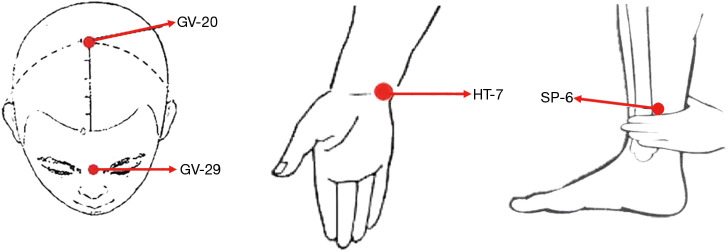
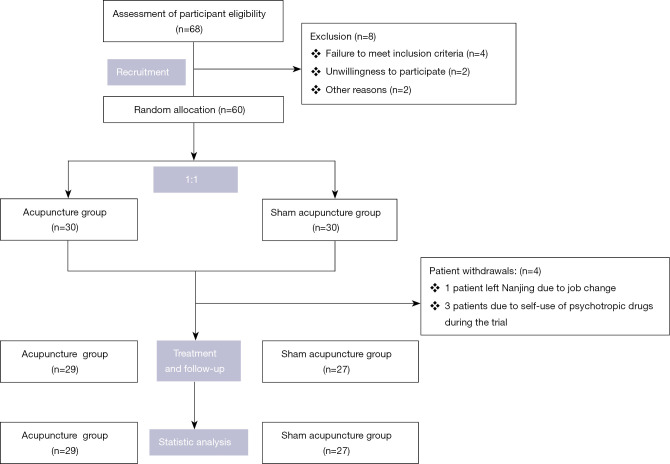
This was a randomized, single-blind (participant), parallel, placebo-controlled trial. Sixty CI patients were randomly divided into acupuncture and sham acupuncture groups, with 30 patients in each group. In the acupuncture group, acupuncture was applied at Baihui (GV20), Yintang (GV29), Shenmen (HT7, bilateral), and Sanyinjiao (SP6, bilateral), while in the sham acupuncture group, superficial needles were used on non-disorder-related acupoints. Both groups were treated 3 times a week (once every other day) for 4 weeks and at the 3-month follow-up. The patients were assessed using the Pittsburgh Sleep Quality Index (PQSI), Hamilton Anxiety Rating Scale (HAMA), and Hamilton Depression Rating Scale (HAMD). The serum concentrations of CORT and 5-HT were also measured before and after treatment.
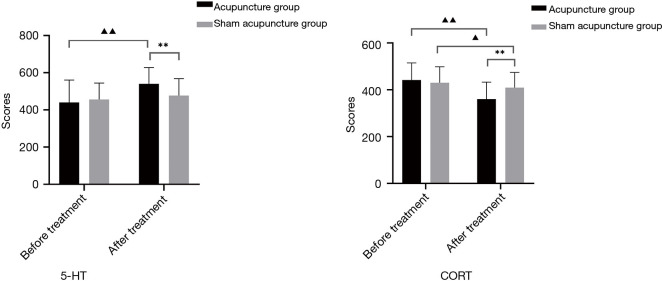
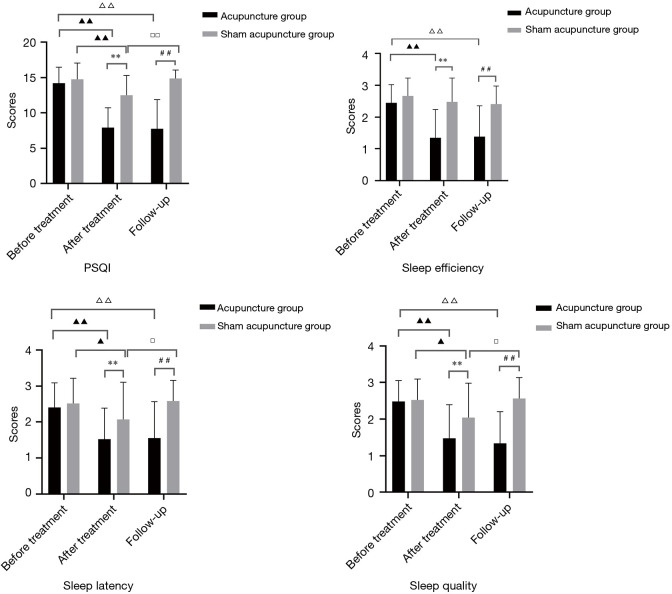
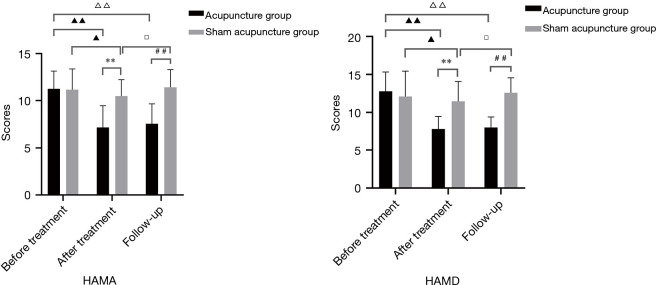
After treatment, the decrease in serum CORT and the increase in serum 5-HT were significantly greater in the acupuncture group than in the sham acupuncture group. At follow-up, the PSQI, HAMA, and HAMD scores in the acupuncture group were significantly lower than those in the sham acupuncture group.
Elevated serum CORT and decreased serum 5-HT levels may be associated with mood regulation disorders in CI patients. Acupuncture can significantly improve the sleep quality, efficiency, and latency of CI patients, and it can alleviate anxiety and depression in such patients. Compared with the sham acupuncture group, the acupuncture group showed a stable long-term efficacy.
Chinese Clinical Trials Register ChiCTR1800020298.
针刺治疗慢性失眠有效。针刺治疗后,慢性失眠患者的焦虑和抑郁症状有不同程度改善。皮质酮(CORT)和5-羟色胺(5-HT)参与失眠、焦虑和抑郁共病的发生发展。针刺是否能通过调节CORT和5-HT治疗失眠及伴发的焦虑和抑郁症状尚不清楚。
这是一项随机、单盲(受试者)、平行、安慰剂对照试验。60例慢性失眠患者随机分为针刺组和假针刺组,每组30例。针刺组针刺百会(GV20)、印堂(GV29)、神门(HT7,双侧)和三阴交(SP6,双侧),假针刺组在与疾病无关的穴位使用浅刺。两组均每周治疗3次(隔日1次),共4周,并进行3个月随访。采用匹兹堡睡眠质量指数(PSQI)、汉密尔顿焦虑量表(HAMA)和汉密尔顿抑郁量表(HAMD)对患者进行评估。治疗前后还检测了血清CORT和5-HT浓度。
治疗后,针刺组血清CORT降低和血清5-HT升高的幅度均显著大于假针刺组。随访时,针刺组的PSQI、HAMA和HAMD评分显著低于假针刺组。
血清CORT升高和血清5-HT水平降低可能与慢性失眠患者的情绪调节障碍有关。针刺可显著改善慢性失眠患者的睡眠质量、效率和潜伏期,并可缓解此类患者的焦虑和抑郁。与假针刺组相比,针刺组显示出稳定的长期疗效。
中国临床试验注册中心ChiCTR1800020298。