• 文献检索
  • 文档翻译
  • 深度研究
  • 学术资讯
  • Suppr Zotero 插件Zotero 插件
  • 邀请有礼
  • 套餐&价格
  • 历史记录
应用&插件
Suppr Zotero 插件Zotero 插件浏览器插件Mac 客户端Windows 客户端微信小程序
定价
高级版会员购买积分包购买API积分包
服务
文献检索文档翻译深度研究API 文档MCP 服务
关于我们
关于 Suppr公司介绍联系我们用户协议隐私条款
关注我们

Suppr 超能文献

核心技术专利:CN118964589B侵权必究
粤ICP备2023148730 号-1Suppr @ 2026

文献检索

告别复杂PubMed语法,用中文像聊天一样搜索,搜遍4000万医学文献。AI智能推荐,让科研检索更轻松。

立即免费搜索

文件翻译

保留排版,准确专业,支持PDF/Word/PPT等文件格式,支持 12+语言互译。

免费翻译文档

深度研究

AI帮你快速写综述,25分钟生成高质量综述,智能提取关键信息,辅助科研写作。

立即免费体验

视频使用的远程医疗预约临床医生和患者因素分析。

Analysis of Clinician and Patient Factors and Completion of Telemedicine Appointments Using Video.

机构信息

Collaborative for Healthcare Delivery Science, Center for Advancing Population Science, Medical College of Wisconsin, Milwaukee.

Inception Labs at Froedtert & Medical College of Wisconsin Health Network, Milwaukee.

出版信息

JAMA Netw Open. 2021 Nov 1;4(11):e2132917. doi: 10.1001/jamanetworkopen.2021.32917.

DOI:10.1001/jamanetworkopen.2021.32917
PMID:34735013
原文链接:https://pmc.ncbi.nlm.nih.gov/articles/PMC8569484/
Abstract

IMPORTANCE

Telemedicine provides patients access to episodic and longitudinal care. Policy discussions surrounding future support for telemedicine require an understanding of factors associated with successful video visits.

OBJECTIVE

To assess patient and clinician factors associated with successful and with failed video visits.

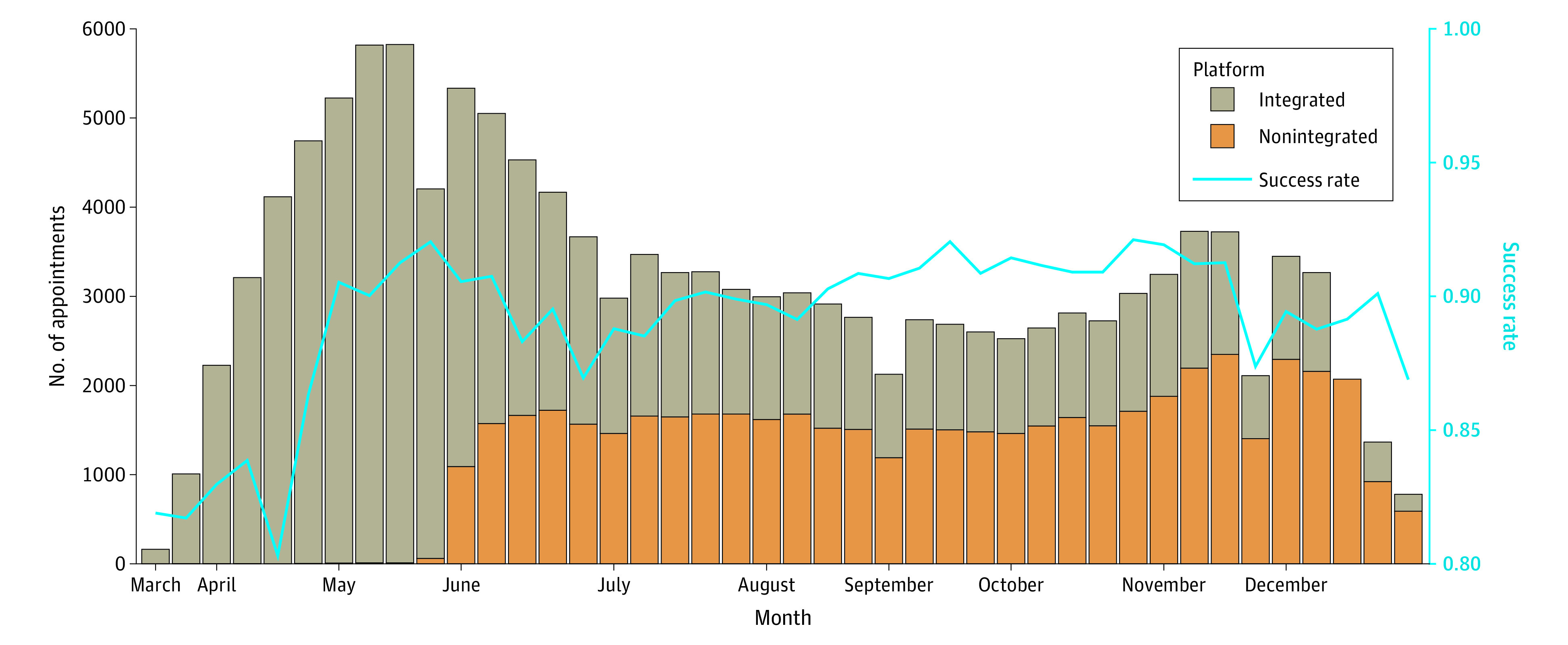
DESIGN, SETTING, AND PARTICIPANTS: This was a quality improvement study of 137 846 scheduled video visits at a single academic health system in southeastern Wisconsin between March 1 and December 31, 2020, supplemented with patient experience survey data. Patient information was gathered using demographic information abstracted from the electronic health record and linked with block-level socioeconomic data from the US Census Bureau. Data on perceived clinician experience with technology was obtained using the survey.

MAIN OUTCOMES AND MEASURES

The primary outcome of interest was the successful completion of a scheduled video visit or the conversion of the video visit to a telephone-based service. Visit types and administrative data were used to categorize visits. Mixed-effects modeling with pseudo R2 values was performed to compare the relative associations of patient and clinician factors with video visit failures.

RESULTS

In total, 75 947 patients and 1155 clinicians participated in 137 846 scheduled video encounters, 17 190 patients (23%) were 65 years or older, and 61 223 (81%) patients were of White race and ethnicity. Of the scheduled video encounters, 123 473 (90%) were successful, and 14 373 (10%) were converted to telephone services. A total of 16 776 patients (22%) completed a patient experience survey. Lower clinician comfort with technology (odds ratio [OR], 0.15; 95% CI, 0.08-0.28), advanced patient age (66-80 years: OR, 0.28; 95% CI, 0.26-0.30), lower patient socioeconomic status (including low high-speed internet availability) (OR, 0.85; 95% CI, 0.77-0.92), and patient racial and ethnic minority group status (Black or African American: OR, 0.75; 95% CI, 0.69-0.81) were associated with conversion to telephone visits. Patient characteristics accounted for systematic components for success; marginal pseudo R2 values decreased from 23% (95% CI, 21.1%-26.1%) to 7.8% (95% CI, 6.3%-9.4%) with exclusion of patient factors.

CONCLUSIONS AND RELEVANCE

As policy makers consider expanding telehealth coverage and hospital systems focus on investments, consideration of patient support, equity, and friction should guide decisions. In particular, this quality improvement study suggests that underserved patients may become disproportionately vulnerable by cuts in coverage for telephone-based services.

摘要

重要性

远程医疗为患者提供了进行偶发性和纵向护理的途径。围绕未来对远程医疗的支持进行的政策讨论需要了解与成功视频访问相关的因素。

目的

评估与成功和失败视频访问相关的患者和临床医生因素。

设计、地点和参与者:这是一项质量改进研究,涉及 2020 年 3 月 1 日至 12 月 31 日期间在威斯康星州东南部的一家学术医疗系统中计划的 137846 次视频访问,补充了患者体验调查数据。使用从电子健康记录中提取的人口统计学信息收集患者信息,并与美国人口普查局的街区级社会经济数据相关联。使用调查获得了与感知临床医生技术经验相关的数据。

主要结果和措施

主要研究结果是成功完成计划中的视频访问或将视频访问转换为基于电话的服务。访问类型和管理数据用于对访问进行分类。使用伪 R2 值进行混合效应模型比较,以比较患者和临床医生因素与视频访问失败的相对关联。

结果

共有 75947 名患者和 1155 名临床医生参加了 137846 次计划中的视频就诊,17190 名患者(23%)年龄在 65 岁或以上,61223 名(81%)患者为白种人。在计划的视频访问中,123473 次(90%)是成功的,14373 次(10%)被转换为电话服务。共有 16776 名患者(22%)完成了患者体验调查。临床医生对技术的舒适度较低(比值比[OR],0.15;95%置信区间,0.08-0.28)、患者年龄较大(66-80 岁:OR,0.28;95%置信区间,0.26-0.30)、较低的患者社会经济地位(包括低高速互联网可用性)(OR,0.85;95%置信区间,0.77-0.92)以及患者的种族和少数民族群体地位(黑人或非裔美国人:OR,0.75;95%置信区间,0.69-0.81)与电话访问的转换相关。患者特征解释了成功的系统成分;偏置伪 R2 值从 23%(95%置信区间,21.1%-26.1%)下降到 7.8%(95%置信区间,6.3%-9.4%),排除了患者因素。

结论和相关性

随着政策制定者考虑扩大远程医疗覆盖范围以及医院系统专注于投资,对患者支持、公平性和摩擦的考虑应该指导决策。特别是,这项质量改进研究表明,服务不足的患者可能会因电话服务覆盖范围的削减而变得不成比例地脆弱。
https://cdn.ncbi.nlm.nih.gov/pmc/blobs/47c5/8569484/2d8de22eced2/jamanetwopen-e2132917-g001.jpg

相似文献

1
Analysis of Clinician and Patient Factors and Completion of Telemedicine Appointments Using Video.视频使用的远程医疗预约临床医生和患者因素分析。
JAMA Netw Open. 2021 Nov 1;4(11):e2132917. doi: 10.1001/jamanetworkopen.2021.32917.
2
Patient Characteristics Associated With Choosing a Telemedicine Visit vs Office Visit With the Same Primary Care Clinicians.与选择与同一位初级保健临床医生进行远程医疗访问相比,与患者特征相关。
JAMA Netw Open. 2020 Jun 1;3(6):e205873. doi: 10.1001/jamanetworkopen.2020.5873.
3
Patient Characteristics Associated With Telemedicine Access for Primary and Specialty Ambulatory Care During the COVID-19 Pandemic.与 COVID-19 大流行期间初级和专科门诊远程医疗访问相关的患者特征。
JAMA Netw Open. 2020 Dec 1;3(12):e2031640. doi: 10.1001/jamanetworkopen.2020.31640.
4
Socioeconomic and Demographic Disparities in the Use of Telemedicine for Ophthalmic Care during the COVID-19 Pandemic.在 COVID-19 大流行期间,眼科医疗中远程医疗的使用存在社会经济和人口统计学差异。
Ophthalmology. 2022 Jan;129(1):15-25. doi: 10.1016/j.ophtha.2021.07.003. Epub 2021 Jul 8.
5
Treatment and Follow-up Care Associated With Patient-Scheduled Primary Care Telemedicine and In-Person Visits in a Large Integrated Health System.在大型综合医疗体系中,与患者预约的初级保健远程医疗和门诊相关的治疗和随访护理。
JAMA Netw Open. 2021 Nov 1;4(11):e2132793. doi: 10.1001/jamanetworkopen.2021.32793.
6
Socioeconomic Disparities in Patient Use of Telehealth During the Coronavirus Disease 2019 Surge.《新冠疫情期间,远程医疗在患者中的使用存在社会经济差异》
JAMA Otolaryngol Head Neck Surg. 2021 Mar 1;147(3):287-295. doi: 10.1001/jamaoto.2020.5161.
7
Converting a Geriatrics Clinic to Virtual Visits during COVID-19: A Case Study.在 COVID-19 期间将老年病学诊所转为虚拟就诊:案例研究。
J Prim Care Community Health. 2021 Jan-Dec;12:21501327211000235. doi: 10.1177/21501327211000235.
8
Disparities in Video and Telephone Visits Among Older Adults During the COVID-19 Pandemic: Cross-Sectional Analysis.新冠疫情期间老年人视频和电话问诊的差异:横断面分析
JMIR Aging. 2020 Nov 10;3(2):e23176. doi: 10.2196/23176.
9
Differences in the use of telephone and video telemedicine visits during the COVID-19 pandemic.在 COVID-19 大流行期间,电话和视频远程医疗就诊的使用差异。
Am J Manag Care. 2021 Jan;27(1):21-26. doi: 10.37765/ajmc.2021.88573.
10
Demographic Disparity in Use of Telemedicine for Ambulatory General Surgical Consultation During the COVID-19 Pandemic: Analysis of the Initial Public Health Emergency and Second Phase Periods.疫情期间门诊普通外科咨询中远程医疗使用的人口统计学差异:对初始公共卫生紧急情况和第二阶段的分析。
J Am Coll Surg. 2022 Feb 1;234(2):191-202. doi: 10.1097/XCS.0000000000000030.

引用本文的文献

1
Measuring the Impact of a Multi-Site In-Hospital Intervention for Opioid Use Disorder Treatment Provision: A Survey of Hospital-Based Clinicians.评估多地点医院内阿片类药物使用障碍治疗干预措施的影响:一项针对医院临床医生的调查
J Gen Intern Med. 2025 Aug 27. doi: 10.1007/s11606-025-09728-8.
2
Telemedicine preferences in pediatric urology following the COVID-19 pandemic: A caregiver survey.COVID-19大流行后儿科泌尿外科的远程医疗偏好:一项照顾者调查。
Front Urol. 2023 Feb 13;3:994540. doi: 10.3389/fruro.2023.994540. eCollection 2023.
3
Enabling Telemedicine From the System-Level Perspective: Scoping Review.

本文引用的文献

1
Telemedicine Adoption during the COVID-19 Pandemic: Gaps and Inequalities.远程医疗在 COVID-19 大流行期间的采用:差距与不平等。
Appl Clin Inform. 2021 Aug;12(4):836-844. doi: 10.1055/s-0041-1733848. Epub 2021 Sep 8.
2
Community Factors Associated With Telemedicine Use During the COVID-19 Pandemic.社区因素与 COVID-19 大流行期间远程医疗的使用相关。
JAMA Netw Open. 2021 May 3;4(5):e2110330. doi: 10.1001/jamanetworkopen.2021.10330.
3
Clinician Satisfaction with Rapid Adoption and Implementation of Telehealth Services During the COVID-19 Pandemic.
从系统层面视角推动远程医疗:范围综述
J Med Internet Res. 2025 Mar 5;27:e65932. doi: 10.2196/65932.
4
Physician and Practice Characteristics Influencing Telemedicine Uptake Among Frontline Clinicians in the Early COVID-19 Pandemic Response: National Survey Study.在COVID-19大流行早期应对中影响一线临床医生采用远程医疗的医生和执业特征:全国调查研究
JMIR Form Res. 2024 Jul 17;8:e50751. doi: 10.2196/50751.
5
Staff-Facilitated Telemedicine Care Delivery for Treatment of Hepatitis C Infection among People Who Inject Drugs.由工作人员协助的远程医疗服务提供,用于治疗注射吸毒者中的丙型肝炎感染。
Healthcare (Basel). 2024 Mar 25;12(7):715. doi: 10.3390/healthcare12070715.
6
Trends in telemedicine visits among pediatric asthma patients during COVID-19.新冠疫情期间儿科哮喘患者的远程医疗就诊趋势
J Allergy Clin Immunol Glob. 2024 Mar 1;3(2):100239. doi: 10.1016/j.jacig.2024.100239. eCollection 2024 May.
7
Translating Value Across Telehealth Stakeholders: A Rapid Review of Telehealth Measurement Evidence and a New Policy Framework to Guide Telehealth Researchers.跨远程医疗利益相关者进行价值转化:对远程医疗测量证据的快速回顾及指导远程医疗研究人员的新政策框架
Telemed J E Health. 2024 Jun;30(6):1559-1573. doi: 10.1089/tmj.2023.0211. Epub 2024 Apr 2.
8
Caregivers' Role in In-Home Video Telehealth: National Survey of Occupational Therapy Practitioners.家庭视频远程医疗中护理人员的角色:职业治疗从业者全国调查。
JMIR Rehabil Assist Technol. 2024 Mar 14;11:e52049. doi: 10.2196/52049.
9
Social Determinants of Health and Patients' Technology Acceptance of Telehealth During the COVID-19 Pandemic: Pilot Survey.COVID-19 大流行期间的健康社会决定因素和患者对远程医疗的技术接受度:试点调查。
JMIR Hum Factors. 2023 Nov 7;10:e47982. doi: 10.2196/47982.
10
Patient-reported Primary Care Video and Telephone Telemedicine Preference Shifts During the COVID-19 Pandemic.患者报告的初级保健视频和电话远程医疗偏好在 COVID-19 大流行期间发生转变。
Med Care. 2023 Nov 1;61(11):772-778. doi: 10.1097/MLR.0000000000001916. Epub 2023 Sep 19.
临床医生对 COVID-19 大流行期间快速采用和实施远程医疗服务的满意度。
Telemed J E Health. 2021 Dec;27(12):1385-1392. doi: 10.1089/tmj.2020.0575. Epub 2021 Feb 19.
4
Paying for Telemedicine After the Pandemic.疫情后的远程医疗付费
JAMA. 2021 Feb 2;325(5):431-432. doi: 10.1001/jama.2020.25706.
5
Ensuring Quality in the Era of Virtual Care.在虚拟医疗时代确保质量。
JAMA. 2021 Feb 2;325(5):429-430. doi: 10.1001/jama.2020.24955.
6
Differences in the use of telephone and video telemedicine visits during the COVID-19 pandemic.在 COVID-19 大流行期间,电话和视频远程医疗就诊的使用差异。
Am J Manag Care. 2021 Jan;27(1):21-26. doi: 10.37765/ajmc.2021.88573.
7
Disparities in Video and Telephone Visits Among Older Adults During the COVID-19 Pandemic: Cross-Sectional Analysis.新冠疫情期间老年人视频和电话问诊的差异:横断面分析
JMIR Aging. 2020 Nov 10;3(2):e23176. doi: 10.2196/23176.
8
Why telemedicine is here to stay.远程医疗为何会持续存在。
BMJ. 2020 Oct 6;371:m3603. doi: 10.1136/bmj.m3603.
9
The new 'normal': Rapid adoption of telemedicine in orthopaedics during the COVID-19 pandemic.新常态:COVID-19 大流行期间骨科领域迅速采用远程医疗。
Injury. 2020 Dec;51(12):2816-2821. doi: 10.1016/j.injury.2020.09.009. Epub 2020 Sep 16.
10
Patient Satisfaction With Telemedicine During the COVID-19 Pandemic: Retrospective Cohort Study.2019年冠状病毒病大流行期间患者对远程医疗的满意度:回顾性队列研究
J Med Internet Res. 2020 Sep 9;22(9):e20786. doi: 10.2196/20786.