Division of Psychosocial Research and Epidemiology, The Netherlands Cancer Institute, Antoni van Leeuwenhoek Hospital, Amsterdam, The Netherlands.
Department of Research, Netherlands Comprehensive Cancer Organization (IKNL), Utrecht, The Netherlands.
BMC Fam Pract. 2021 Nov 4;22(1):218. doi: 10.1186/s12875-021-01567-w.
With the increasing attention for the role of General Practitioners (GPs) after cancer treatment, it is important to better understand the involvement of GPs following prostate cancer treatment. This study investigates factors associated with GP contact during follow-up of prostate cancer survivors, such as patient, treatment and symptom variables, and satisfaction with, trust in, and appraised knowledge of GPs.
Of 787 prostate cancer survivors diagnosed between 2007 and 2013, and selected from the Netherlands Cancer Registry, 557 (71%) responded to the invitation to complete a questionnaire. Multivariable logistic regression analyses were performed to investigate which variables were associated with GP contact during follow- up.
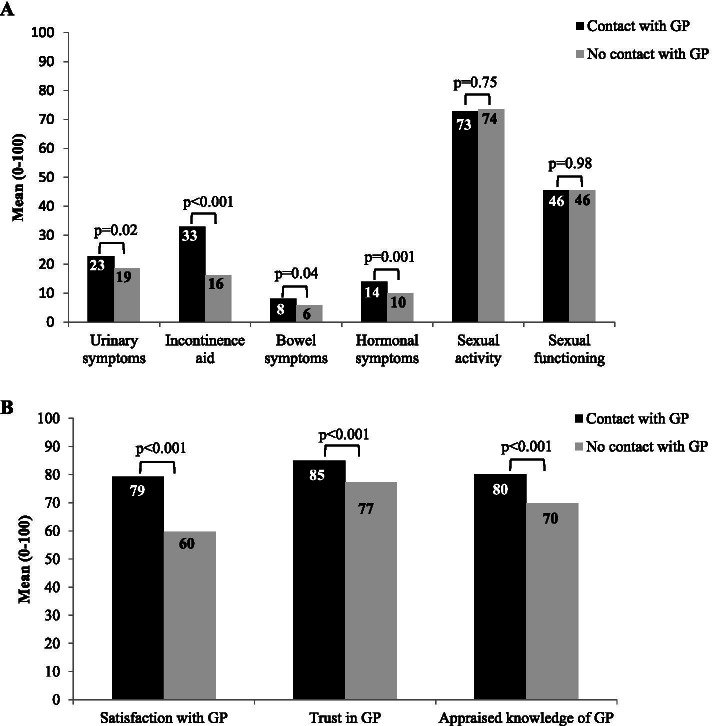
In total, 200 (42%) prostate cancer survivors had contact with their GP during follow-up, and 76 (16%) survivors preferred more contact. Survivors who had an intermediate versus low educational level (OR = 2.0) were more likely to have had contact with their GP during follow-up. Survivors treated with surgery (OR = 2.8) or hormonal therapy (OR = 3.5) were also more likely to seek follow-up care from their GP compared to survivors who were treated with active surveillance. Patient reported bowel symptoms (OR = 1.4), hormonal symptoms (OR = 1.4), use of incontinence aids (OR = 1.6), and being satisfied with their GP (OR = 9.5) were also significantly associated with GP contact during follow-up.
Education, treatment, symptoms and patient satisfaction were associated with GP contact during prostate cancer follow-up. These findings highlight the potential for adverse side-effects to be managed in primary care. In light of future changes in cancer care, evaluating prostate cancer follow-up in primary care remains important.
随着人们对全科医生(GP)在癌症治疗后所扮演角色的关注度不断提高,了解前列腺癌患者接受治疗后的 GP 参与情况变得尤为重要。本研究旨在调查与 GP 接触相关的因素,包括患者、治疗和症状变量,以及对 GP 的满意度、信任度和评估知识。
本研究从荷兰癌症登记处选取了 787 名 2007 年至 2013 年间被诊断为前列腺癌的幸存者,邀请其中 557 名(71%)幸存者完成了一份调查问卷。采用多变量逻辑回归分析,以调查哪些变量与随访期间与 GP 的接触相关。
共有 200 名(42%)前列腺癌幸存者在随访期间与 GP 有过接触,其中 76 名(16%)幸存者希望有更多接触。与教育水平较低的幸存者相比,中等教育水平(OR=2.0)和较高教育水平(OR=2.6)的幸存者在随访期间更有可能与 GP 接触。与接受主动监测治疗的幸存者相比,接受手术(OR=2.8)或激素治疗(OR=3.5)治疗的幸存者更有可能寻求 GP 的随访治疗。患者报告的肠道症状(OR=1.4)、激素症状(OR=1.4)、使用尿失禁辅助工具(OR=1.6)和对 GP 的满意度(OR=9.5)也与随访期间与 GP 的接触显著相关。
教育程度、治疗方法、症状和患者满意度与前列腺癌随访期间与 GP 的接触相关。这些发现强调了在初级保健中管理潜在不良反应的潜力。鉴于未来癌症治疗的变化,对初级保健中的前列腺癌随访进行评估仍然很重要。