Johns Hopkins School of Education, Baltimore, MD, USA.
Johns Hopkins Bloomberg School of Public Health, Baltimore, MD, USA.
BMC Public Health. 2021 Nov 4;21(1):2009. doi: 10.1186/s12889-021-12098-5.
School closures and family economic instability caused by the COVID-19 lockdown measures have threatened the mental health and academic progress of adolescents. Through secondary data analysis of World Vision Asia Pacific Region's COVID-19 response-assessments in May-June 2020, this study examined whether adolescents' study, physical, and leisure activities, psychosocial status, and sources of COVID-19 information differed by gender.
The assessments used cross-sectional surveys of adolescents in poor communities served by World Vision (n = 5552 males and n = 6680 females) aged 10-18 years old in six countries. The study households of adolescents were selected either by random sampling or non-probability convenience sampling and assessed using telephone or in-person interviews. Multivariate logistic regression analyses examined the relationship between gender and psychosocial status; daily activities (e.g., play, study); and sources of information about COVID-19.
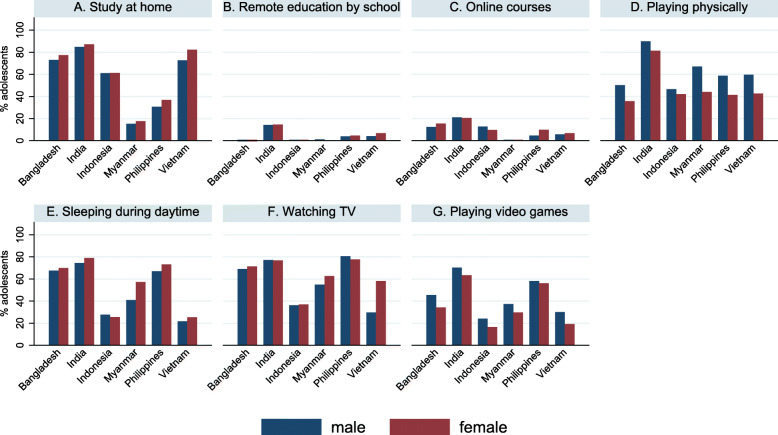
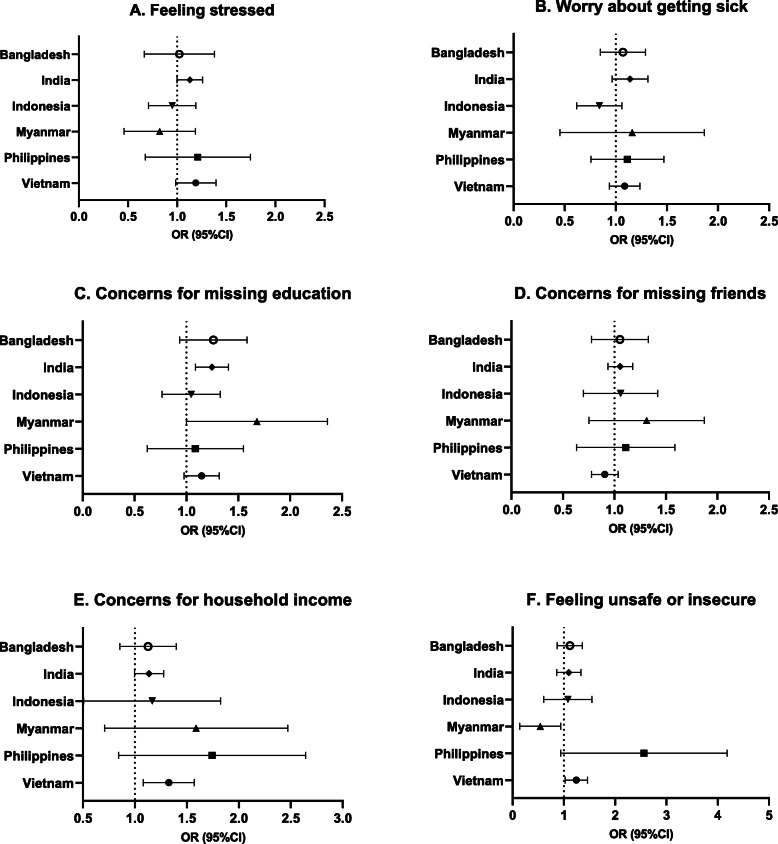
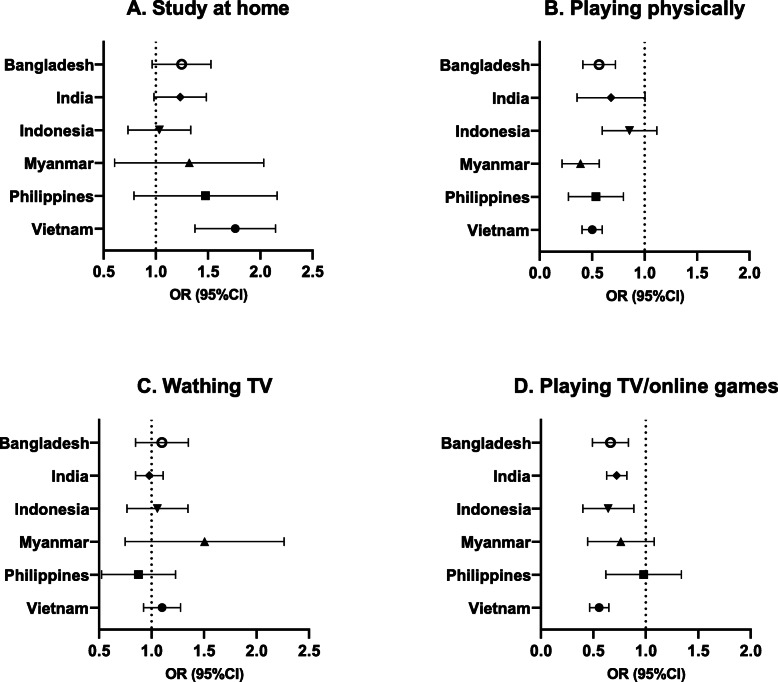
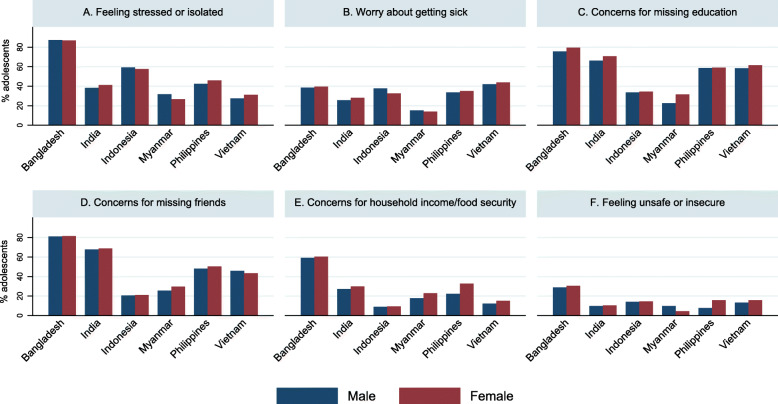
Participation in remote education was low (range: 0.5-20.7% across countries), with gender difference found only in Vietnam. Compared to males, female adolescents were less likely to play physically with a range of AOR: 0.36-0.55 (n = 5 countries) or play video games with a range of AOR: 0.55-0.72 (n = 2 countries). Female adolescents were more likely to feel isolated or stressed (India, AOR = 1.13, 95%CI:1.00, 1.26); feel unsafe (the Philippines, AOR = 2.22, 95%CI:1.14, 4.33; Vietnam, AOR = 1.31, 95%CI:1.03, 1.47); be concerned about education (India, AOR = 1.24, 95%CI:1.09, 1.41; Myanmar, AOR = 1.59, 95%CI:1.05, 2.40); or be concerned about household income (India, AOR = 1.13, 95%CI:1.00, 1.28; Vietnam, AOR = 1.31, 95%CI:1.09, 1.58). Female adolescents were also less likely to obtain COVID-19 related information through internet/social media (Bangladesh, AOR = 0.51, 95%CI:0.41, 0.64; India, AOR = 0.84, 95%CI:0.73, 0.96; and Myanmar, AOR = 0.65, 95%CI:0.43, 0.97) and mobile call or short message (India, AOR = 0.88, 95%CI:0.80, 0.98) but more likely to get the information from friends (Vietnam, AOR = 1.18, 95%CI:1.02, 1.36) and family (Bangladesh, AOR = 1.44, 95% CI:1.21, 1.70; India, AOR = 1.29, 95% CI:1.15, 1.45).
An understanding of gender differences in the impacts of COVID-19 on adolescents' schooling, physical, and mental health can inform adolescent protection interventions. Psychosocial support during response and recovery phases needs to pay special attention to gender differences, since female adolescents' psychosocial status is at higher risk when facing the challenges of this pandemic.
新冠疫情封锁措施导致学校关闭和家庭经济不稳定,威胁到青少年的心理健康和学业进步。本研究通过对世界宣明会亚太地区 2020 年 5 月至 6 月的新冠疫情应对评估进行二次数据分析,调查了青少年的学习、身体和休闲活动、心理社会状况以及新冠疫情信息来源是否因性别而异。
评估使用了世界宣明会服务的贫困社区青少年的横断面调查(n=5552 名男性和 n=6680 名女性),年龄在 10-18 岁,来自六个国家。青少年的家庭通过随机抽样或非概率便利抽样选择,并通过电话或面对面访谈进行评估。多变量逻辑回归分析考察了性别与心理社会状况、日常活动(如玩耍、学习)和新冠疫情信息来源之间的关系。
远程教育的参与率较低(各国范围为 0.5-20.7%),仅在越南发现了性别差异。与男性相比,女性青少年更不可能进行各种身体活动(AOR:0.36-0.55,n=5 个国家)或玩电子游戏(AOR:0.55-0.72,n=2 个国家)。女性青少年更有可能感到孤立或压力(印度,AOR=1.13,95%置信区间:1.00,1.26);感到不安全(菲律宾,AOR=2.22,95%置信区间:1.14,4.33;越南,AOR=1.31,95%置信区间:1.03,1.47);担心教育(印度,AOR=1.24,95%置信区间:1.09,1.41;缅甸,AOR=1.59,95%置信区间:1.05,2.40);或担心家庭收入(印度,AOR=1.13,95%置信区间:1.00,1.28;越南,AOR=1.31,95%置信区间:1.09,1.58)。女性青少年也更不可能通过互联网/社交媒体(孟加拉国,AOR=0.51,95%置信区间:0.41,0.64;印度,AOR=0.84,95%置信区间:0.73,0.96;缅甸,AOR=0.65,95%置信区间:0.43,0.97)和手机通话或短信(印度,AOR=0.88,95%置信区间:0.80,0.98)获得新冠疫情相关信息,但更有可能从朋友(越南,AOR=1.18,95%置信区间:1.02,1.36)和家人(孟加拉国,AOR=1.44,95%置信区间:1.21,1.70;印度,AOR=1.29,95%置信区间:1.15,1.45)获得信息。
了解新冠疫情对青少年学业、身体和心理健康影响的性别差异,可以为青少年保护干预措施提供信息。在应对和恢复阶段,社会心理支持需要特别关注性别差异,因为女性青少年在面临这一流行病的挑战时,心理社会状况面临更高的风险。