Department of Internal Medicine, school of Medicine, University of Gondar comprehensive specialized Hospital, University of Gondar, Gondar, Ethiopia.
Department of Epidemiology and Biostatistics, Institute of Public Health, College of Medicine and Health Sciences, and comprehensive specialized Hospital, University of Gondar, Gondar, Ethiopia.
BMC Public Health. 2021 Nov 4;21(1):2005. doi: 10.1186/s12889-021-11959-3.
Undernutrition among late-adolescent girls (15-19 years) in Ethiopia is the highest among Southern and Eastern African countries. However, the spatial variation of undernutrition as a national context is not well understood in Ethiopia. This study aimed at the spatial patterns and determinants of undernutrition among late-adolescent girls in Ethiopia.
Secondary data analysis was conducted from women's data of four consecutive Ethiopian Demographic and Health Surveys (EDHS) from 2000 to 2016. A total of 12,056 late-adolescent girls were included in this study. The global spatial autocorrelation was assessed using the Global Moran's I autocorrelation to evaluate the presence of geographical clustering and variability of undernutrition. SaTScan cluster analysis by using the Bernoulli model to detect most likely SaTScan cluster areas of significant high-rate and low-rate of undernutrition was explored. A Multilevel binary logistic regression model with cluster-level random effects was fitted to determine factors associated with undernutrition among late-adolescent girls in Ethiopia.
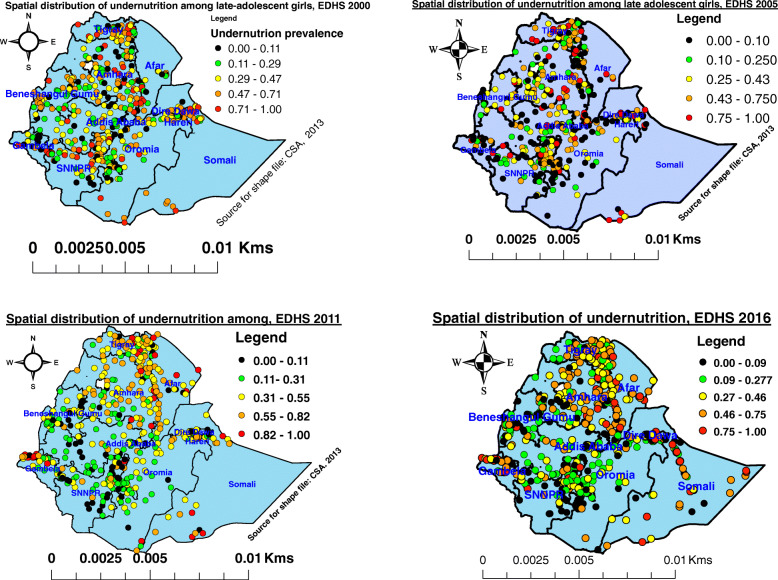
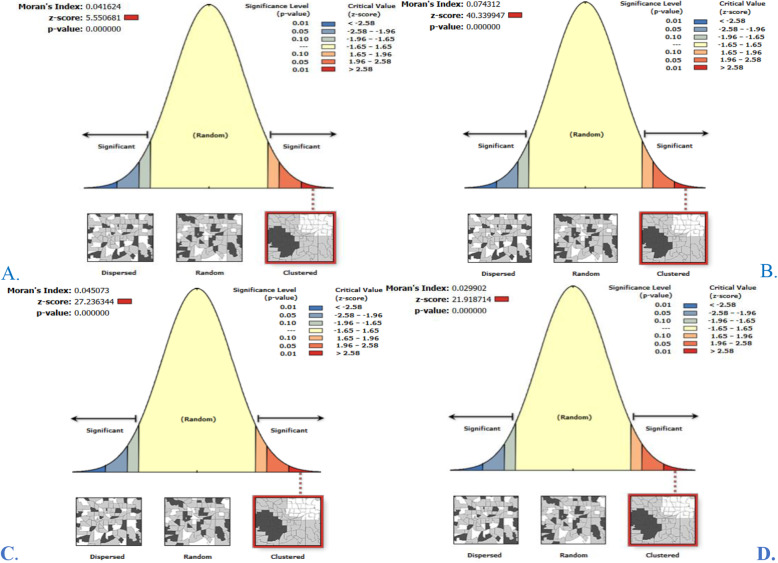
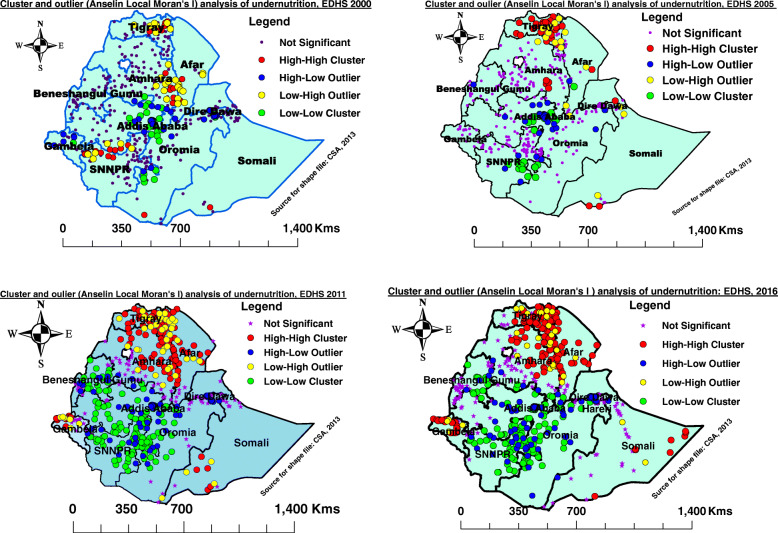
Undernutrition was clustered nationally during each survey (Global Moran's I = 0.009-0.045, Z-score = 5.55-27.24, p-value < 0.001). In the final model, individual and community level factors accounted for about 31.02% of the regional variations for undernutrition. The odds of undernutrition among 18-19 years of adolescent girls, was 57% (AOR = 0.43; 95% CI: (0.35-0.53) lower than those 15-17 years old. Late-adolescent girls with higher educational status were 4.40 times (AOR = 4.40; 95% CI: (1.64-11.76) more likely to be undernourished than those with no educational status. The odds of undernutrition among late-adolescent girls, with the occupation of sales, was 40% (AOR = 0.60; 95% CI: 0.43-0.84) lower than those with not working adolescents. The odds of undernutrition, among late-adolescent girls, having an unimproved latrine type, was 1.79 times (AOR = 1.79; 95% CI: 1.15-2.79) higher than those participants with improved latrine type. The odds of undernutrition among late-adolescent girls with rural residents was 2.33 times higher (AOR = 2.33; 95% CI: 1.29-4.22) than those with urban residents.
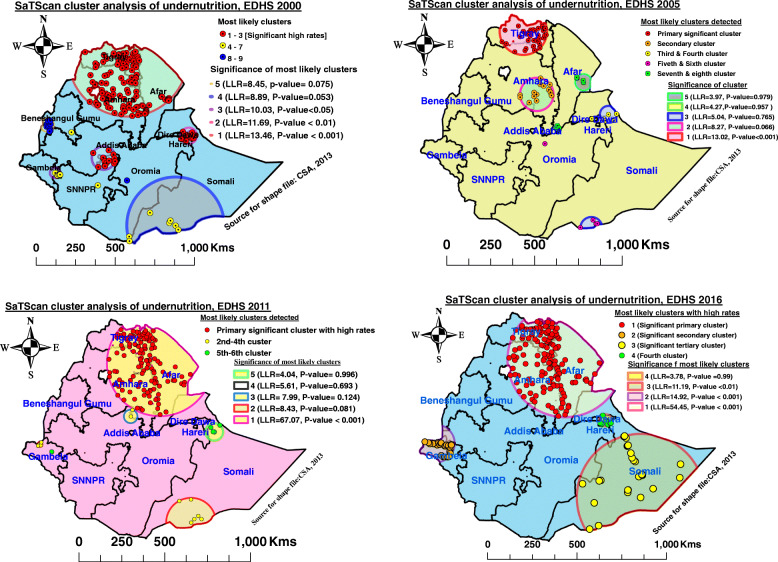
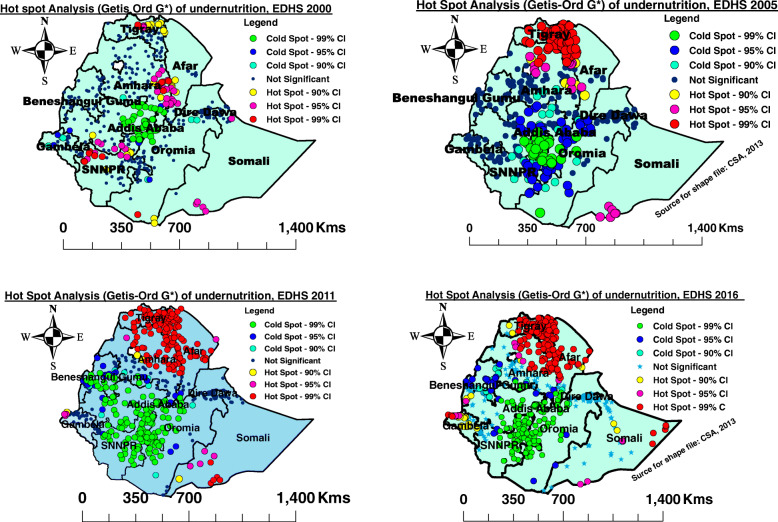
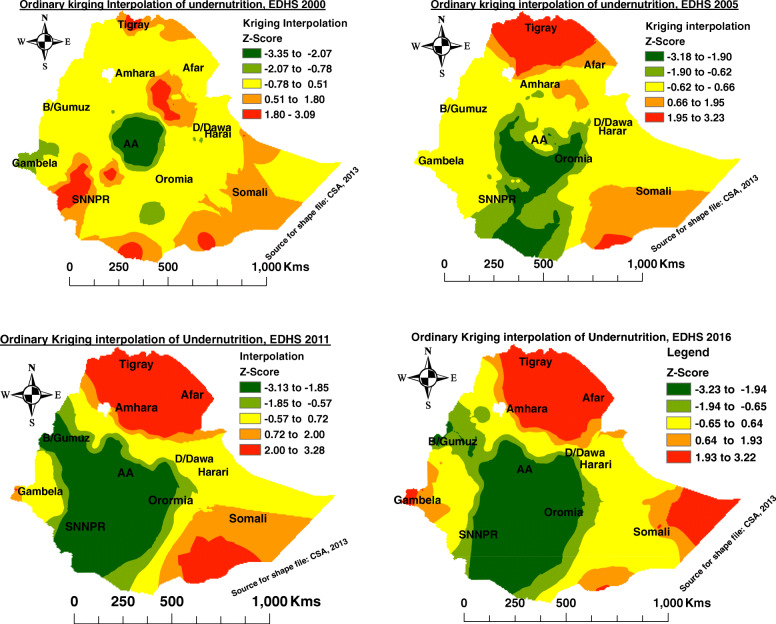
Undernutrition among late-adolescent girls was spatially clustered in Ethiopia. The local significant clusters with high prevalence of undernutrition was observed in Northern and Eastern Ethiopia. Those regions with a high prevalence of undernutrition should design interventions to combat undernutrition.
埃塞俄比亚青春期后女孩(15-19 岁)的营养不良率在南部和东部非洲国家中是最高的。然而,埃塞俄比亚的全国范围内营养不良的空间变化情况还不太清楚。本研究旨在探讨青春期后女孩营养不良的空间模式和决定因素。
对 2000 年至 2016 年四次埃塞俄比亚人口与健康调查(EDHS)中妇女的数据进行二次数据分析。共有 12056 名青春期后女孩纳入本研究。使用全局 Moran's I 自相关评估全局空间自相关,以评估营养不良的地理聚集和变异性。使用 Bernoulli 模型的 SaTScan 聚类分析来检测最有可能存在高率和低率营养不良的 SaTScan 聚类区域。使用包含聚类水平随机效应的多水平二项逻辑回归模型来确定与埃塞俄比亚青春期后女孩营养不良相关的因素。
在每次调查中,营养不良都呈现出全国性的聚集现象(全局 Moran's I=0.009-0.045,Z 分数=5.55-27.24,p 值均<0.001)。在最终模型中,个体和社区层面的因素解释了营养不良区域差异的约 31.02%。与 15-17 岁的少女相比,18-19 岁少女的营养不良风险降低了 57%(OR=0.43;95%CI:(0.35-0.53)。受教育程度较高的青春期后女孩比没有受教育的女孩更容易营养不良,其发生的可能性增加了 4.40 倍(OR=4.40;95%CI:(1.64-11.76)。与不工作的青少年相比,从事销售职业的青春期后女孩的营养不良风险降低了 40%(OR=0.60;95%CI:0.43-0.84)。与使用改良厕所类型的参与者相比,使用未改良厕所类型的青春期后女孩的营养不良风险增加了 1.79 倍(OR=1.79;95%CI:1.15-2.79)。与城市居民相比,农村居民的青春期后女孩的营养不良风险增加了 2.33 倍(OR=2.33;95%CI:1.29-4.22)。
埃塞俄比亚青春期后女孩的营养不良呈空间聚集性。在埃塞俄比亚北部和东部地区发现了局部显著的高营养不良率的聚集区。这些高营养不良率地区应设计干预措施来应对营养不良问题。