Department of Health, Behavior, and Society, Johns Hopkins University, 624 N Broadway, Baltimore, MD 21205, United States of America (USA).
Department of Prevention and Community Health, George Washington University, Washington, DC, USA.
Bull World Health Organ. 2021 Nov 1;99(11):773-782. doi: 10.2471/BLT.20.278820. Epub 2021 Aug 31.
To assess whether improvements in social norms related to iron and folic acid consumption are associated with increased iron and folic acid consumption.
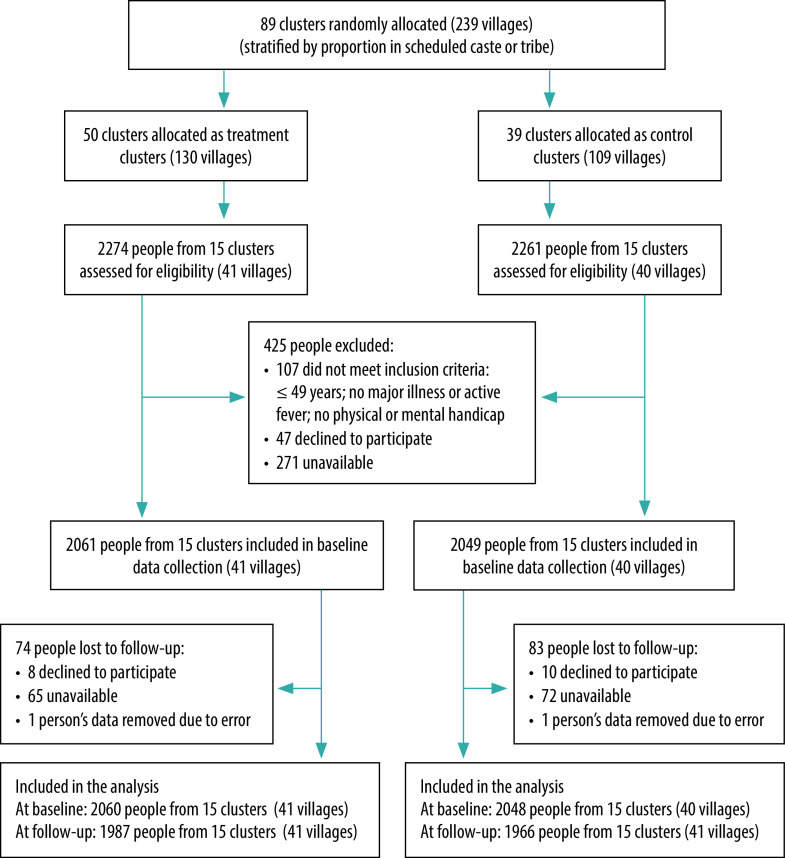
In a cluster randomized trial in Odisha, India, we implemented an intervention to improve descriptive norms (people's perceptions about how many other people take iron and folic acid), injunctive norms (social pressures people feel to take iron and folic acid) and collective norms (actual levels of iron and folic acid consumption). We assessed changes in these norms and self-reported iron and folic acid consumption in control and intervention arms after 6 months (September 2019-February 2020). We collected data from control ( = 2048) and intervention ( = 2060) arms at baseline and follow-up ( = 1966 and = 1987, respectively).
At follow-up, mean scores in self-reported iron and folic acid consumption in the control arm had decreased from 0.39 to 0.31 (21% decrease; not significant). In the intervention arm, mean scores increased from 0.39 to 1.62 (315% increase; < 0.001). The difference between the two arms was statistically significant ( < 0.001). Each of the three norms also improved at significantly higher rates in the intervention than in the control arm ( < 0.001 for each norm). Changes in descriptive and collective norms (but not injunctive norms) were associated with changes in self-reported iron and folic acid consumption ( < 0.001 for both norms).
Our results show that social norms can be improved and that these improvements are associated with positive behavioural changes. A social norms-based approach may help promote iron and folic acid consumption in India.
评估与铁和叶酸摄入相关的社会规范的改善是否与铁和叶酸摄入的增加有关。
在印度奥里萨邦的一项整群随机试验中,我们实施了一项干预措施,以改善描述性规范(人们对其他人服用铁和叶酸的看法)、规范性规范(人们感受到的服用铁和叶酸的社会压力)和集体规范(铁和叶酸的实际摄入量)。我们评估了对照组和干预组在 6 个月(2019 年 9 月至 2020 年 2 月)后这些规范和自我报告的铁和叶酸摄入量的变化。我们在基线和随访时从对照组( = 2048)和干预组( = 2060)收集数据(分别为 = 1966 和 = 1987)。
在随访时,对照组自我报告的铁和叶酸摄入量的平均得分从 0.39 下降到 0.31(下降 21%;不显著)。在干预组,平均得分从 0.39 增加到 1.62(增加 315%; < 0.001)。两组之间的差异具有统计学意义( < 0.001)。三种规范在干预组的改善速度都明显高于对照组(每种规范均 < 0.001)。描述性规范和集体规范的变化(但规范性规范的变化则不然)与自我报告的铁和叶酸摄入量的变化相关(两种规范均 < 0.001)。
我们的结果表明,社会规范可以得到改善,并且这些改善与积极的行为变化相关。基于社会规范的方法可能有助于促进印度铁和叶酸的摄入。