Courbalay Anne, Jobard Romane, Descarreaux Martin, Bouvard Béatrice
Institut de Formation en Education Physique et en Sport d'Angers (IFEPSA-UCO), APCoSS, Les Ponts de Cé, France.
Department of Human Kinetics, Université du Québec à Trois-Rivières Québec, Trois-Rivières, Canada.
J Pain Res. 2021 Oct 28;14:3387-3399. doi: 10.2147/JPR.S323424. eCollection 2021.
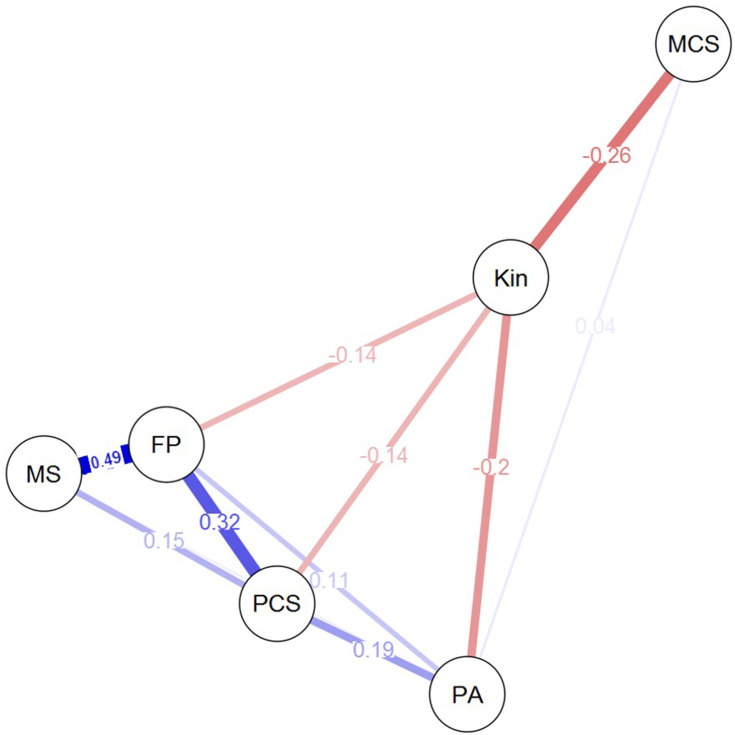
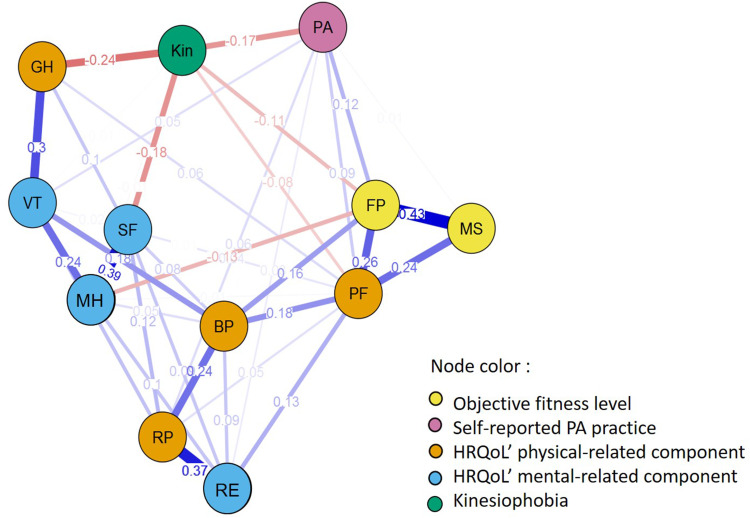
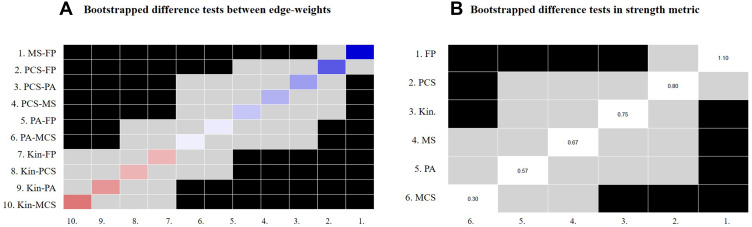
Using a network analysis, the present study investigated the extent to which physical activity (PA), objective fitness level, kinesiophobia, and health-related quality of life (HRQoL) interact in patients with rheumatic and musculoskeletal diseases. The objectives were twofold: 1) to clarify the direct and indirect relationships between these variables while controlling for the shared variance between them, and 2) to establish a potential ranking of influence among them.
This cross-sectional design study involved patients recruited from a rheumatology unit. One hundred and twenty patients completed self-reported measures of PA, the Tampa scale of kinesiophobia and the 36-item Short-Form Health Survey, and ninety-seven of those patients performed the six-minute walking test and the thirty-second sit-to-stand test. Network analyses were conducted using bootnet and qgraph packages.
Weekly time spent on PA, as well as physical fitness measures, were directly linked to kinesiophobia and the HRQoL physical dimension, but indirectly linked to HRQoL mental dimension through the mediation of kinesiophobia. Specifically, weekly PA time had direct relationships to physical functioning, vitality, and role limitations due to physical and emotional problems. Fitness measures had direct relationships with physical functioning, bodily pain, and mental health. The analyses did not clearly highlight one variable as the most influential in the network.
The study highlights the complexities of direct and indirect biopsychosocial relationships that are at the core of patients' daily functioning. Measurement of PA, use of a longitudinal design, and interventions are discussed.
本研究采用网络分析方法,调查了风湿性和肌肉骨骼疾病患者的身体活动(PA)、客观健康水平、运动恐惧以及健康相关生活质量(HRQoL)之间的相互作用程度。目标有两个:1)在控制这些变量之间共享方差的同时,阐明这些变量之间的直接和间接关系;2)确定它们之间潜在的影响排名。
这项横断面设计研究纳入了从风湿病科招募的患者。120名患者完成了PA的自我报告测量、坦帕运动恐惧量表和36项简短健康调查,其中97名患者进行了六分钟步行测试和30秒坐立测试。使用bootnet和qgraph软件包进行网络分析。
每周花在PA上的时间以及身体素质测量结果与运动恐惧和HRQoL的身体维度直接相关,但通过运动恐惧的中介作用与HRQoL的心理维度间接相关。具体而言,每周的PA时间与身体功能、活力以及因身体和情感问题导致的角色限制直接相关。身体素质测量结果与身体功能、身体疼痛和心理健康直接相关。分析并未明确突出网络中最具影响力的一个变量。
该研究强调了直接和间接生物心理社会关系的复杂性,这些关系是患者日常功能的核心。讨论了PA的测量、纵向设计的使用和干预措施。