Amajjar Ihsane, Vergauwen Kuni, Willigenburg Nienke W, Huijnen Ivan P J, Smeets Rob J E M, Ham S John
Department of Orthopedic Surgery, OLVG, Oosterpark 9, 1091 AC, Amsterdam, The Netherlands.
Department of Rehabilitation Medicine, CAPHRI, Maastricht University, Maastricht, The Netherlands.
Sci Rep. 2025 May 30;15(1):18990. doi: 10.1038/s41598-025-02812-3.
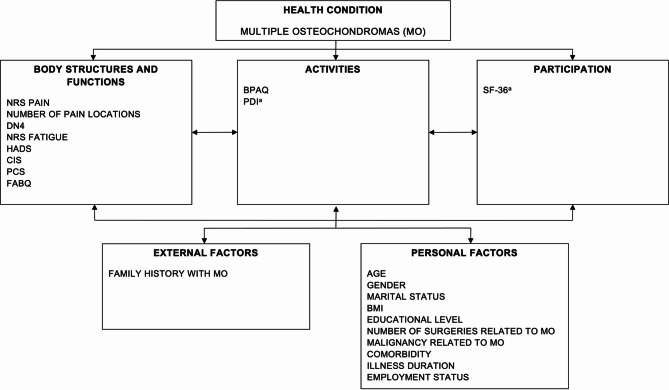
Multiple Osteochondromas (MO) can significantly impact physical functioning, yet evidence on how MO affects physical activity levels (PAL) and health-related quality of life (HRQOL) remains limited. This study aimed to: (1) characterize the PAL and physical and mental HRQOL of adult patients with MO and compare them with healthy subjects (2) explore whether illness-related symptoms, sociodemographic and psychological factors are associated with patients' PAL and HRQOL. This cross-sectional study used a survey consisting of sociodemographic data and validated questionnaires on the PAL (Baecke Physical Activity Questionnaire) and HRQOL (SF-36). The PAL, physical and mental HRQOL were compared with reference scores of healthy subjects using a one-sample t-test. An a-priori defined theoretical framework (ICF-model) was used to select explanatory variables, including several psychological factors, for the multiple linear regression models of the dependent variables PAL and HRQOL. 342 patients (42.6% males) with a mean age of 41.8 ± 16.3 completed the survey. Mean PAL scores were 7.2 ± 1.7, physical HRQOL 41.7 ± 11.1 and mental HRQOL 49.1 ± 10.5. Except for mental HRQOL, these scores were lower than healthy subjects (p < 0.001). The final regression model for the PAL contained six factors (R = 0.221, p < 0.001) showing the strongest association with having a job and malignant degeneration. Fourteen variables, including pain-related disability and number of surgical procedures, explained physical HRQOL (R = 0.731, p < 0.001). For mental HRQOL, eight factors remained in the model (R = 0.618, p < 0.001) with anxiety explaining the most unique variance (9.4%). MO patients reported significantly lower PAL and physical HRQOL than healthy controls. This study provides insight in several factors associated with the PAL and HRQOL in MO which could be used to optimize patients' treatment.
多发性骨软骨瘤(MO)会对身体功能产生重大影响,但关于MO如何影响身体活动水平(PAL)和健康相关生活质量(HRQOL)的证据仍然有限。本研究旨在:(1)描述成年MO患者的PAL以及身体和心理HRQOL,并将其与健康受试者进行比较;(2)探讨疾病相关症状、社会人口学和心理因素是否与患者的PAL和HRQOL相关。这项横断面研究采用了一项调查,其中包括社会人口学数据以及关于PAL(贝克身体活动问卷)和HRQOL(SF-36)的经过验证的问卷。使用单样本t检验将PAL、身体和心理HRQOL与健康受试者的参考分数进行比较。一个预先定义的理论框架(ICF模型)被用于选择解释变量,包括几个心理因素,用于建立因变量PAL和HRQOL的多元线性回归模型。342名患者(42.6%为男性)完成了调查,平均年龄为41.8±16.3岁。平均PAL得分为7.2±1.7,身体HRQOL为41.7±11.1,心理HRQOL为49.1±10.5。除心理HRQOL外,这些分数均低于健康受试者(p<0.001)。PAL的最终回归模型包含六个因素(R=0.221,p<0.001),显示与有工作和恶性退变的关联最强。包括疼痛相关残疾和手术次数在内的14个变量解释了身体HRQOL(R=0.731,p<0.001)。对于心理HRQOL,模型中保留了八个因素(R=0.618,p<0.001),焦虑解释了最大的独特方差(9.4%)。MO患者报告的PAL和身体HRQOL显著低于健康对照组。本研究揭示了与MO患者的PAL和HRQOL相关的几个因素,这些因素可用于优化患者的治疗。