Kim Dakyung, Park Soo-Jeung, Kim Jinkyung, Hong Unpyo, Lee Jeongmin
Department of Medical Nutrition, Kyung Hee University, Gyeonggi 17104, Korea.
Research Institute of Medical Nutrition, Kyung Hee University, Seoul 02447, Korea.
Prev Nutr Food Sci. 2021 Sep 30;26(3):321-329. doi: 10.3746/pnf.2021.26.3.321.
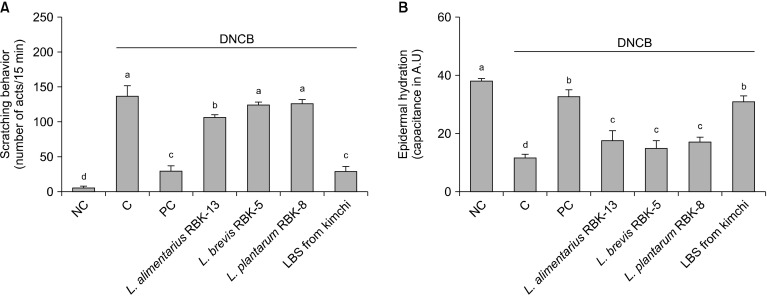
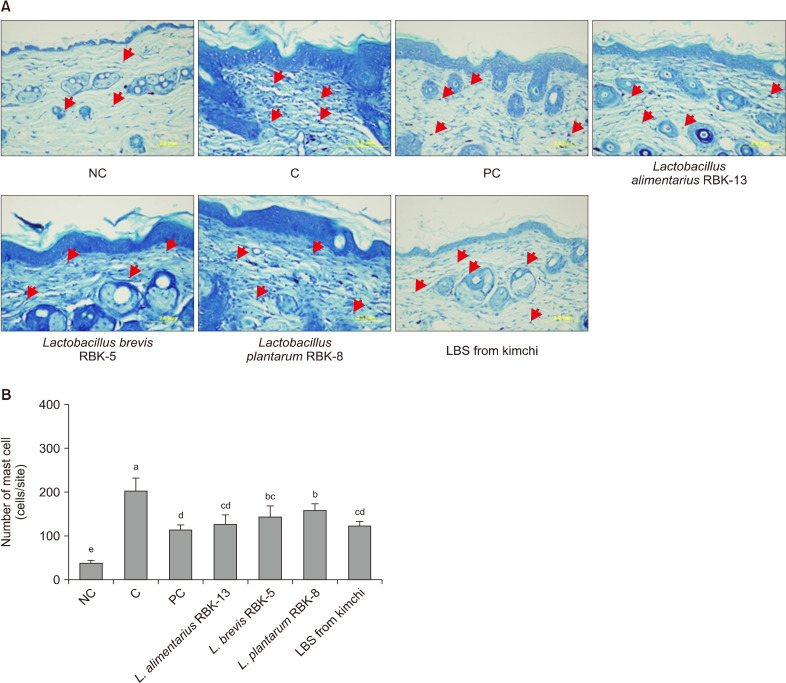
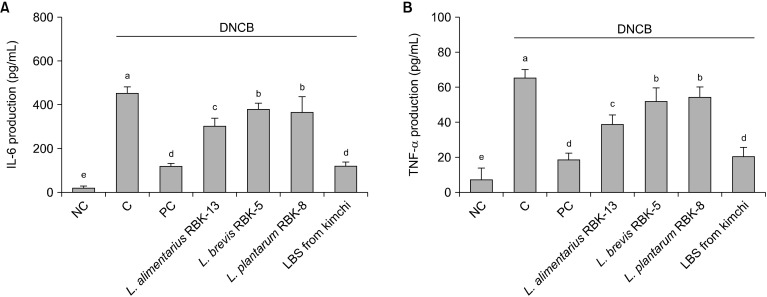
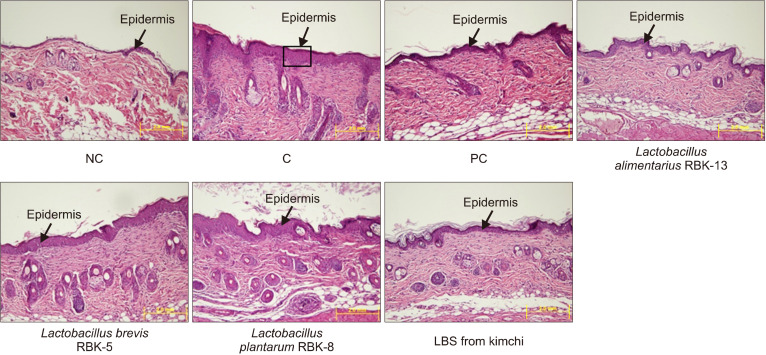
Kimchi is a traditional Korean food, of which its constituent lactic acid bacteria have been reported to possess various physiological activities. However, few studies have investigated the immunological activity of these bacteria or their effect on atopic dermatitis (AD). We investigated whether a mixture of 6 types of lactic acid bacteria strains (LBS) isolated from kimchi has an immunomodulating effect on atopy. Mice with atopic dermatitis were orally administered LSB from kimchi for 8 weeks, and skin moisture content, scratching behavior, T-and B-cell proliferation, Th1/2 cytokines, and serum IgE and histamine levels were measured. In addition, hematoxylin and eosin and toluidine blue staining were con-ducted. Mice receiving LBS from kimchi had increased skin moisture content (164.3%) and T-cell proliferation (more than 4-fold), and decreased number of scratching behaviors (78.2%) and B-cell proliferation (63.7%) compared with the 2,4-dinitrochlorobenzene control group. In addition, LBS increased Th1 type cytokines, decreased Th2 type and pro-inflam-matory cytokines, and decreased blood IgE (70.4%), histamine (67.6%) and mast cell levels. Therefore, it suggests that LBS of kimchi may be helpful in improving AD caused by immunological imbalance.
泡菜是一种传统的韩国食品,据报道其所含的乳酸菌具有多种生理活性。然而,很少有研究调查这些细菌的免疫活性或它们对特应性皮炎(AD)的影响。我们研究了从泡菜中分离出的6种乳酸菌菌株(LBS)的混合物对特应性是否具有免疫调节作用。对患有特应性皮炎的小鼠口服来自泡菜的LSB,持续8周,并测量皮肤水分含量、抓挠行为、T细胞和B细胞增殖、Th1/2细胞因子以及血清IgE和组胺水平。此外,还进行了苏木精-伊红染色和甲苯胺蓝染色。与2,4-二硝基氯苯对照组相比,接受来自泡菜的LBS的小鼠皮肤水分含量增加(164.3%),T细胞增殖增加(超过4倍),抓挠行为次数减少(78.2%),B细胞增殖减少(63.7%)。此外,LBS增加了Th1型细胞因子,减少了Th2型和促炎细胞因子,并降低了血液中的IgE(70.4%)、组胺(67.6%)和肥大细胞水平。因此,这表明泡菜的LBS可能有助于改善由免疫失衡引起的特应性皮炎。