Chen Zehua, Ye Xiangling, Shen Zhen, Wang Yi, Wu Zugui, Chen Guoqian, Guan Yingxin, Wu Jiatao, Jiang Tao, Wu Huai, Liu Wengang, Xu Xuemeng
The Fifth Clinical Medical College of Guangzhou University of Chinese Medicine, Guangzhou, China.
Kunming Municipal Hospital of Traditional Chinese Medicine, Kunming, China.
Front Bioeng Biotechnol. 2021 Oct 14;9:636571. doi: 10.3389/fbioe.2021.636571. eCollection 2021.
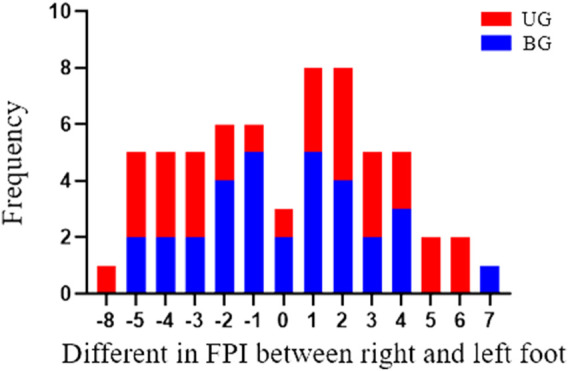
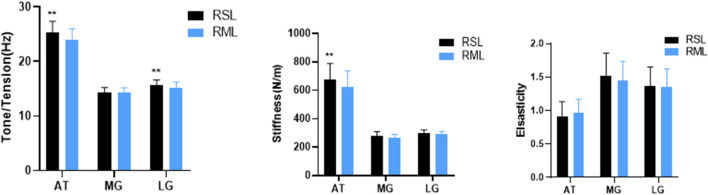
Asymmetrical foot posture and properties alterations of the gastrocnemius muscle (GM) and Achilles tendon (AT) were observed in knee osteoarthritis (KOA). We aimed to investigate the inter-limbs asymmetries in foot posture and the properties of GM and AT and explore the association between them. A total of 62 subjects with unilateral or bilateral KOA were included in this study: 30 patients with unilateral pain and 32 patients with bilateral pain were assigned to the bilateral group (BG) and unilateral group (UG), respectively. The relatively serious leg (RSL) and relatively moderate leg (RML) were judged according to the severity of symptoms assessed by using visual analogue scale (VAS) motion. Foot posture and asymmetrical foot posture scores were assessed based on Foot Posture index (FPI-6). Subsequently, all the participants received an assessment for properties of GM and AT, including tone/tension (Hz), stiffness (N/m), and elasticity. We calculated the asymmetry index of AT (Asy ) in both legs and the difference of muscle properties between medial and lateral gastrocnemius (D) in the ipsilateral limb. Asymmetry of foot posture was categorized into three types including normal, asymmetry, and severe asymmetry. The percentage of subjects classified as normal was higher in the BG (62.5%) than in the UG (36.67%), < 0.05. Tension of AT and tone of lateral gastrocnemius (LG) in RSL were higher than those in RML (15.71 ± 0.91 vs. 15.23 ± 1.01; 25.31 ± 2.09 vs. 23.96 ± 2.08, < 0.01 and < 0.01, respectively), and stiffness of AT in the RSL was higher than that in RML (676.58 ± 111.45 vs. 625.66 ± 111.19, < 0.01). Meanwhile, a positive relationship was found between ipsilateral FPI and tone of MG and LG in the left leg (0.246 per degree, 95% CI: -0.001, 0.129; = 0.054 and 0.293 per degree, 95% CI: -0.014, 0.157; = 0.021, respectively) and right leg (0.363 per degree, 95% CI: 0.033, 0.146; = 0.004 and 0.272 per degree, 95% CI: 0.007, -0.144; = 0.032, respectively). Moreover, a positive link was observed between asymmetrical FPI scores and K/L grade (0.291 per degree, 95% CI: 0.018, 0.216; = 0.022). Furthermore, a significantly greater Asy was detected in the UG than that in the BG (UG vs. UG: 8.20 ± 5.09% vs. 5.11 ± 4.72%, < 0.01). Additionally, an increased asymmetrical FPI score (i.e., more severe asymmetry) was significantly associated with increases in Asy and Asy (0.42 per degree, 95% CI: 0.533, 1.881; = 0.001 and 0.369 per degree, 95% CI: 0.596, 2.82; = 0.003, respectively). The stiffness and tension of AT and the tone of LG in RSL were higher than those in RML in KOA patients, and inter-limbs foot posture and tension of AT were more asymmetrical in unilateral KOA patients compared to patients with bilateral KOA. Notably, foot posture, as an important biomechanical factor, was significantly associated with properties of GM, AT, and K/L grade in KOA patients.
在膝关节骨关节炎(KOA)患者中观察到足部姿势不对称以及腓肠肌(GM)和跟腱(AT)的特性改变。我们旨在研究双下肢足部姿势以及GM和AT特性的不对称性,并探讨它们之间的关联。本研究共纳入62例单侧或双侧KOA患者:30例单侧疼痛患者和32例双侧疼痛患者分别被分配至双侧组(BG)和单侧组(UG)。根据使用视觉模拟量表(VAS)运动评估的症状严重程度判断相对严重侧下肢(RSL)和相对中度侧下肢(RML)。基于足部姿势指数(FPI-6)评估足部姿势和不对称足部姿势评分。随后,所有参与者接受GM和AT特性评估,包括张力/紧张度(Hz)、刚度(N/m)和弹性。我们计算了双腿AT的不对称指数(Asy)以及同侧肢体中外侧和内侧腓肠肌之间肌肉特性的差异(D)。足部姿势不对称分为三种类型,包括正常、不对称和严重不对称。BG组中分类为正常的受试者百分比(62.5%)高于UG组(36.67%),<0.05。RSL侧AT的张力和外侧腓肠肌(LG)的紧张度高于RML侧(分别为15.71±0.91 vs. 15.23±1.01;25.31±2.09 vs. 23.96±2.08,分别<0.01和<0.01),且RSL侧AT的刚度高于RML侧(676.58±111.45 vs. 625.66±111.19,<0.01)。同时,发现同侧FPI与左腿内侧腓肠肌(MG)和LG的紧张度之间呈正相关(每度0.246,95%CI:-0.001,0.129;=0.054和每度0.293,95%CI:-0.014,0.157;=0.021)以及右腿(每度0.363,95%CI:0.033,0.146;=0.004和每度0.272,95%CI:0.007,-0.144;=0.032)。此外,观察到不对称FPI评分与K/L分级之间呈正相关(每度0.291,95%CI:0.018,0.216;=0.022)。此外,UG组中检测到的Asy显著大于BG组(UG组与BG组:8.20±5.09% vs. 5.11±4.72%,<0.01)。另外,不对称FPI评分增加(即更严重的不对称)与Asy和Asy增加显著相关(每度0.42,95%CI:0.533,1.881;=0.001和每度0.369,95%CI:0.596,2.82;=0.003)。KOA患者中RSL侧AT的刚度和张力以及LG的紧张度高于RML侧,与双侧KOA患者相比,单侧KOA患者双下肢足部姿势和AT张力更不对称。值得注意的是,足部姿势作为一个重要的生物力学因素,与KOA患者的GM、AT特性以及K/L分级显著相关。