Jiang Qian, Yin Jie, Chen Jiashun, Ma Xiaokang, Wu Miaomiao, Li Xilong, Yao Kang, Tan Bie, Yin Yulong
Animal Nutritional Genome and Germplasm Innovation Research Center, College of Animal Science and Technology, Hunan Agricultural University, Changsha, Hunan 410128, China.
Key Laboratory of Feed Biotechnology of Ministry of Agriculture and Rural Affairs, Feed Research Institute, Chinese Academy of Agricultural Sciences, Beijing 100081, China.
Anim Nutr. 2021 Dec;7(4):1061-1069. doi: 10.1016/j.aninu.2021.02.003. Epub 2021 Jul 3.
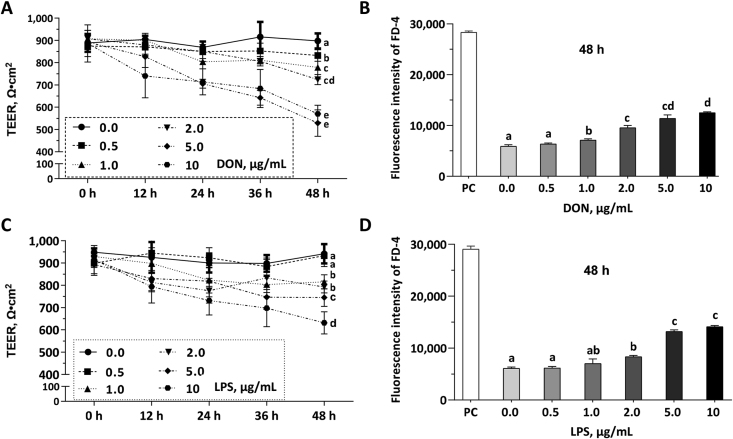
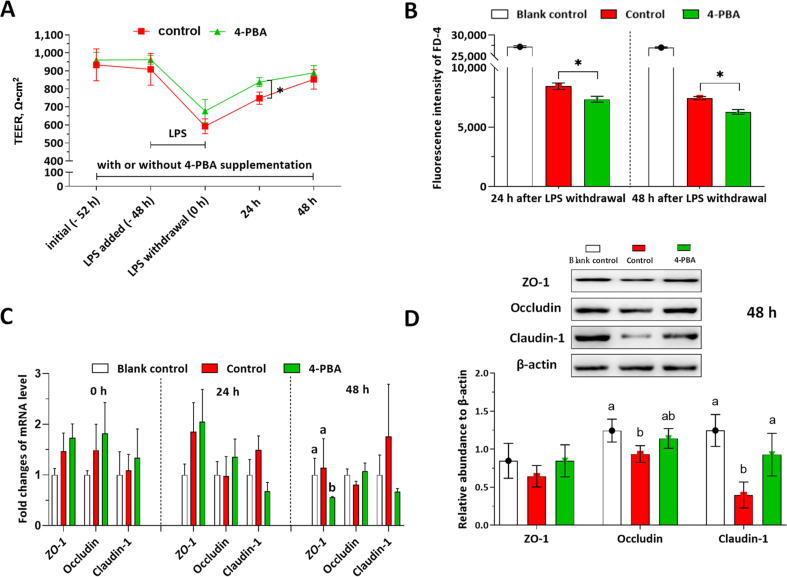
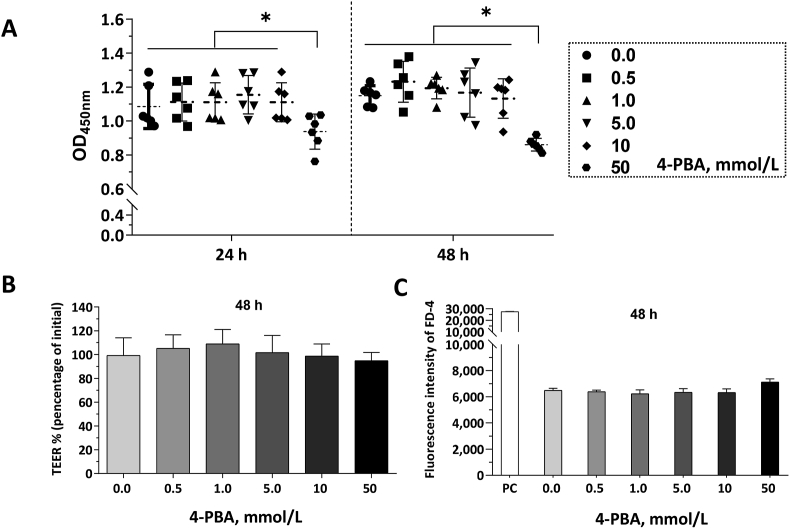
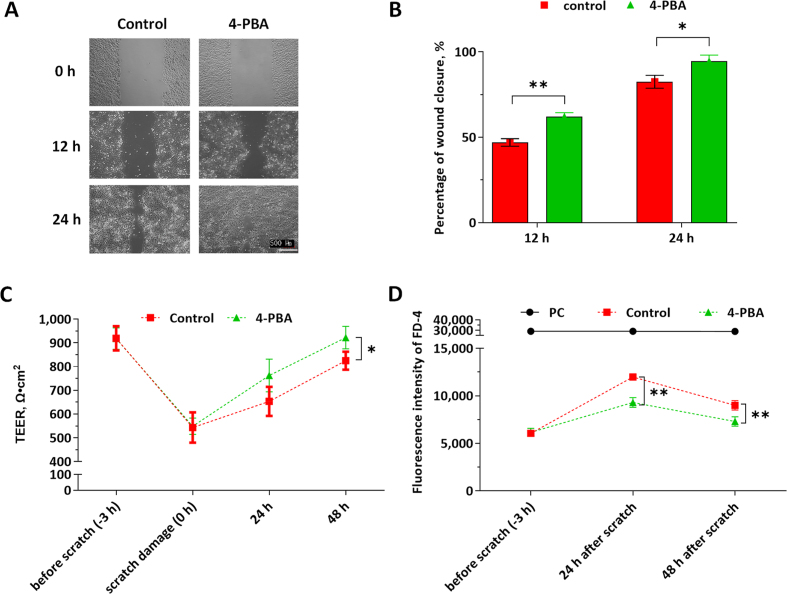
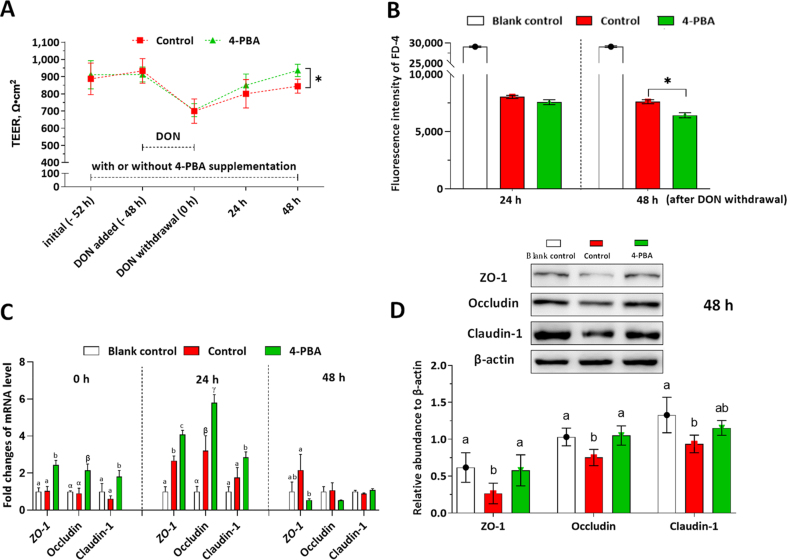
As the first line of defence against pathogens and endotoxins crossing the intestine-blood barrier, the intestinal epithelial barrier plays a determinant role in pigs' health and growth. 4-Phenylbutyric acid (4-PBA), an aromatic fatty acid, was reported to benefit homeostasis of endoplasmic reticulum and protein synthesis. However, whether 4-PBA affects intestinal epithelial barrier function in pigs is unknown. This study aimed to explore the effects of 4-PBA on the intestinal barrier function, using in vitro models of well-differentiated intestinal porcine epithelial cell (IPEC-J2) monolayers in the transwell plates. Cell monolayers with or without 4-PBA (1.0 mmol/L) treatment were challenged with physical scratch, deoxynivalenol (DON, 2.0 μg/mL, 48 h), and lipopolysaccharide (LPS, 5.0 μg/mL, 48 h), respectively. Transepithelial electrical resistance (TEER) and fluorescein isothiocyanate-dextran (FD-4) permeability were measured to indicate barrier integrity and permeability. Real-time PCR and Western blot were conducted to determine relative gene and protein expressions of tight junction proteins. As expected, physical scratch, DON, and LPS challenges decreased TEER and increased FD-4 permeability. 4-PBA treatment accelerated cell mitigation and rehabilitation of the physical scratch-damaged intestinal epithelial barrier but did not alleviate DON or LPS induced barrier damage. However, once 48-h DON and LPS challenges were removed, rehabilitation of the epithelial barrier function of IPEC-J2 monolayer was accelerated by the 4-PBA treatment. Also, the relative gene and protein expressions of zonula occludens-1 (ZO-1), occludin, and claudin-1 were further upregulated by the 4-PBA treatment during the barrier rehabilitation. Taken together, 4-PBA accelerated the IPEC-J2 cell monolayer barrier recovering from physical scratch, DON-, and LPS-induced damage, via enhancing cell mitigation and expressions of tight junction proteins.
作为抵御病原体和内毒素穿越肠-血屏障的第一道防线,肠道上皮屏障对猪的健康和生长起着决定性作用。4-苯丁酸(4-PBA)是一种芳香脂肪酸,据报道其有助于内质网稳态和蛋白质合成。然而,4-PBA是否影响猪的肠道上皮屏障功能尚不清楚。本研究旨在利用transwell板中分化良好的猪肠上皮细胞(IPEC-J2)单层体外模型,探讨4-PBA对肠道屏障功能的影响。分别用物理划痕、脱氧雪腐镰刀菌烯醇(DON,2.0μg/mL,48小时)和脂多糖(LPS,5.0μg/mL,48小时)对经或未经4-PBA(1.0mmol/L)处理的细胞单层进行刺激。测量跨上皮电阻(TEER)和异硫氰酸荧光素-葡聚糖(FD-4)通透性,以指示屏障完整性和通透性。进行实时PCR和蛋白质免疫印迹以确定紧密连接蛋白的相对基因和蛋白质表达。正如预期的那样,物理划痕、DON和LPS刺激降低了TEER并增加了FD-4通透性。4-PBA处理加速了物理划痕损伤的肠道上皮屏障的细胞修复和恢复,但并未减轻DON或LPS诱导的屏障损伤。然而,一旦去除48小时的DON和LPS刺激,4-PBA处理加速了IPEC-J2单层上皮屏障功能的恢复。此外,在屏障恢复过程中,4-PBA处理进一步上调了闭合蛋白-1(ZO-1)、闭合蛋白和紧密连接蛋白-1的相对基因和蛋白质表达。综上所述,4-PBA通过增强细胞修复和紧密连接蛋白的表达,加速了IPEC-J2细胞单层屏障从物理划痕、DON和LPS诱导的损伤中恢复。