Laforest Richard, Khalighi Mehdi, Natsuaki Yutaka, Rajagopal Abhejit, Chandramohan Dharshan, Byrd Darrin, An Hongyu, Larson Peder, James Sara St, Sunderland John J, Kinahan Paul E, Hope Thomas A
Mallinckrodt Institute of Radiology, Washington University, St. Louis, MO, USA.
Department of Radiology, Stanford University, Stanford, CA, USA.
EJNMMI Phys. 2021 Nov 5;8(1):75. doi: 10.1186/s40658-021-00416-0.
Simultaneous PET/MRIs vary in their quantitative PET performance due to inherent differences in the physical systems and differences in the image reconstruction implementation. This variability in quantitative accuracy confounds the ability to meaningfully combine and compare data across scanners. In this work, we define image reconstruction parameters that lead to comparable contrast recovery curves across simultaneous PET/MRI systems.
The NEMA NU-2 image quality phantom was imaged on one GE Signa and on one Siemens mMR PET/MRI scanner. The phantom was imaged at 9.7:1 contrast with standard spheres (diameter 10, 13, 17, 22, 28, 37 mm) and with custom spheres (diameter: 8.5, 11.5, 15, 25, 32.5, 44 mm) using a standardized methodology. Analysis was performed on a 30 min listmode data acquisition and on 6 realizations of 5 min from the listmode data. Images were reconstructed with the manufacturer provided iterative image reconstruction algorithms with and without point spread function (PSF) modeling. For both scanners, a post-reconstruction Gaussian filter of 3-7 mm in steps of 1 mm was applied. Attenuation correction was provided from a scaled computed tomography (CT) image of the phantom registered to the MR-based attenuation images and verified to align on the non-attenuation corrected PET images. For each of these image reconstruction parameter sets, contrast recovery coefficients (CRCs) were determined for the SUV, SUV and SUV for each sphere. A hybrid metric combining the root-mean-squared discrepancy (RMSD) and the absolute CRC values was used to simultaneously optimize for best match in CRC between the two scanners while simultaneously weighting toward higher resolution reconstructions. The image reconstruction parameter set was identified as the best candidate reconstruction for each vendor for harmonized PET image reconstruction.
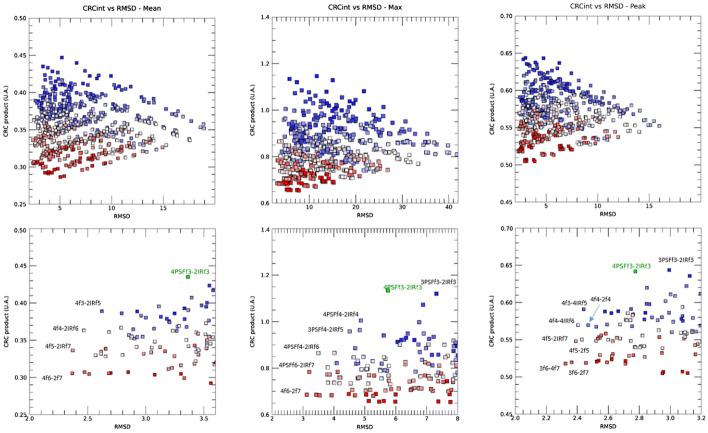
The range of clinically relevant image reconstruction parameters demonstrated widely different quantitative performance across cameras. The best match of CRC curves was obtained at the lowest RMSD values with: for CRC, 2 iterations-7 mm filter on the GE Signa and 4 iterations-6 mm filter on the Siemens mMR, for CRC, 4 iterations-6 mm filter on the GE Signa, 4 iterations-5 mm filter on the Siemens mMR and for CRC, 4 iterations-7 mm filter with PSF on the GE Signa and 4 iterations-7 mm filter on the Siemens mMR. Over all reconstructions, the RMSD between CRCs was 1.8%, 3.6% and 2.9% for CRC mean, max and peak, respectively. The solution of 2 iterations-3 mm on the GE Signa and 4 iterations-3 mm on Siemens mMR, both with PSF, led to simultaneous harmonization and with high CRC and low RMSD for CRC mean, max and peak with RMSD values of 2.8%, 5.8% and 3.2%, respectively.
For two commercially available PET/MRI scanners, user-selectable parameters that control iterative updates, image smoothing and PSF modeling provide a range of contrast recovery curves that allow harmonization in harmonization strategies of optimal match in CRC or high CRC values. This work demonstrates that nearly identical CRC curves can be obtained on different commercially available scanners by selecting appropriate image reconstruction parameters.
由于物理系统的固有差异以及图像重建实现方式的不同,同时进行的PET/MRI在定量PET性能方面存在差异。这种定量准确性的变异性混淆了跨扫描仪有意义地组合和比较数据的能力。在这项工作中,我们定义了能使不同的同时进行的PET/MRI系统获得可比的对比度恢复曲线的图像重建参数。
使用NEMA NU - 2图像质量体模在一台GE Signa和一台西门子mMR PET/MRI扫描仪上进行成像。采用标准化方法,以9.7:1的对比度对标准球体(直径10、13、17、22、28、37毫米)和定制球体(直径:8.5、11.5、15、25、32.5、44毫米)进行成像。对30分钟的列表模式数据采集以及从该列表模式数据中提取的6次5分钟的采集数据进行分析。使用制造商提供的带和不带点扩散函数(PSF)建模的迭代图像重建算法对图像进行重建。对于两台扫描仪,均应用步长为1毫米、3 - 7毫米的重建后高斯滤波器。通过将体模的缩放计算机断层扫描(CT)图像配准到基于MR的衰减图像来提供衰减校正,并在未进行衰减校正的PET图像上验证其对齐情况。对于这些图像重建参数集的每一个,确定每个球体的SUV、SUV和SUV的对比度恢复系数(CRC)。使用一种结合均方根偏差(RMSD)和绝对CRC值的混合度量,以同时优化两台扫描仪之间CRC的最佳匹配,同时向更高分辨率的重建进行加权。确定图像重建参数集作为每个供应商用于统一PET图像重建的最佳候选重建。
临床相关图像重建参数的范围显示,不同相机的定量性能差异很大。在最低RMSD值时获得了CRC曲线的最佳匹配:对于CRC,GE Signa上为2次迭代 - 7毫米滤波器,西门子mMR上为4次迭代 - 6毫米滤波器;对于CRC,GE Signa上为4次迭代 - 6毫米滤波器,西门子mMR上为4次迭代 - 5毫米滤波器;对于CRC,GE Signa上为4次迭代 - 7毫米滤波器(带PSF),西门子mMR上为4次迭代 - 7毫米滤波器。在所有重建中,CRC均值、最大值和峰值的CRC之间的RMSD分别为1.8%、3.6%和2.9%。GE Signa上2次迭代 - 3毫米和西门子mMR上4次迭代 - 3毫米(均带PSF)的解决方案导致同时实现了统一,并且CRC均值、最大值和峰值具有高CRC和低RMSD,RMSD值分别为2.8%、5.8%和3.2%。
对于两台商用PET/MRI扫描仪,控制迭代更新、图像平滑和PSF建模的用户可选择参数提供了一系列对比度恢复曲线,这些曲线在CRC的最佳匹配或高CRC值的统一策略中实现了统一。这项工作表明,通过选择合适的图像重建参数,可以在不同的商用扫描仪上获得几乎相同的CRC曲线。