School of Public Health and Preventive Medicine, Monash University, Australia.
Institute for Clinical Research, National Institutes of Health, Ministry of Health, Malaysia.
Epidemics. 2021 Dec;37:100517. doi: 10.1016/j.epidem.2021.100517. Epub 2021 Oct 26.
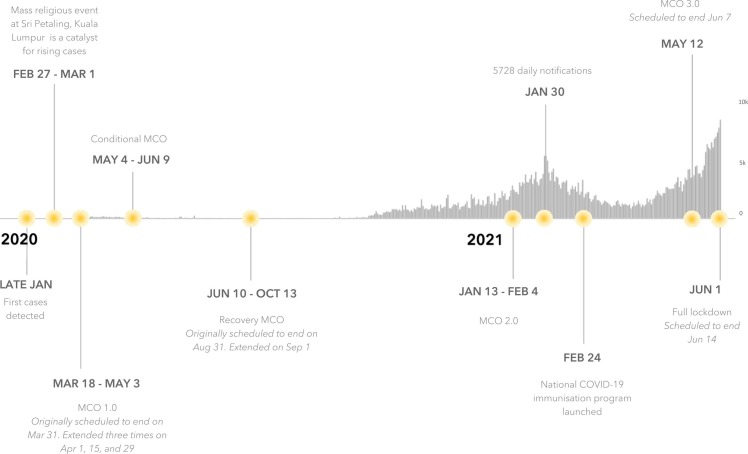
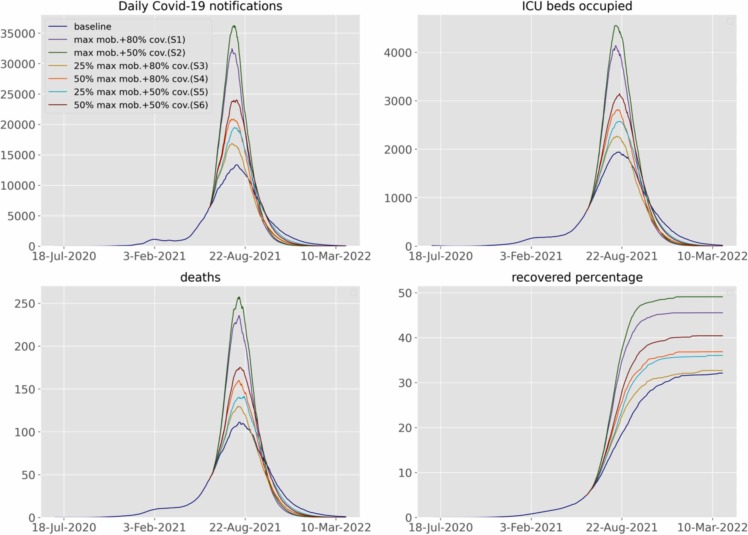
As of 3rd June 2021, Malaysia is experiencing a resurgence of COVID-19 cases. In response, the federal government has implemented various non-pharmaceutical interventions (NPIs) under a series of Movement Control Orders and, more recently, a vaccination campaign to regain epidemic control. In this study, we assessed the potential for the vaccination campaign to control the epidemic in Malaysia and four high-burden regions of interest, under various public health response scenarios.
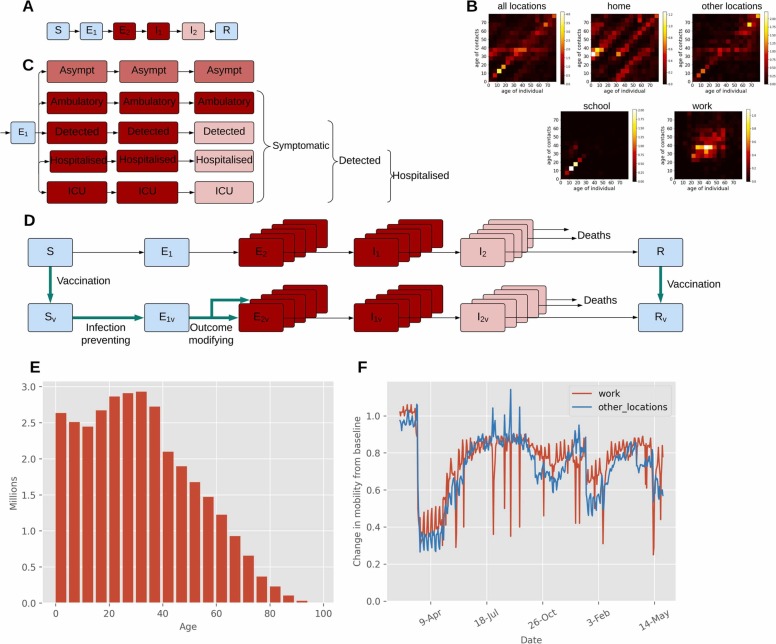
A modified susceptible-exposed-infectious-recovered compartmental model was developed that included two sequential incubation and infectious periods, with stratification by clinical state. The model was further stratified by age and incorporated population mobility to capture NPIs and micro-distancing (behaviour changes not captured through population mobility). Emerging variants of concern (VoC) were included as an additional strain competing with the existing wild-type strain. Several scenarios that included different vaccination strategies (i.e. vaccines that reduce disease severity and/or prevent infection, vaccination coverage) and mobility restrictions were implemented.
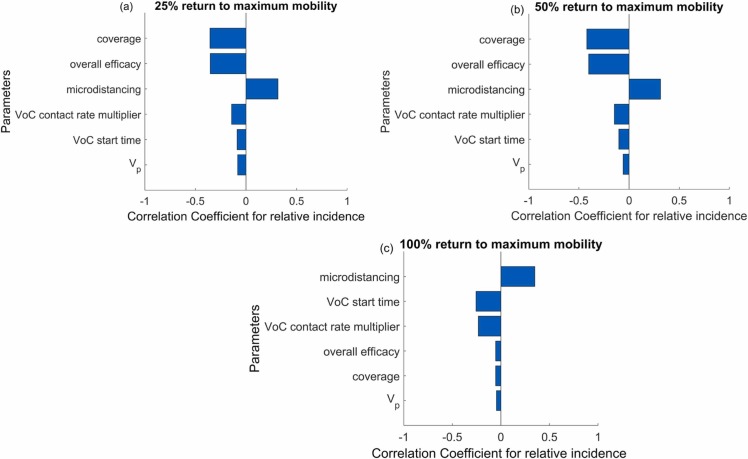
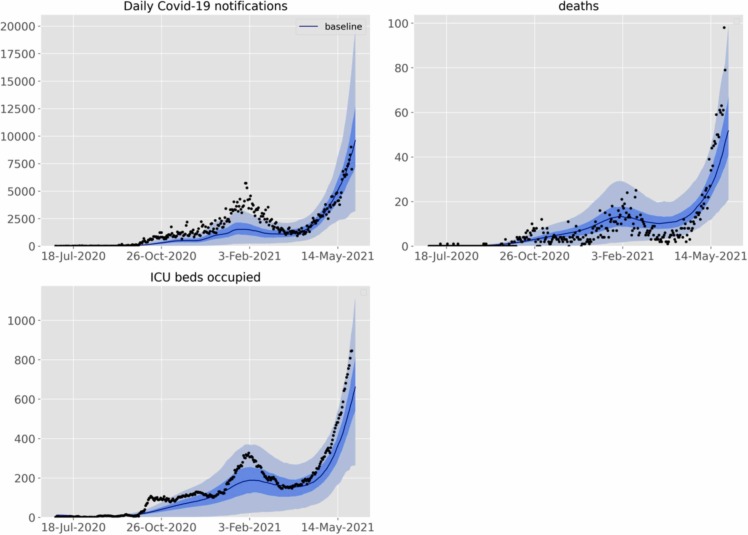
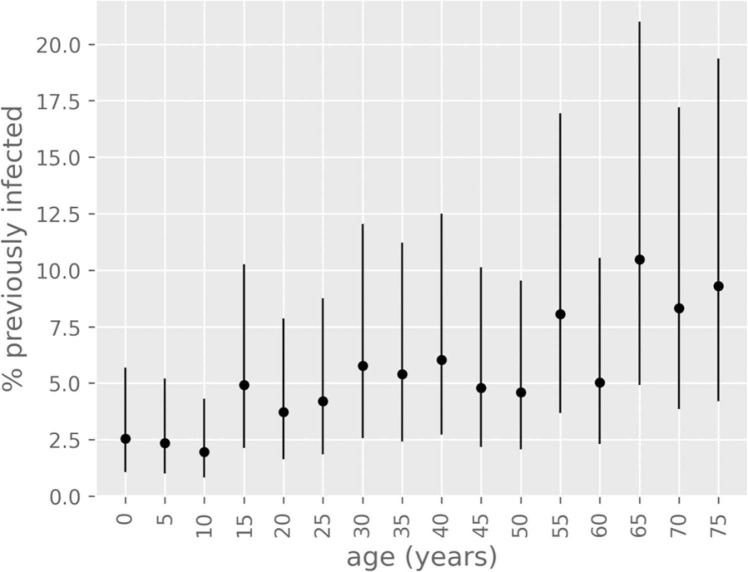
The national model and the regional models all fit well to notification data but underestimated ICU occupancy and deaths in recent weeks, which may be attributable to increased severity of VoC or saturation of case detection. However, the true case detection proportion showed wide credible intervals, highlighting incomplete understanding of the true epidemic size. The scenario projections suggested that under current vaccination rates complete relaxation of all NPIs would trigger a major epidemic. The results emphasise the importance of micro-distancing, maintaining mobility restrictions during vaccination roll-out and accelerating the pace of vaccination for future control. Malaysia is particularly susceptible to a major COVID-19 resurgence resulting from its limited population immunity due to the country's historical success in maintaining control throughout much of 2020.
截至 2021 年 6 月 3 日,马来西亚正面临 COVID-19 病例的再次爆发。为此,联邦政府在一系列行动管制令下实施了各种非药物干预措施(NPIs),最近又开展了疫苗接种运动,以重新控制疫情。在这项研究中,我们评估了疫苗接种运动在马来西亚和四个高负担地区的潜在控制疫情的能力,在各种公共卫生应对情景下。
我们开发了一个改良的易感染-暴露-感染-恢复的 compartmental 模型,该模型包括两个连续的潜伏期和感染期,并按临床状态分层。该模型进一步按年龄分层,并纳入人口流动性,以捕捉非药物干预措施和微距离(行为变化未通过人口流动捕获)。将关注的变异株(VoC)作为与现有野生型竞争的额外菌株纳入。实施了几种不同的疫苗接种策略(即减轻疾病严重程度和/或预防感染的疫苗、疫苗接种覆盖率)和流动性限制的方案。
全国模型和地区模型都很好地拟合了通报数据,但最近几周低估了 ICU 占用率和死亡率,这可能归因于变异株的严重性增加或病例检测的饱和。然而,真实病例检出比例的可信区间很宽,突出了对真实疫情规模的不完全了解。方案预测表明,在当前的疫苗接种率下,完全取消所有非药物干预措施将引发重大疫情。结果强调了微距离的重要性,在疫苗接种推广期间保持流动性限制,并加快未来控制的疫苗接种速度。由于马来西亚在 2020 年大部分时间成功地保持了控制,其人口免疫力有限,因此特别容易受到 COVID-19 再次爆发的影响。