School of Medicine and Public Health, Ateneo de Manila University, Ortigas Ave., Pasig City, Philippines.
Deutsche Gesellschaft für Internationale Zusammenarbeit (GIZ), Makati City, Philippines.
BMC Health Serv Res. 2021 Nov 5;21(1):1201. doi: 10.1186/s12913-021-07219-0.
To address the maldistribution of healthcare providers and the shortage of physicians in geographically isolated and disadvantaged areas of the Philippines, the Philippine National Rural Physician Deployment Program, or more commonly known as the Doctors to the Barrios (DTTB) program was established in 1993. However, as of 2011, only 18% of the DTTBs chose to stay in their assigned municipalities after their two-year deployment, termed retention. This study aims to identify the individual, local, work, national, and international factors affecting the retention of DTTBs in their assigned communities after their two-year deployment.
A descriptive, mixed-methods, explanatory design was used. For the quantitative part, the modified and updated Stayers Questionnaire was given to all current DTTBs present in a Continuing Medical Education session in the Development Academy of the Philippines. Descriptive statistics were then presented. For the qualitative part, individual, semi-structured key informant interviews were conducted in-person or via phone with current and alumni DTTBs from 2012 to 2019. Proceedings of the interviews were transcribed, translated, and analyzed thematically.
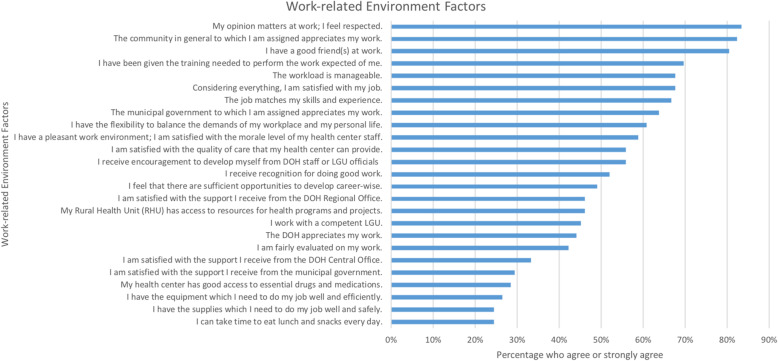
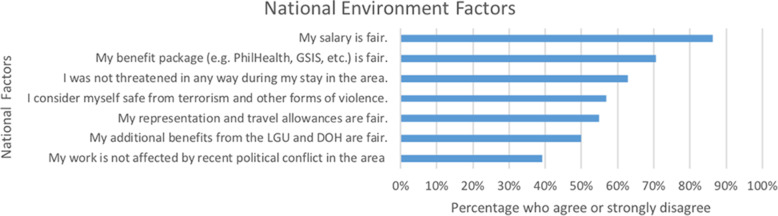
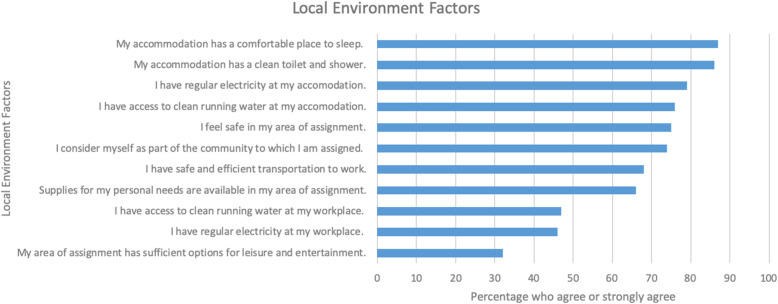
102 current DTTBs participated in the quantitative part of our study, while 10 current and former DTTBs participated in the interviews. Demographic factors and location, personal beliefs, well-being, friends and family dynamics, and perceptions about work were the individual factors identified to affect retention. Social working conditions, career development, and infrastructure, medical equipment, and supplies were among the work factors identified to affect retention. Geography, living conditions, local social needs, and technology were among the local factors identified to affect retention. Compensation, the recently signed Universal Healthcare Law, and Safety and Security were identified as national factors that could affect retention. International factors did not seem to discourage DTTBs from staying in their communities.
A host of individual, work-related, local, national, and international factors influence the DTTB's decision to be retained in different, complex, interconnected, and dynamic ways. We also identified implementation issues in the DTTB program and suggested interventions to encourage retention.
为了解决医疗服务提供者在菲律宾地理上偏远和贫困地区的分布不均以及医生短缺的问题,菲律宾国家农村医生部署计划(或更通俗地称为“医生下乡”计划)于 1993 年成立。然而,截至 2011 年,只有 18%的下乡医生在完成两年的部署后选择留在他们被分配的市镇,这被称为留任。本研究旨在确定影响下乡医生在完成两年部署后留在其分配社区的个人、地方、工作、国家和国际因素。
本研究采用描述性、混合方法、解释性设计。在定量部分,对参加菲律宾发展学院继续教育课程的所有现任下乡医生发放了经过修改和更新的留任者问卷。然后呈现了描述性统计数据。在定性部分,对 2012 年至 2019 年期间的现任和前下乡医生进行了个人、半结构化的关键知情人访谈。采访记录被转录、翻译,并进行了主题分析。
102 名现任下乡医生参加了我们研究的定量部分,而 10 名现任和前下乡医生参加了访谈。人口统计学因素和地点、个人信念、幸福、朋友和家庭动态以及对工作的看法被确定为影响留任的个人因素。社会工作条件、职业发展以及基础设施、医疗设备和用品被确定为影响留任的工作因素。地理、生活条件、当地社会需求和技术被确定为影响留任的地方因素。薪酬、最近签署的全民医保法以及安全保障被确定为可能影响留任的国家因素。国际因素似乎并没有阻止下乡医生留在他们的社区。
一系列个人、与工作相关、地方、国家和国际因素以不同的、复杂的、相互关联的和动态的方式影响下乡医生留任的决定。我们还确定了下乡医生计划中的实施问题,并提出了鼓励留任的干预措施。