Lima Everton E C, Vilela Estevão A, Peralta Andrés, Rocha Marília, Queiroz Bernardo L, Gonzaga Marcos R, Piscoya-Díaz Mario, Martinez-Folgar Kevin, García-Guerrero Víctor M, Freire Flávio H M A
Universidade Estadual de Campinas, Campinas, Brazil.
Universidade Federal de Minas Gerais, Belo Horizonte, Brazil.
Genus. 2021;77(1):30. doi: 10.1186/s41118-021-00139-1. Epub 2021 Nov 3.
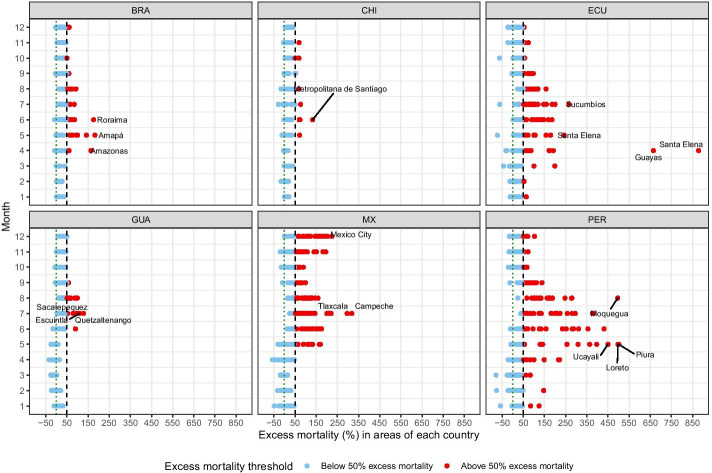
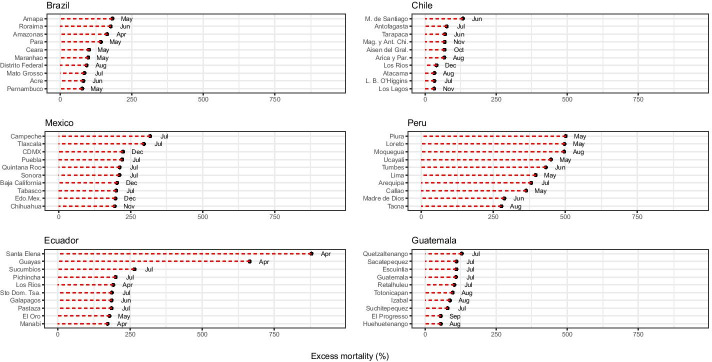
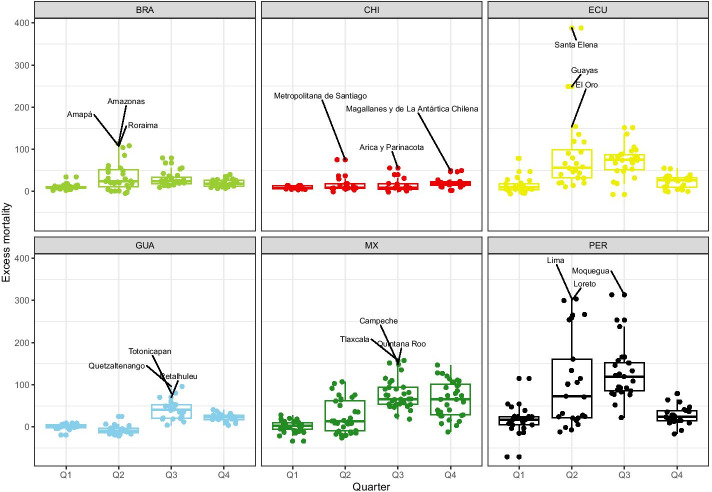
In this paper, we measure the effect of the 2020 COVID-19 pandemic wave at the national and subnational levels in selected Latin American countries that were most affected: Brazil, Chile, Ecuador, Guatemala, Mexico, and Peru. We used publicly available monthly mortality data to measure the impacts of the pandemic using excess mortality for each country and its regions. We compare the mortality, at national and regional levels, in 2020 to the mortality levels of recent trends and provide estimates of the impact of mortality on life expectancy at birth. Our findings indicate that from April 2020 on, mortality exceeded its usual monthly levels in multiple areas of each country. In Mexico and Peru, excess mortality was spreading through many areas by the end of the second half of 2020. To a lesser extent, we observed a similar pattern in Brazil, Chile, and Ecuador. We also found that as the pandemic progressed, excess mortality became more visible in areas with poorer socioeconomic and sanitary conditions. This excess mortality has reduced life expectancy across these countries by 2-10 years. Despite the lack of reliable information on COVID-19 mortality, excess mortality is a useful indicator for measuring the effects of the coronavirus pandemic, especially in the context of Latin American countries, where there is still a lack of good information on causes of death in their vital registration systems.
The online version contains supplementary material available at 10.1186/s41118-021-00139-1.
在本文中,我们衡量了2020年新冠疫情浪潮在部分受影响最严重的拉丁美洲国家的国家和次国家层面的影响,这些国家包括巴西、智利、厄瓜多尔、危地马拉、墨西哥和秘鲁。我们使用公开可得的月度死亡率数据,通过每个国家及其地区的超额死亡率来衡量疫情的影响。我们将2020年国家和地区层面的死亡率与近期趋势的死亡率水平进行比较,并提供死亡率对出生时预期寿命影响的估计。我们的研究结果表明,自2020年4月起,每个国家的多个地区死亡率超过了其通常的月度水平。在墨西哥和秘鲁,到2020年下半年末,超额死亡率已蔓延至许多地区。在较小程度上,我们在巴西、智利和厄瓜多尔也观察到了类似模式。我们还发现,随着疫情的发展,在社会经济和卫生条件较差的地区,超额死亡率变得更加明显。这种超额死亡率已使这些国家的预期寿命缩短了2至10年。尽管缺乏关于新冠死亡率的可靠信息,但超额死亡率是衡量冠状病毒大流行影响的一个有用指标,尤其是在拉丁美洲国家的背景下,这些国家的人口动态登记系统中仍然缺乏关于死亡原因的良好信息。
在线版本包含可在10.1186/s41118-021-00139-1获取的补充材料。