Universidade Estadual de Campinas, Campinas, Brasil.
Instituto de Matemática, Universidade Federal da Bahia, Salvador, Brasil.
Cad Saude Publica. 2024 Jun 14;40(5):e00194723. doi: 10.1590/0102-311XEN194723. eCollection 2024.
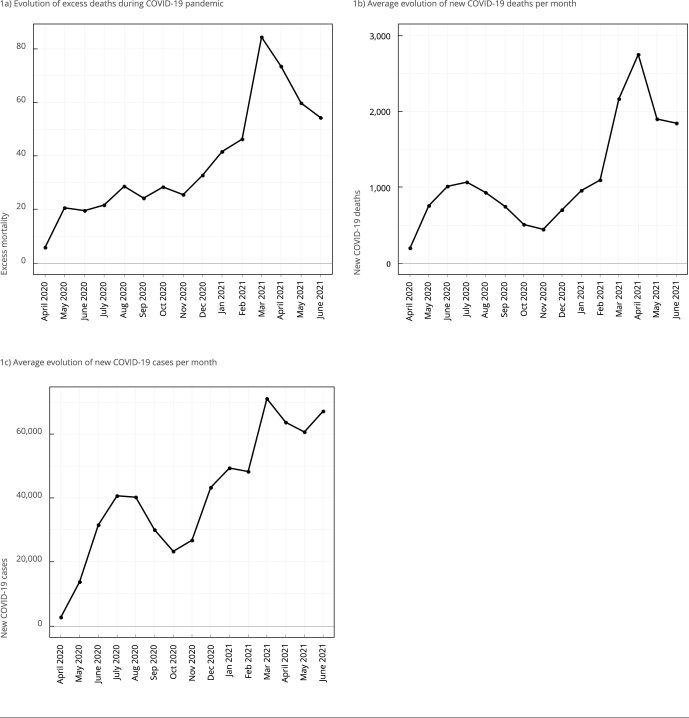
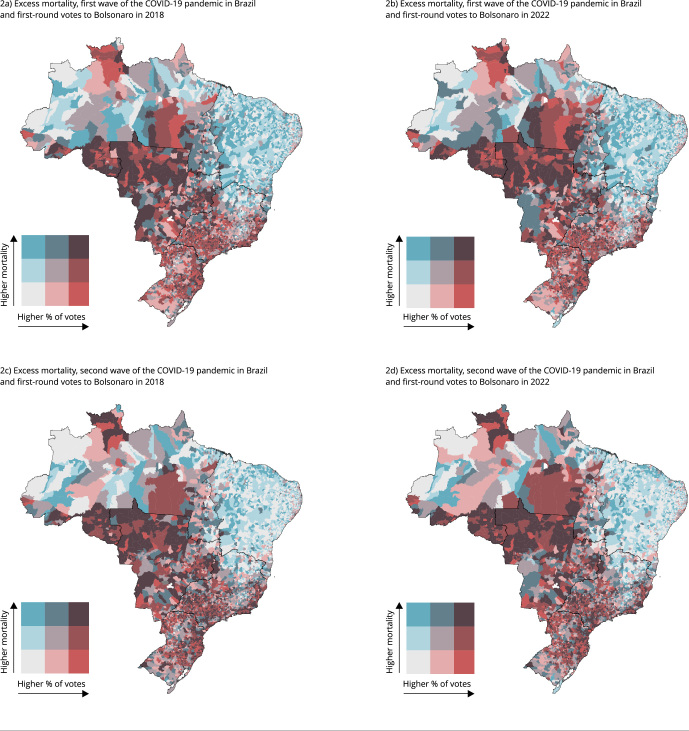
We evaluated the hypothesis of an association between excess mortality and political partisanship in Brazil using municipal death certificates registered in the Brazilian Ministry of Health database and first-round electoral results of Presidential elections in 2018 and 2022. Considering the former Brazilian President's stance of discrediting and neglecting the severity of the pandemic, we expect a possible relationship between excessive mortality rates during the COVID-19 health crisis and the number of municipal votes for Bolsonaro. Our results showed that, in both elections, the first-round percentage of municipal votes for Bolsonaro was positively associated with the peaks of excess deaths across Brazilian municipalities in 2020 and 2021. Despite the excess mortality during the pandemic, the political loyalty to Bolsonaro remained the same during the electoral period of 2022. A possible explanation for this is linked to the Brazilian political scenario, which presents an environment of tribal politics and affective polarization.
我们评估了巴西超额死亡率与政治党派之间存在关联的假设,使用了巴西卫生部数据库中登记的市级死亡证明和 2018 年和 2022 年总统选举的第一轮选举结果。考虑到前巴西总统诋毁和忽视疫情严重程度的立场,我们预计在 COVID-19 健康危机期间过高的死亡率与博索纳罗在市级的得票数之间可能存在关联。我们的结果表明,在这两次选举中,博索纳罗在首轮选举中的市级得票率与 2020 年和 2021 年巴西市级超额死亡人数的峰值呈正相关。尽管在大流行期间出现了超额死亡,但在 2022 年的选举期间,对博索纳罗的政治忠诚度保持不变。这种情况的一个可能解释与巴西的政治环境有关,巴西的政治环境呈现出部落政治和情感极化的特征。