Gordon Ethan, Davila Federico, Riedy Chris
Institute for Sustainable Futures, University of Technology Sydney, Bldg 10, 235 Jones St, Ultimo, NSW 2007 Australia.
Agric Human Values. 2022;39(2):809-826. doi: 10.1007/s10460-021-10276-0. Epub 2021 Nov 2.
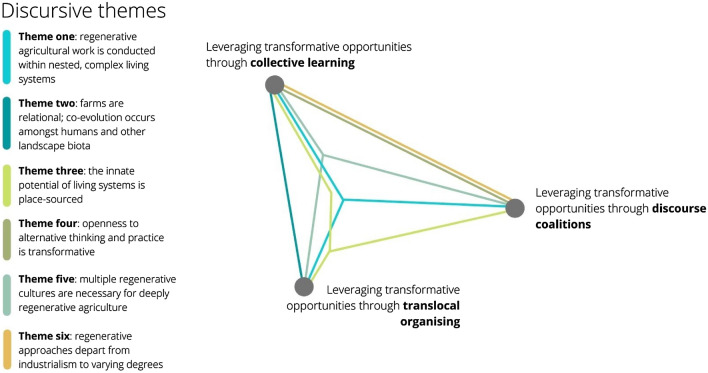
Agriculture occupies 38% of the planet's terrestrial surface, using 70% of freshwater resources. Its modern practice is dominated by an industrial-productivist discourse, which has contributed to the simplification and degradation of human and ecological systems. As such, agricultural transformation is essential for creating more sustainable food systems. This paper focuses on discursive change. A prominent discursive alternative to industrial-productivist agriculture is regenerative agriculture. Regenerative discourses are emergent, radically evolving and diverse. It is unclear whether they have the potential to generate the changes required to shift industrial-productivist agriculture. This paper presents a literature-based discourse analysis to illustrate key thematic characteristics of regenerative agricultural discourses. The analysis finds that such discourses: situate agricultural work within nested, complex living systems; position farms as relational, characterised by co-evolution between humans and other landscape biota; perceive the innate potential of living systems as place-sourced; maintain a transformative openness to alternative thinking and practice; believe that multiple regenerative cultures are necessary for deeply regenerative agriculture; and depart from industrialism to varying degrees. The paper concludes by reviewing three transformative opportunities for regenerative discourses-discourse coalitions, translocal organising and collective learning.
The online version supplementary material available at 10.1007/s10460-021-10276-0.
农业占据了地球陆地表面的38%,消耗了70%的淡水资源。其现代实践以工业生产主义话语为主导,这导致了人类和生态系统的简化与退化。因此,农业转型对于创建更可持续的粮食系统至关重要。本文聚焦于话语变革。工业生产主义农业的一个突出话语替代方案是再生农业。再生话语正在兴起,且在急剧演变且多种多样。尚不清楚它们是否有潜力带来转变工业生产主义农业所需的变革。本文进行了一项基于文献的话语分析,以阐明再生农业话语的关键主题特征。分析发现,此类话语将农业工作置于嵌套的复杂生命系统之中;将农场定位为具有关联性的,其特点是人类与其他景观生物群落之间的共同进化;将生命系统的内在潜力视为源于特定地点;对替代思维和实践保持变革性的开放态度;认为深度再生农业需要多种再生文化;并且在不同程度上背离工业主义。本文最后回顾了再生话语的三个变革性机遇——话语联盟、跨地区组织和集体学习。
在线版本的补充材料可在10.1007/s10460-021-10276-0获取。