Loring Philip A
Department of Geography, Environment, and Geomatics, Arrell Food Institute, University of Guelph, 50 Stone Road E., Guelph, ON N1G2W1 Canada.
Agric Human Values. 2022;39(2):701-713. doi: 10.1007/s10460-021-10282-2. Epub 2021 Nov 9.
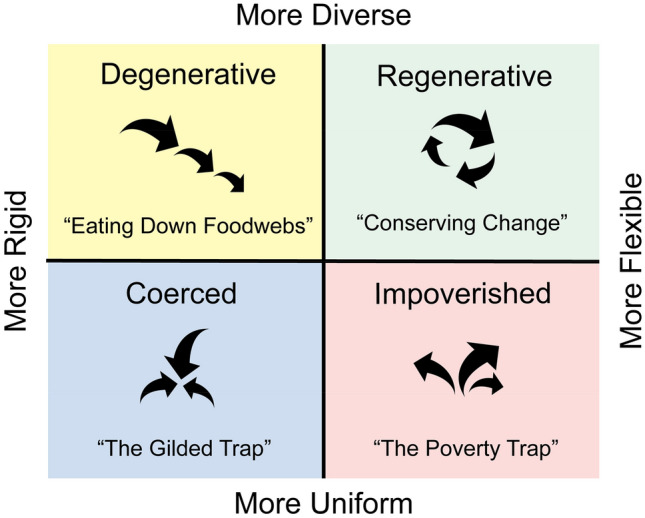
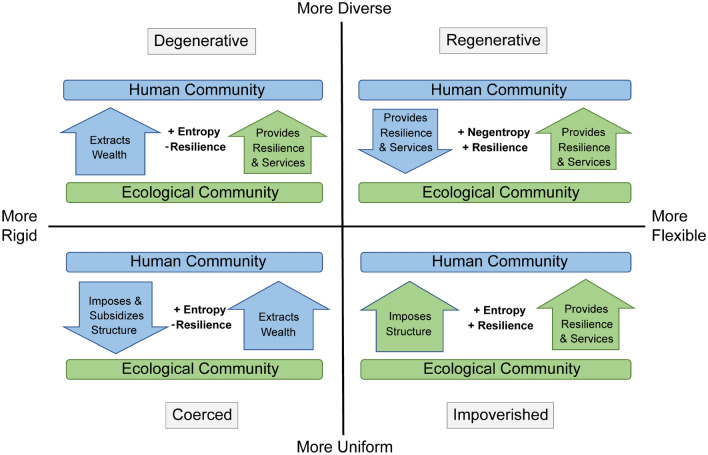
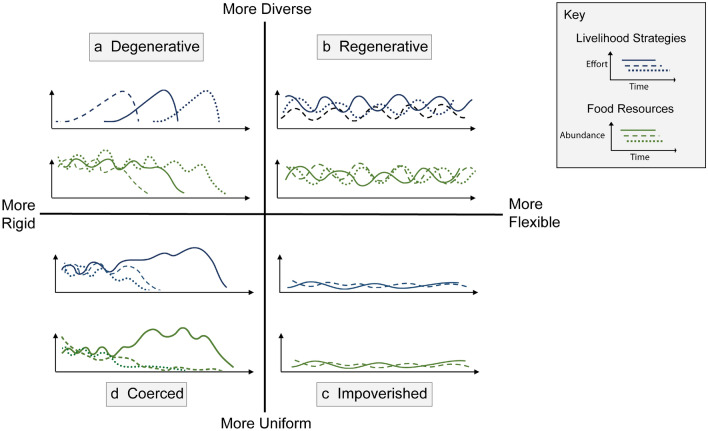
In recent years, interest has increased in regenerative practices as a strategy for transforming food systems and solving major environmental problems such as biodiversity loss and climate change. However, debates persist regarding these practices and how they ought to be defined. This paper presents a framework for exploring the regenerative potential of food systems, focusing on how food systems activities and technologies are organized rather than the specific technologies or practices being employed. The paper begins with a brief review of debates over sustainable food systems and the varying ways that regenerative food systems have been defined and theorized. Then, it provides the theoretical backing of the framework-the conservation of change principle-which is an interpretation of the laws of thermodynamics and theories of adaptive change as relevant to the regenerative capacity of living systems. Next, the paper introduces the framework itself, which comprises two independent but intersecting dimensions of food systems organization: resource diversity and livelihood flexibility. These two dimensions result in four archetypical regimes for food systems: degenerative, regenerative, impoverished, and coerced. The paper defines each and offers real-world examples. Finally, the paper concludes with a discussion of pathways for transforming food systems and opportunities for additional research.
近年来,人们对再生实践作为一种转变粮食系统和解决生物多样性丧失和气候变化等重大环境问题的策略的兴趣与日俱增。然而,关于这些实践以及应如何对其进行定义的争论仍在持续。本文提出了一个探索粮食系统再生潜力的框架,重点关注粮食系统活动和技术的组织方式,而非所采用的具体技术或实践。本文首先简要回顾了关于可持续粮食系统的争论,以及对再生粮食系统的不同定义和理论阐述方式。然后,它提供了该框架的理论依据——变化守恒原则,这是对热力学定律和与生命系统再生能力相关的适应性变化理论的一种解释。接下来,本文介绍了该框架本身,它由粮食系统组织的两个独立但相互交叉的维度组成:资源多样性和生计灵活性。这两个维度产生了粮食系统的四种典型模式:退化型、再生型、贫困型和强制型。本文对每种模式进行了定义并给出了实际例子。最后,本文以对转变粮食系统的途径和进一步研究机会的讨论作为结论。