Wang Xiaokun Cara, Kim Woojung, Holguín-Veras José, Schmid Joshua
Department of Civil and Environmental Engineering, Rensselaer Polytechnic Institute, 110 8th Street, 4032 JEC Building, Troy, NY 12180, USA.
VREF Center of Excellence for Sustainable Urban Freight Systems, Rensselaer Polytechnic Institute, 110 8th St, Room JEC 4030, Troy, NY 12180, USA.
Transp Res Part A Policy Pract. 2021 Dec;154:270-286. doi: 10.1016/j.tra.2021.10.012. Epub 2021 Nov 2.
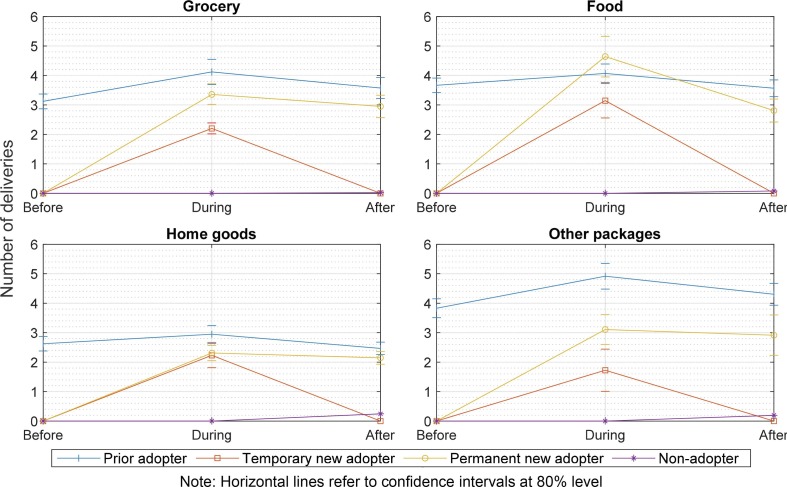
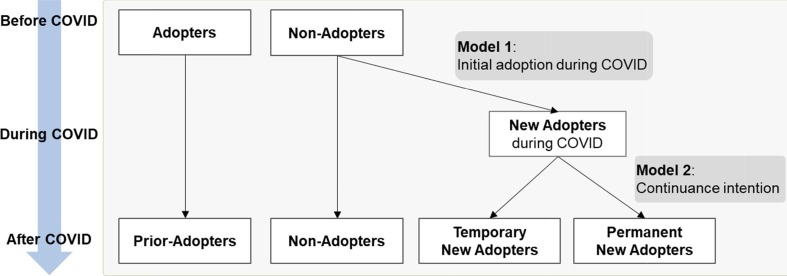
A significant growth in demand for online shopping in light of the Coronavirus Disease (COVID) crisis has received attention from transportation practitioners, policy-makers, and researchers. However, an important question arises in this increase in online shopping and resulting deliveries: How long will this last? Very little is known whether this popularity would last a long time. To address this question, the authors conducted a survey of 915 individuals residing in the U.S. and classified them into the four distinctive consumer types (i.e., the prior adopter, temporary adopter and permanent new adopter, and non-adopter) depending on their usage of delivery services before, during, and after (expected) the COVID crisis. This research aims to gain behavioral insight by exploring the differences between the four consumer types and investigating factors affecting the initial adoption and continuance intention of using delivery services. The descriptive analysis revealed that there are clear differences not only between the four types of consumers but also between the four product types (i.e., grocery, food, home goods, and other packages) considered in the survey. The models found that factors affecting the initial adoption and continuance intention are different from the previous studies conducted before the COVID pandemic. Implications for planning and policymaking are also discussed.
鉴于冠状病毒病(COVID)危机,在线购物需求显著增长,这已引起运输从业者、政策制定者和研究人员的关注。然而,随着在线购物及由此产生的配送量增加,一个重要问题出现了:这种情况会持续多久?对于这种流行趋势是否会长期持续,人们知之甚少。为了解决这个问题,作者对915名居住在美国的个人进行了调查,并根据他们在COVID危机之前、期间和之后(预期)对配送服务的使用情况,将他们分为四种不同的消费者类型(即早期采用者、临时采用者和永久新采用者,以及非采用者)。本研究旨在通过探索这四种消费者类型之间的差异,并调查影响使用配送服务的初始采用和持续意愿的因素,来获得行为洞察。描述性分析表明,不仅这四种消费者类型之间存在明显差异,调查中考虑的四种产品类型(即食品杂货、食品、家居用品和其他包裹)之间也存在明显差异。模型发现,影响初始采用和持续意愿的因素与COVID大流行之前进行的先前研究不同。还讨论了对规划和政策制定的影响。