Department of Epidemiology of Chronic Non-Communicable Diseases, National Medical Research Center for Therapy and Preventive Medicine of the Ministry of Healthcare of the Russian Federation, Moscow, Russia.
Int J Public Health. 2021 Apr 1;66:599570. doi: 10.3389/ijph.2021.599570. eCollection 2021.
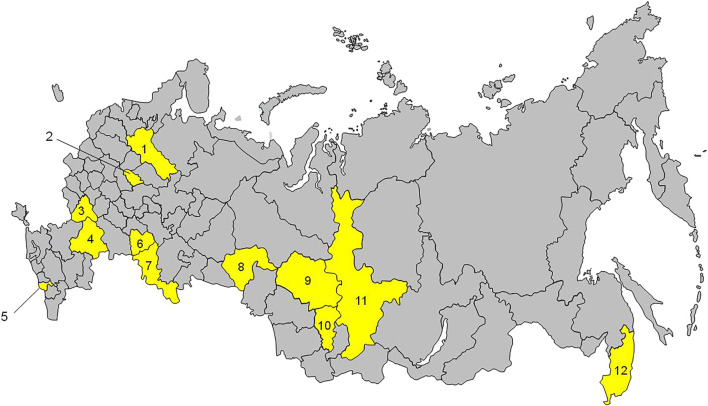
Our study evaluated the impact of a wide range of characteristics of large administrative regions on the individual level of cigarette smoking in the Russian adult population. The pool of participants included 20,303 individuals aged 25-64 years. We applied 64 characteristics of the 12 Russian regions under study for 2010-2014. Using principal component analysis, we deduced five evidence-based composite indices of the regions. We applied the generalized estimating equation to determine associations between the regional indices and the individual level of smoking. The increased Industrial index in the region is associated with the probability of smoking (odds ratio = 1.15; 95% confidence interval = 1.06-1.24). The other indices show associations with smoking only in separate gender and educational groups. Surprisingly, it was found that the Economic index has no associations with the probability of smoking. We evaluated the key associations of the territorial indices with the individual probability of smoking, as well as the mutual influence between the territorial indices and individual factors.
我们的研究评估了广泛的大区特征对俄罗斯成年人群体中个体吸烟水平的影响。参与者包括年龄在 25-64 岁之间的 20303 人。我们应用了 2010-2014 年研究的 12 个俄罗斯地区的 64 个特征。使用主成分分析,我们推导出了五个基于证据的地区综合指数。我们应用广义估计方程来确定地区指数与个体吸烟水平之间的关联。地区工业指数的增加与吸烟的可能性相关(优势比=1.15;95%置信区间=1.06-1.24)。其他指数仅在不同性别和教育群体中与吸烟相关。令人惊讶的是,发现经济指数与吸烟的可能性没有关联。我们评估了地域指数与个体吸烟概率的主要关联,以及地域指数与个体因素之间的相互影响。