Ball Lorenzo, Sutherasan Yuda, Fiorito Martina, Dall'Orto Antonella, Maiello Lorenzo, Vargas Maria, Robba Chiara, Brunetti Iole, D'Antini Davide, Raimondo Pasquale, Huhle Robert, Schultz Marcus J, Rocco Patricia R M, Gama de Abreu Marcelo, Pelosi Paolo
Department of Surgical Sciences and Integrated Diagnostics, University of Genoa, Genoa, Italy.
Anesthesia and Intensive Care, Ospedale Policlinico San Martino Istituto di Ricerca e Cura a Carattere Scientifico (IRCCS) for Oncology and Neurosciences, Genova, Italy.
Front Physiol. 2021 Oct 22;12:725738. doi: 10.3389/fphys.2021.725738. eCollection 2021.
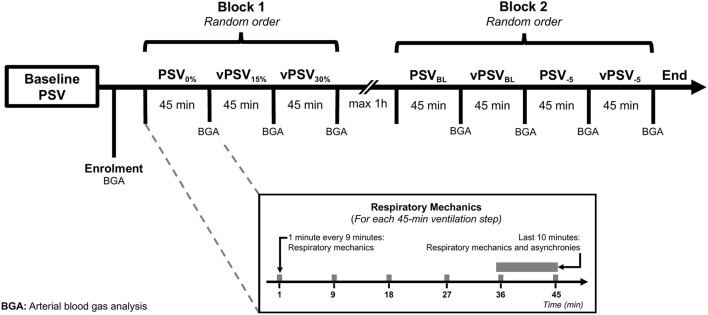
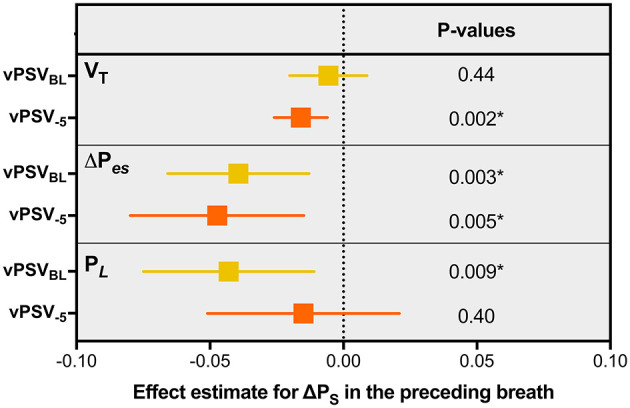
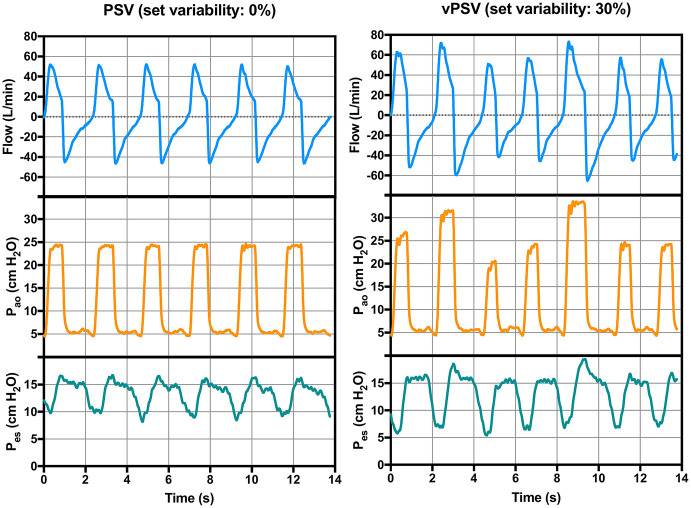
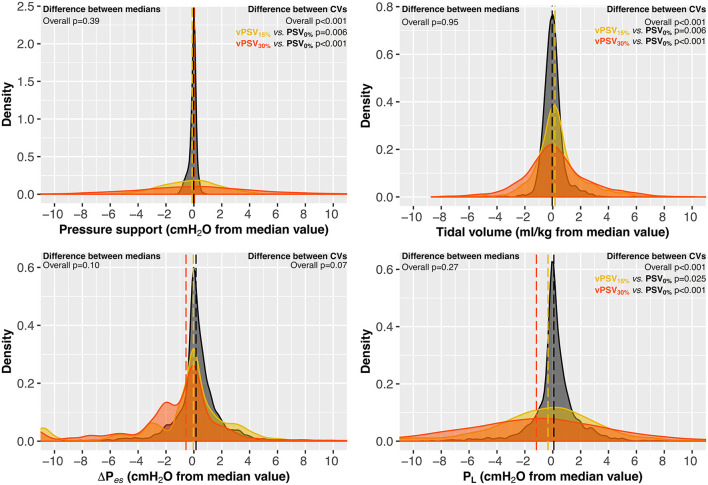
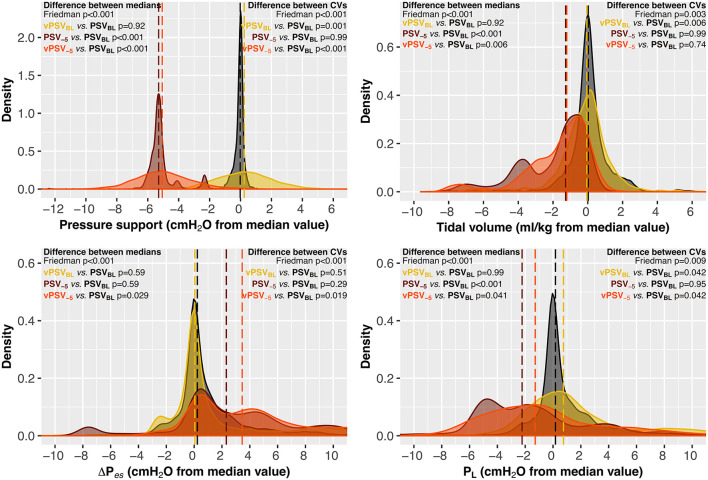
Variable pressure support ventilation (vPSV) is an assisted ventilation mode that varies the level of pressure support on a breath-by-breath basis to restore the physiological variability of breathing activity. We aimed to compare the effects of vPSV at different levels of variability and pressure support (Δ ) in patients with acute respiratory distress syndrome (ARDS). This study was a crossover randomized clinical trial. We included patients with mild to moderate ARDS already ventilated in conventional pressure support ventilation (PSV). The study consisted of two blocks of interventions, and variability during vPSV was set as the coefficient of variation of the Δ level. In the first block, the effects of three levels of variability were tested at constant Δ : 0% (PSV, conventional PSV), 15% (vPSV), and 30% (vPSV). In the second block, two levels of variability (0% and variability set to achieve ±5 cmHO variability) were tested at two ΔP levels (baseline Δ and Δ reduced by 5 cmHO from baseline). The following four ventilation strategies were tested in the second block: PSV with baseline Δ and 0% variability (PSV) or ±5 cmHO variability (vPSV), PSV with ΔP reduced by 5 cmHO and 0% variability (PSV) or ±5 cmHO variability (vPSV). Outcomes included gas exchange, respiratory mechanics, and patient-ventilator asynchronies. The study enrolled 20 patients. In the first block of interventions, oxygenation and respiratory mechanics parameters did not differ between vPSV and vPSV compared with PSV. The variability of tidal volume ( ) was higher with vPSV and vPSV compared with PSV. The incidence of asynchronies and the variability of transpulmonary pressure ( ) were higher with vPSV compared with PSV. In the second block of interventions, different levels of pressure support with and without variability did not change oxygenation. The variability of and was higher with vPSV compared with PSV, but not with vPSV compared with PSV. In patients with mild-moderate ARDS, the addition of variability did not improve oxygenation at different pressure support levels. Moreover, high variability levels were associated with worse patient-ventilator synchrony. www.clinicaltrials.gov, identifier: NCT01683669.
可变压力支持通气(vPSV)是一种辅助通气模式,它逐次呼吸改变压力支持水平,以恢复呼吸活动的生理变异性。我们旨在比较不同变异性水平和压力支持(Δ)的vPSV对急性呼吸窘迫综合征(ARDS)患者的影响。本研究为交叉随机临床试验。我们纳入了已接受传统压力支持通气(PSV)的轻至中度ARDS患者。该研究包括两个干预阶段,vPSV期间的变异性设定为Δ水平的变异系数。在第一阶段,在恒定的Δ下测试三个变异性水平的影响:0%(PSV,传统PSV)、15%(vPSV)和30%(vPSV)。在第二阶段,在两个ΔP水平(基线Δ和比基线降低5 cmH₂O的Δ)下测试两个变异性水平(0%和设定为实现±5 cmH₂O变异性)。在第二阶段测试了以下四种通气策略:具有基线Δ和0%变异性(PSV)或±5 cmH₂O变异性(vPSV)的PSV,具有降低5 cmH₂O的ΔP和0%变异性(PSV)或±5 cmH₂O变异性(vPSV)的PSV。结局指标包括气体交换、呼吸力学和患者 - 呼吸机不同步情况。该研究纳入了20名患者。在第一阶段干预中,与PSV相比,vPSV和vPSV之间的氧合和呼吸力学参数无差异。与PSV相比,vPSV和vPSV时潮气量()的变异性更高。与PSV相比,vPSV时不同步发生率和跨肺压()的变异性更高。在第二阶段干预中,有或没有变异性的不同压力支持水平并未改变氧合情况。与PSV相比,vPSV时和的变异性更高,但与PSV相比,vPSV时并非如此。在轻至中度ARDS患者中,增加变异性并未在不同压力支持水平下改善氧合情况。此外,高变异性水平与更差的患者 - 呼吸机同步性相关。临床试验.gov,标识符:NCT01683669。