Tang Lili, Zhang Yening, Pang Ying, Zhou Yuhe, Li Jinjiang, Song Lili, He Yi, Li Zimeng, Wang Yan
Department of Psycho-Oncology, Key Laboratory of Carcinogenesis and Translational Research (Ministry of Education/Beijing), Peking University Cancer Hospital and Institute, Beijing, China.
Front Psychiatry. 2021 Oct 20;12:715756. doi: 10.3389/fpsyt.2021.715756. eCollection 2021.
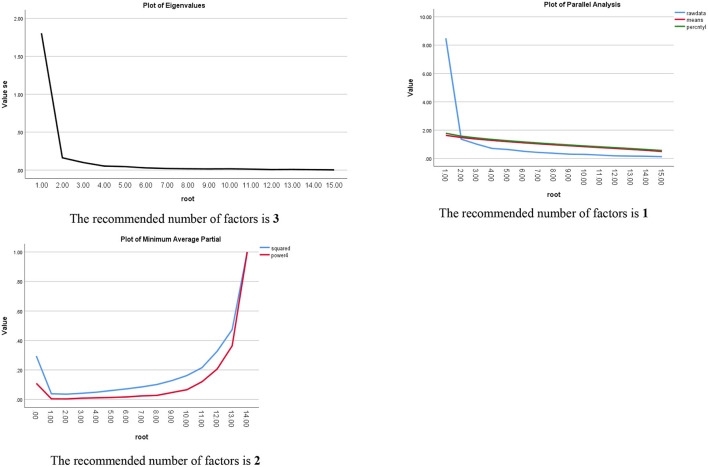
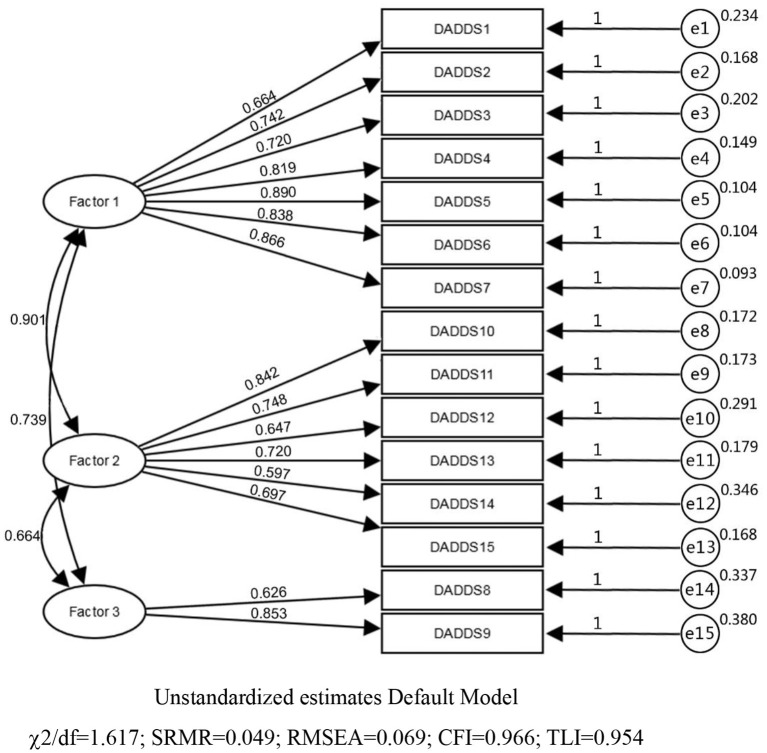
Death anxiety is commonly experienced by individuals with advanced cancer who have a limited life expectancy. The Death and Dying Distress Scale (DADDS) is a validated measure that was created to capture this experience; but no Chinese version is available to date. We conducted a cross-sectional study to explore the psychometric properties of a Chinese version DADDS (DADDS-C) and address prevalence of death anxiety among patients with advanced cancer. Patients with advanced cancer were recruited from Peking University Cancer Hospital. Measures administered included: DADDS-C, Patient Health Questionnaire (PHQ-9), General Anxiety Disorder-7(GAD-7), Quality of Life at End of Life in Cancer (QUAL-EC), Functional Assessment of Chronic Illness Therapy-Spiritual Well-Being Scale (FACIT-sp). McDonald's Omega, Cronbach's alpha, Exploratory Factor Analysis and Confirmatory Factor Analysis were used to test DADDS-C's reliability and validity. Logistic regression analysis was used to identify risk factors for death anxiety. Of 300 patients approached, 256 (85%) provided informed consent and completed the questionnaires. Of these participants, 43 (16.8%) had moderate death anxiety based on scores of ≥45 on the DADDS-C. Three factors (feeling shortness of time, dying and death distress, being a burden to others) explained 71.643% of shared variation with factor loadings ranging from 0.629 to 0.822. Cronbach's alpha was 0.939; Omega total was 0.959. DADDS-C had acceptable convergent and discriminant validity. Logistic regression analysis indicated that two factors (better relationship with healthcare providers and preparation for end of life) protected patients from death anxiety. DADDS-C is a valid tool for measuring death anxiety in Chinese patients with advanced cancer. The presence of at least moderate death anxiety in a substantial minority of these patients calls for screening for this symptom and for more routine psychological interventions to alleviate and prevent such distress in this population.
预期寿命有限的晚期癌症患者普遍会经历死亡焦虑。死亡与临终困扰量表(DADDS)是一种经过验证的测量工具,旨在捕捉这种体验;但迄今为止尚无中文版。我们进行了一项横断面研究,以探索中文版DADDS(DADDS-C)的心理测量特性,并了解晚期癌症患者中死亡焦虑的患病率。从北京大学肿瘤医院招募晚期癌症患者。所实施的测量工具包括:DADDS-C、患者健康问卷(PHQ-9)、广泛性焦虑障碍量表(GAD-7)、癌症临终生活质量量表(QUAL-EC)、慢性病治疗功能评估-精神幸福感量表(FACIT-sp)。采用麦克唐纳欧米伽系数、克朗巴哈系数、探索性因素分析和验证性因素分析来检验DADDS-C的信效度。采用逻辑回归分析来确定死亡焦虑的危险因素。在300名被邀请的患者中,256名(85%)提供了知情同意并完成了问卷。在这些参与者中,根据DADDS-C得分≥45,有43名(16.8%)存在中度死亡焦虑。三个因素(感觉时间紧迫、濒死和死亡困扰、成为他人负担)解释了71.643%的共同变异,因子载荷范围为0.629至0.822。克朗巴哈系数为0.939;总欧米伽系数为0.959。DADDS-C具有可接受的聚合效度和区分效度。逻辑回归分析表明,两个因素(与医疗服务提供者关系更好以及为临终做好准备)可使患者免受死亡焦虑。DADDS-C是测量中国晚期癌症患者死亡焦虑的有效工具。这些患者中相当一部分人至少存在中度死亡焦虑,这就需要对这种症状进行筛查,并进行更常规的心理干预,以减轻和预防该人群的此类困扰。