Department of Neurology, Xuanwu Hospital, Capital Medical University, Beijing, China.
Center for Medical Genetics & Hunan Key Laboratory of Medical Genetics, School of Life Sciences, Central South University, Changsha, China.
Front Immunol. 2021 Oct 21;12:768682. doi: 10.3389/fimmu.2021.768682. eCollection 2021.
Previous studies have suggested essential roles of growth factors on the risk of Multiple Sclerosis (MS), but it remains undefined whether the effects are causal.
We applied Mendelian randomization (MR) approaches to disentangle the causal relationship between genetically predicted circulating levels of growth factors and the risk of MS.
Genetic instrumental variables for fibroblast growth factor (FGF) 23, growth differentiation factor 15 (GDF15), insulin growth factor 1 (IGF1), insulin-like growth factor binding proteins 3 (IGFBP3) and vascular endothelial growth factor (VEGF) were obtained from up-to-date genome-wide association studies (GWAS). Summary-level statistics of MS were obtained from the International Multiple Sclerosis Genetics Consortium, incorporating 14,802 subjects with MS and 26,703 healthy controls of European ancestry. Inverse-variance weighted (IVW) MR was used as the primary method and multiple sensitivity analyses were employed in this study.
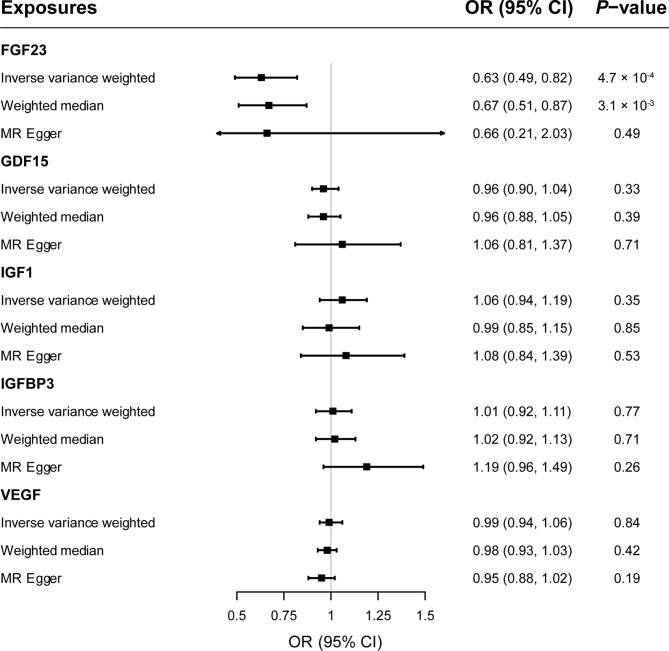
Genetically predicted circulating levels of FGF23 were associated with risk of MS. The odds ratio (OR) of IVW was 0.63 (95% confidence interval [CI], 0.49-0.82; < 0.001) per one standard deviation increase in circulating FGF23 levels. Weighted median estimators also suggested FGF23 associated with lower MS risk (OR = 0.67; 95% CI, 0.51-0.87; = 0.003). While MR-Egger approach provided no evidence of horizontal pleiotropy (intercept = -0.003, = 0.95). Results of IVW methods provided no evidence for causal roles of GDF1, IGF1, IGFBP3 and VEGF on MS risks, and additional sensitivity analyses confirmed the robustness of these null findings.
Our results implied a causal relationship between FGF23 and the risk of MS. Further studies are warranted to confirm FGF23 as a genetically valid target for MS.
先前的研究表明,生长因子在多发性硬化症(MS)的风险中起着重要作用,但尚不清楚这些作用是否具有因果关系。
我们应用孟德尔随机化(MR)方法来理清遗传预测的循环生长因子水平与 MS 风险之间的因果关系。
从最新的全基因组关联研究(GWAS)中获得成纤维细胞生长因子(FGF)23、生长分化因子 15(GDF15)、胰岛素样生长因子 1(IGF1)、胰岛素样生长因子结合蛋白 3(IGFBP3)和血管内皮生长因子(VEGF)的遗传工具变量。MS 的汇总水平统计数据来自国际多发性硬化症遗传学联合会,包括 14802 名 MS 患者和 26703 名欧洲血统的健康对照者。本研究采用逆方差加权(IVW)MR 作为主要方法,并进行了多种敏感性分析。
遗传预测的循环 FGF23 水平与 MS 风险相关。IVW 的优势比(OR)为每增加一个循环 FGF23 水平的标准差 0.63(95%置信区间 [CI],0.49-0.82;<0.001)。加权中位数估计值也表明 FGF23 与较低的 MS 风险相关(OR=0.67;95%CI,0.51-0.87;=0.003)。而 MR-Egger 方法没有提供水平多效性的证据(截距=-0.003,=0.95)。IVW 方法的结果没有提供 GDF1、IGF1、IGFBP3 和 VEGF 对 MS 风险具有因果作用的证据,额外的敏感性分析证实了这些无效发现的稳健性。
我们的结果表明 FGF23 与 MS 风险之间存在因果关系。需要进一步的研究来证实 FGF23 作为 MS 的遗传有效靶点。