Miranda Amanda Carvalho, Santana José Carlos Curvelo, Yamamura Charles Lincoln Kenji, Rosa Jorge Marcos, Tambourgi Elias Basile, Ho Linda Lee, Berssaneti Fernando Tobal
Department of Pharmaceutical Sciences, Nine July University, São Paulo, Brazil.
Department of Production Engineering, Polytechnic School, University of São Paulo, Av. Prof. Luciano Gualberto, 1380, Butantã, São Paulo, SP 05508-010 Brazil.
Air Qual Atmos Health. 2021;14(12):2091-2099. doi: 10.1007/s11869-021-01077-9. Epub 2021 Oct 29.
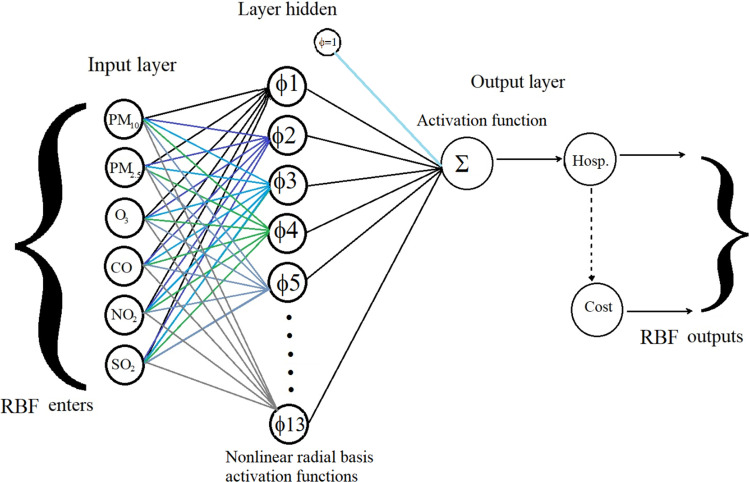
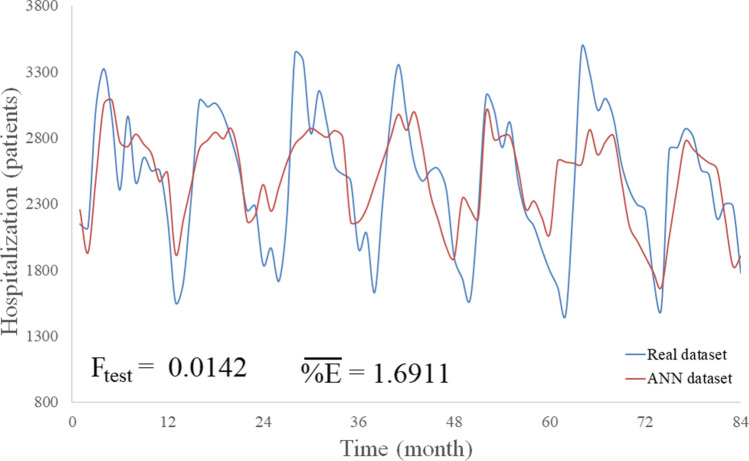
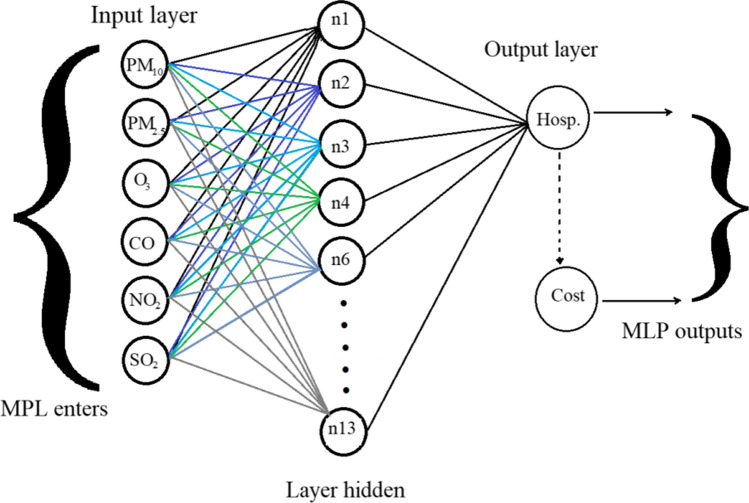
This work aims to obtain an artificial neural network to simulate hospitalizations for respiratory diseases influenced by pollutant gaseous such as CO, PM, PM, NO, O, and SO emitted from 2011 to 2017, in the city of São Paulo. The hospitalization costs were also be calculated. MLP and RBF neural networks have been tested by varying the number of neurons in the hidden layer and the type of equation of the output function. The following pollutants and its concentration range were collected considering the supervision of Alto Tiete station set, in several neighborhoods in the city of São Paulo, from in the period 2011 to 2017: 28-63 µg/m of PM, 52-110 µg/m of PM, 49-135 µg/m of O, 0.8-2.6 ppm CO, 41-98 µg/m of NO, and 3-16 µg/m of SO. Results showed that a RBF neural network with 6 input neurons, 13 hidden layer neurons, and 1 output neuron, using BFGS algorithm and a Gaussian function to neuronal activation, was the best fitted to the experimental datasets. So, knowing the monthly concentration of gaseous pollutions was possible to predict the hospitalization of 1464 to 3483 ± 510 patients, with costs between 570,447 and 1,357,151 ± 198,171 USD per month. This way, it is possible to use this neural network to predict the costs of hospitalizing patients for respiratory diseases and to contribute to the decision-making of how much the government should spend on health care.
这项工作旨在获得一个人工神经网络,以模拟2011年至2017年圣保罗市受一氧化碳、细颗粒物、粗颗粒物、氮氧化物、臭氧和二氧化硫等气态污染物影响的呼吸系统疾病住院情况。同时还将计算住院费用。通过改变隐藏层神经元数量和输出函数方程类型,对多层感知器(MLP)和径向基函数(RBF)神经网络进行了测试。考虑到圣保罗市多个社区阿尔托铁特站的监测数据,收集了2011年至2017年期间以下污染物及其浓度范围:细颗粒物为28 - 63微克/立方米、粗颗粒物为52 - 110微克/立方米、臭氧为49 - 135微克/立方米、一氧化碳为0.8 - 2.6 ppm、氮氧化物为41 - 98微克/立方米、二氧化硫为3 - 16微克/立方米。结果表明,一个具有6个输入神经元、13个隐藏层神经元和1个输出神经元的RBF神经网络,使用BFGS算法和高斯函数进行神经元激活,最适合实验数据集。因此,了解气态污染物的月浓度后,有可能预测1464至3483±510名患者的住院情况,每月费用在570,447至1,357,151±198,171美元之间。通过这种方式,可以使用这个神经网络来预测呼吸系统疾病患者的住院费用,并有助于政府在医疗保健方面的支出决策。