Hearing Sciences (Scottish Section), Mental Health and Clinical Neurosciences, School of Medicine, 6123University of Nottingham, Glasgow, UK.
School of Health Sciences, 6123University of Nottingham, Nottingham, UK.
Trends Hear. 2021 Jan-Dec;25:23312165211052786. doi: 10.1177/23312165211052786.
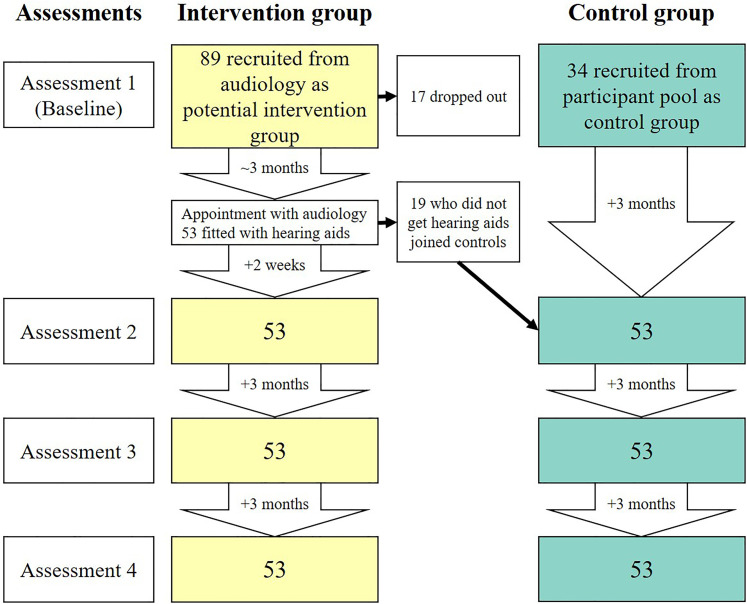
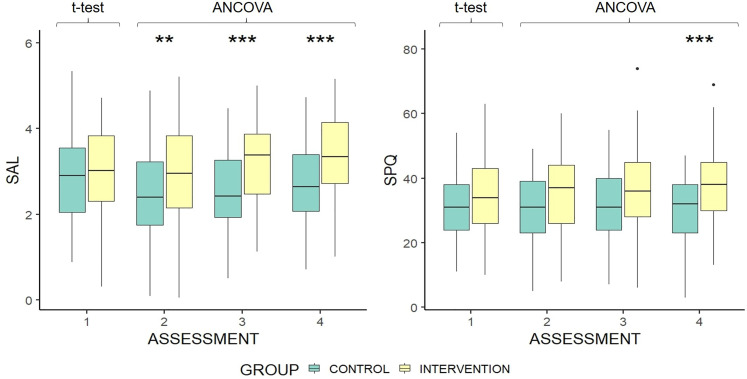
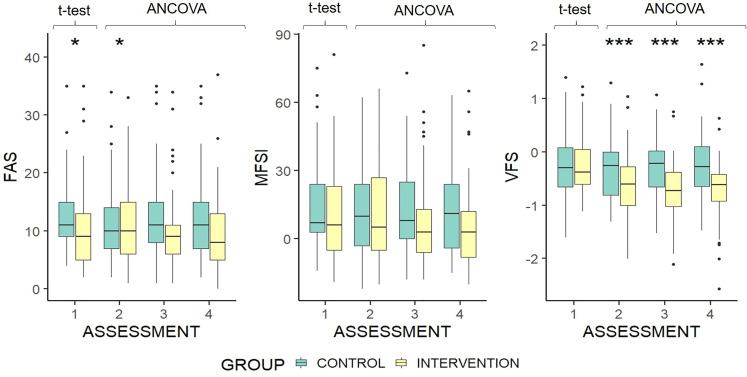
People with hearing loss experience fatigue, and it is unknown whether this is alleviated by treatment with hearing aids. The objective of this study was to address this issue and to investigate the possible concomitant effect of hearing-aid fitting on activity levels. An intervention group ( = 53) who were due to be fitted with their first-ever hearing aid(s) and a control group ( = 53) who had hearing loss but no change in hearing aid status-completed a battery of self-report outcome measures four times: once before fitting, and at 2 weeks, 3 months, and 6 months post fitting. Self-report outcome measures at each assessment captured fatigue, listening effort, hearing handicap, auditory lifestyle, social participation restrictions, and work, social and physical activity levels. Hearing-aid fitting led to a significant reduction in listening-related fatigue, but not general fatigue, in the intervention group compared to the control group. Additionally, social activity level increased and social participation restriction decreased significantly after hearing aid fitting in the intervention group compared to the control group. No significant interaction was found between working status and change in listening-related fatigue score. This study is the first to make a longitudinal measurement of fatigue before and after first-ever hearing aid fitting and to identify an increase in social activity level after hearing aid fitting. These findings have important implications for future research and the clinical practice of hearing aid fitting.
患有听力损失的人会感到疲劳,目前尚不清楚使用助听器治疗是否可以缓解这种情况。本研究的目的是解决这个问题,并研究助听器适配对活动水平的可能伴随影响。一个干预组( = 53)即将首次适配助听器,而一个对照组( = 53)有听力损失但助听器状况没有变化,他们完成了一系列自我报告的结果测量,共进行了四次:在适配前、适配后 2 周、3 个月和 6 个月各进行一次。每次评估的自我报告结果测量都捕捉到了疲劳、听力努力、听力障碍、听觉生活方式、社会参与限制以及工作、社会和身体活动水平。与对照组相比,助听器适配使干预组的听力相关疲劳显著降低,但对一般疲劳没有影响。此外,与对照组相比,干预组的社会活动水平在助听器适配后显著增加,社会参与限制显著降低。工作状态与听力相关疲劳评分的变化之间未发现显著的相互作用。本研究首次对首次佩戴助听器前后的疲劳进行了纵向测量,并确定佩戴助听器后社会活动水平增加。这些发现对未来的研究和助听器适配的临床实践具有重要意义。