Department of Psychology, University of Calgary, Calgary, Alberta, Canada.
Department of Radiology, University of Calgary, Calgary, Alberta, Canada.
Hum Brain Mapp. 2022 Feb 15;43(3):1032-1046. doi: 10.1002/hbm.25705. Epub 2021 Nov 8.
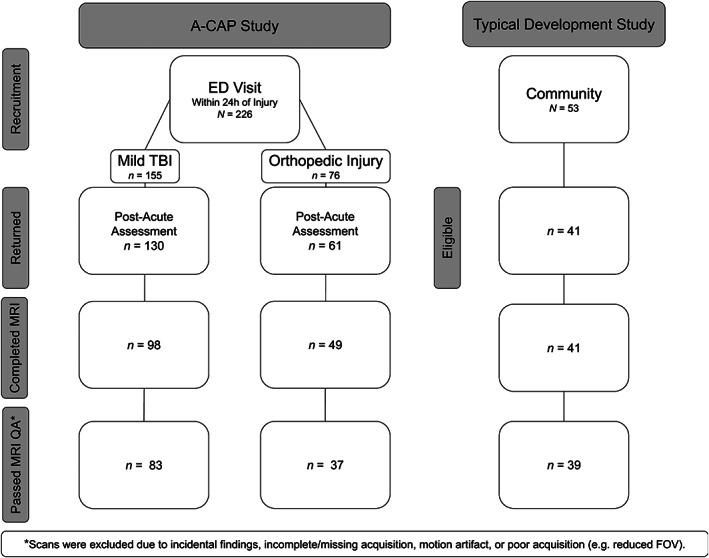
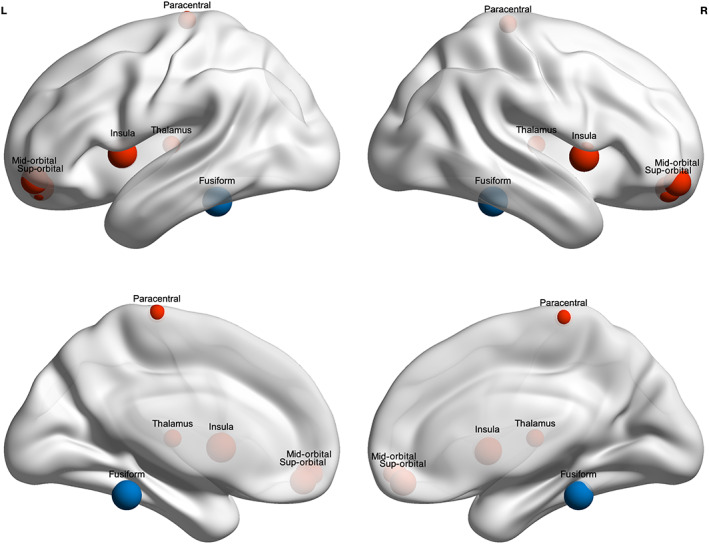
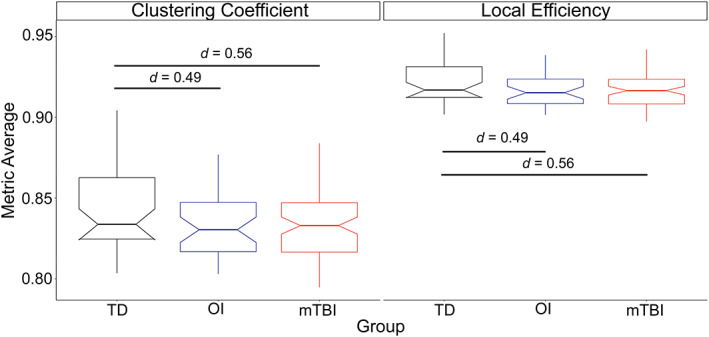
Sophisticated network-based approaches such as structural connectomics may help to detect a biomarker of mild traumatic brain injury (mTBI) in children. This study compared the structural connectome of children with mTBI or mild orthopedic injury (OI) to that of typically developing (TD) children. Children aged 8-16.99 years with mTBI (n = 83) or OI (n = 37) were recruited from the emergency department and completed 3T diffusion MRI 2-20 days postinjury. TD children (n = 39) were recruited from the community and completed diffusion MRI. Graph theory metrics were calculated for the binarized average fractional anisotropy among 90 regions. Multivariable linear regression and linear mixed effects models were used to compare groups, with covariates age, hemisphere, and sex, correcting for multiple comparisons. The two injury groups did not differ on graph theory metrics, but both differed from TD children in global metrics (local network efficiency: TD > OI, mTBI, d = 0.49; clustering coefficient: TD < OI, mTBI, d = 0.49) and regional metrics for the fusiform gyrus (lower degree centrality and nodal efficiency: TD > OI, mTBI, d = 0.80 to 0.96; characteristic path length: TD < OI, mTBI, d = -0.75 to -0.90) and in the superior and middle orbital frontal gyrus, paracentral lobule, insula, and thalamus (clustering coefficient: TD > OI, mTBI, d = 0.66 to 0.68). Both mTBI and OI demonstrated reduced global and regional network efficiency and segregation as compared to TD children. Findings suggest a general effect of childhood injury that could reflect pre- and postinjury factors that can alter brain structure. An OI group provides a more conservative comparison group than TD children for structural neuroimaging research in pediatric mTBI.
基于网络的复杂方法,如结构连接组学,可能有助于检测儿童轻度创伤性脑损伤 (mTBI) 的生物标志物。本研究比较了 mTBI 或轻度骨科损伤 (OI) 患儿与典型发育 (TD) 儿童的结构连接组。从急诊科招募年龄在 8-16.99 岁的 mTBI (n = 83) 或 OI (n = 37) 患儿,并在受伤后 2-20 天内完成 3T 扩散 MRI。从社区招募 TD 儿童 (n = 39) 并完成扩散 MRI。计算了 90 个区域之间的二值平均各向异性分数的图论指标。使用多变量线性回归和线性混合效应模型比较组间差异,协变量为年龄、半球和性别,并进行了多次比较校正。两组损伤患儿在图论指标上无差异,但与 TD 儿童在全局指标上存在差异 (局部网络效率:TD > OI、mTBI,d = 0.49;聚类系数:TD < OI、mTBI,d = 0.49) ,以及梭状回的区域指标 (度中心度和节点效率较低:TD > OI、mTBI,d = 0.80-0.96;特征路径长度:TD < OI、mTBI,d = -0.75- -0.90) 和额上回、中央旁小叶、岛叶和丘脑 (聚类系数:TD > OI、mTBI,d = 0.66-0.68)。mTBI 和 OI 与 TD 儿童相比,全局和区域网络效率和分离度均降低。研究结果表明,儿童损伤存在普遍影响,可能反映了损伤前后可改变大脑结构的因素。与 TD 儿童相比,OI 组为儿科 mTBI 的结构神经影像学研究提供了更保守的对照组。