Department of Psychology, Hotchkiss Brain Institute, University of Calgary, Calgary, Alberta, Canada.
Department of Neurology, University of Utah, Salt Lake City, Utah, USA.
Hum Brain Mapp. 2022 Aug 15;43(12):3809-3823. doi: 10.1002/hbm.25885. Epub 2022 Apr 25.
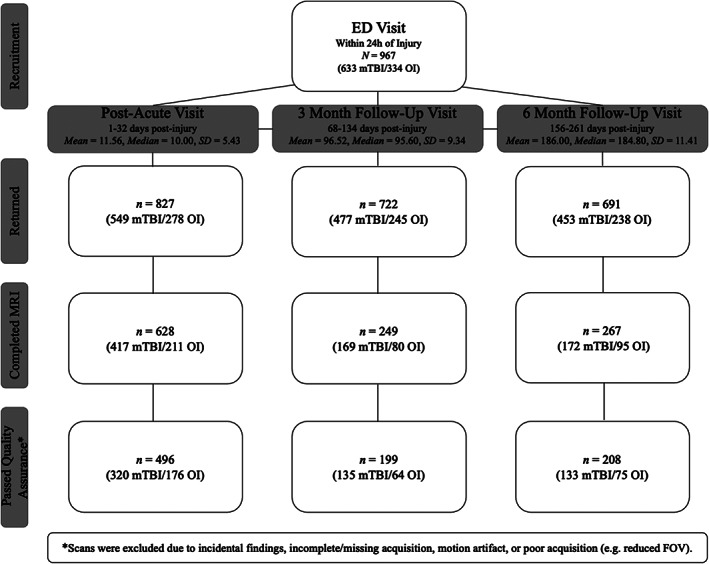
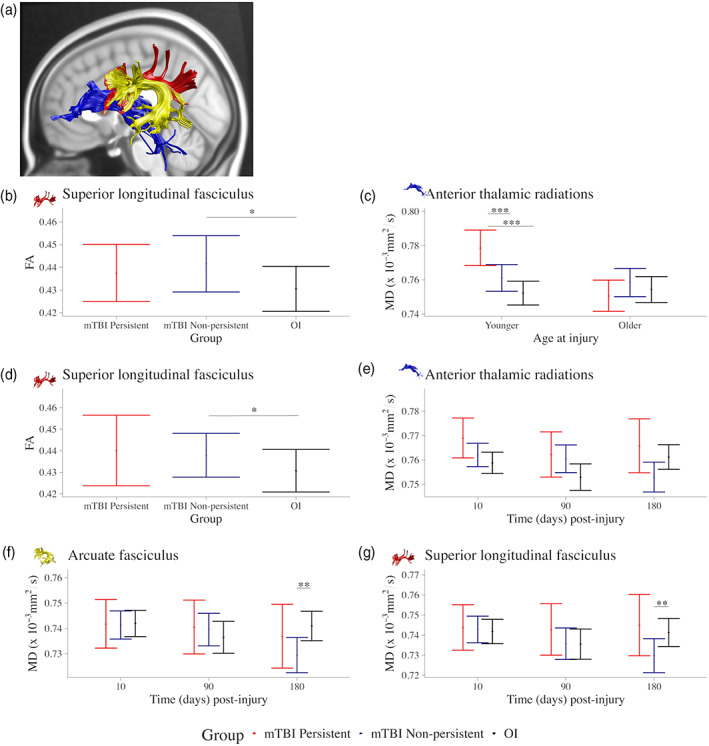
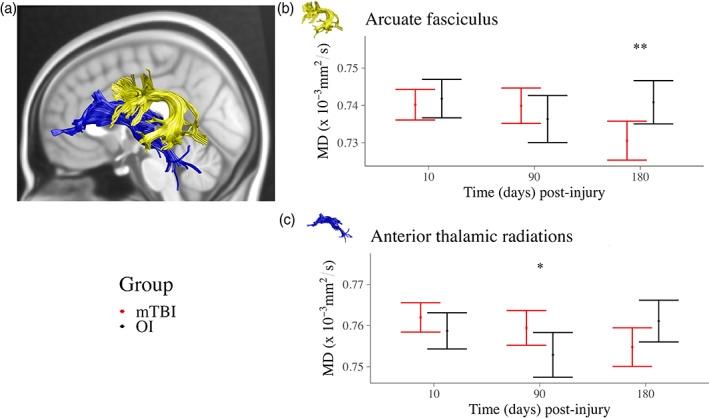
In the largest sample studied to date, white matter microstructural trajectories and their relation to persistent symptoms were examined after pediatric mild traumatic brain injury (mTBI). This prospective, longitudinal cohort study recruited children aged 8-16.99 years with mTBI or mild orthopedic injury (OI) from five pediatric emergency departments. Children's pre-injury and 1-month post-injury symptom ratings were used to classify mTBI with or without persistent symptoms. Children completed diffusion-weighted imaging at post-acute (2-33 days post-injury) and chronic (3 or 6 months via random assignment) post-injury assessments. Mean diffusivity (MD) and fractional anisotropy (FA) were derived for 18 white matter tracts in 560 children (362 mTBI/198 OI), 407 with longitudinal data. Superior longitudinal fasciculus FA was higher in mTBI without persistent symptoms relative to OI, d (95% confidence interval) = 0.31 to 0.37 (0.02, 0.68), across time. In younger children, MD of the anterior thalamic radiations was higher in mTBI with persistent symptoms relative to both mTBI without persistent symptoms, 1.43 (0.59, 2.27), and OI, 1.94 (1.07, 2.81). MD of the arcuate fasciculus, -0.58 (-1.04, -0.11), and superior longitudinal fasciculus, -0.49 (-0.90, -0.09) was lower in mTBI without persistent symptoms relative to OI at 6 months post-injury. White matter microstructural changes suggesting neuroinflammation and axonal swelling occurred chronically and continued 6 months post injury in children with mTBI, especially in younger children with persistent symptoms, relative to OI. White matter microstructure appears more organized in children without persistent symptoms, consistent with their better clinical outcomes.
在迄今为止研究样本最大的一项研究中,研究了儿科轻度创伤性脑损伤(mTBI)后白质微观结构轨迹及其与持续性症状的关系。这项前瞻性、纵向队列研究招募了来自五个儿科急诊室的年龄在 8-16.99 岁之间的 mTBI 或轻度骨科损伤(OI)的儿童。使用儿童受伤前和受伤后 1 个月的症状评分来分类有或没有持续性症状的 mTBI。儿童在急性后期(受伤后 2-33 天)和慢性后期(通过随机分配,受伤后 3 或 6 个月)进行扩散加权成像。在 560 名儿童(362 名 mTBI/198 名 OI)中,有 407 名儿童具有纵向数据,得出了 18 条白质束的平均弥散度(MD)和分数各向异性(FA)。与 OI 相比,无持续性症状的 mTBI 的上纵束 FA 更高,d(95%置信区间)为 0.31 至 0.37(0.02,0.68),随时间变化。在年幼的儿童中,有持续性症状的 mTBI 的前丘脑辐射 MD 高于无持续性症状的 mTBI 和 OI,分别为 1.43(0.59,2.27)和 1.94(1.07,2.81)。无持续性症状的 mTBI 在受伤后 6 个月时,其弓状束 MD 降低 0.58(-1.04,-0.11),上纵束 MD 降低 0.49(-0.90,-0.09),低于 OI。在 mTBI 中,有持续性症状的儿童中,白质微观结构变化提示神经炎症和轴突肿胀持续存在,且在受伤后 6 个月仍在继续,与 OI 相比,这种情况在年幼的儿童中更为明显。无持续性症状的儿童的白质微观结构似乎更有组织,这与他们更好的临床结果相一致。