Neural Connectivity Laboratory, Department of Radiology and Biomedical Imaging, University of California, San Francisco, 185 Berry St., Suite 350, San Francisco, CA, 94158, USA.
Mallinckrodt Institute of Radiology, Division of Neuroradiology, Washington University in St. Louis, St. Louis, MO, USA.
Pediatr Radiol. 2020 Oct;50(11):1594-1601. doi: 10.1007/s00247-020-04743-9. Epub 2020 Jun 30.
Although acute neurologic impairment might be transient, other long-term effects can be observed with mild traumatic brain injury. However, when pediatric patients with mild traumatic brain injury present for medical care, conventional imaging with CT and MR imaging often does not reveal abnormalities.
To determine whether edge density imaging can separate pediatric mild traumatic brain injury from typically developing controls.
Subjects were recruited as part of the "Therapeutic Resources for Attention Improvement using Neuroimaging in Traumatic Brain Injury" (TRAIN-TBI) study. We included 24 adolescents (χ=14.1 years of age, σ=1.6 years, range 10-16 years), 14 with mild traumatic brain injury (TBI) and 10 typically developing controls. Neurocognitive assessments included the pediatric version of the California Verbal Learning Test (CVLT) and the Attention Network Task (ANT). Diffusion MR imaging was acquired on a 3-tesla (T) scanner. Edge density images were computed utilizing fiber tractography. Principal component analysis (PCA) and support vector machines (SVM) were used in an exploratory analysis to separate mild TBI and control groups. The diagnostic accuracy of edge density imaging, neurocognitive tests, and fractional anisotropy (FA) from diffusion tensor imaging (DTI) was computed with two-sample t-tests and receiver operating characteristic (ROC) metrics.
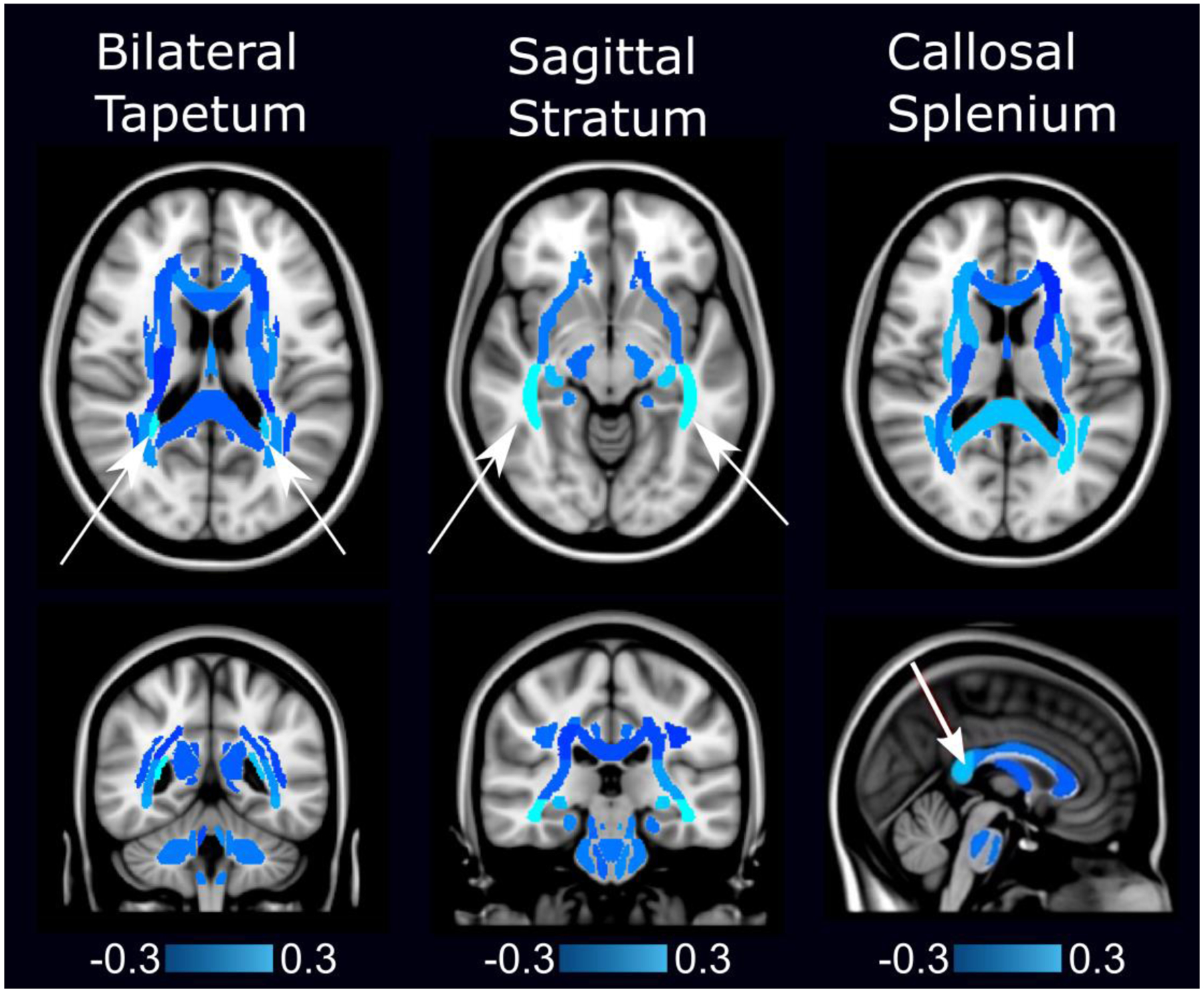
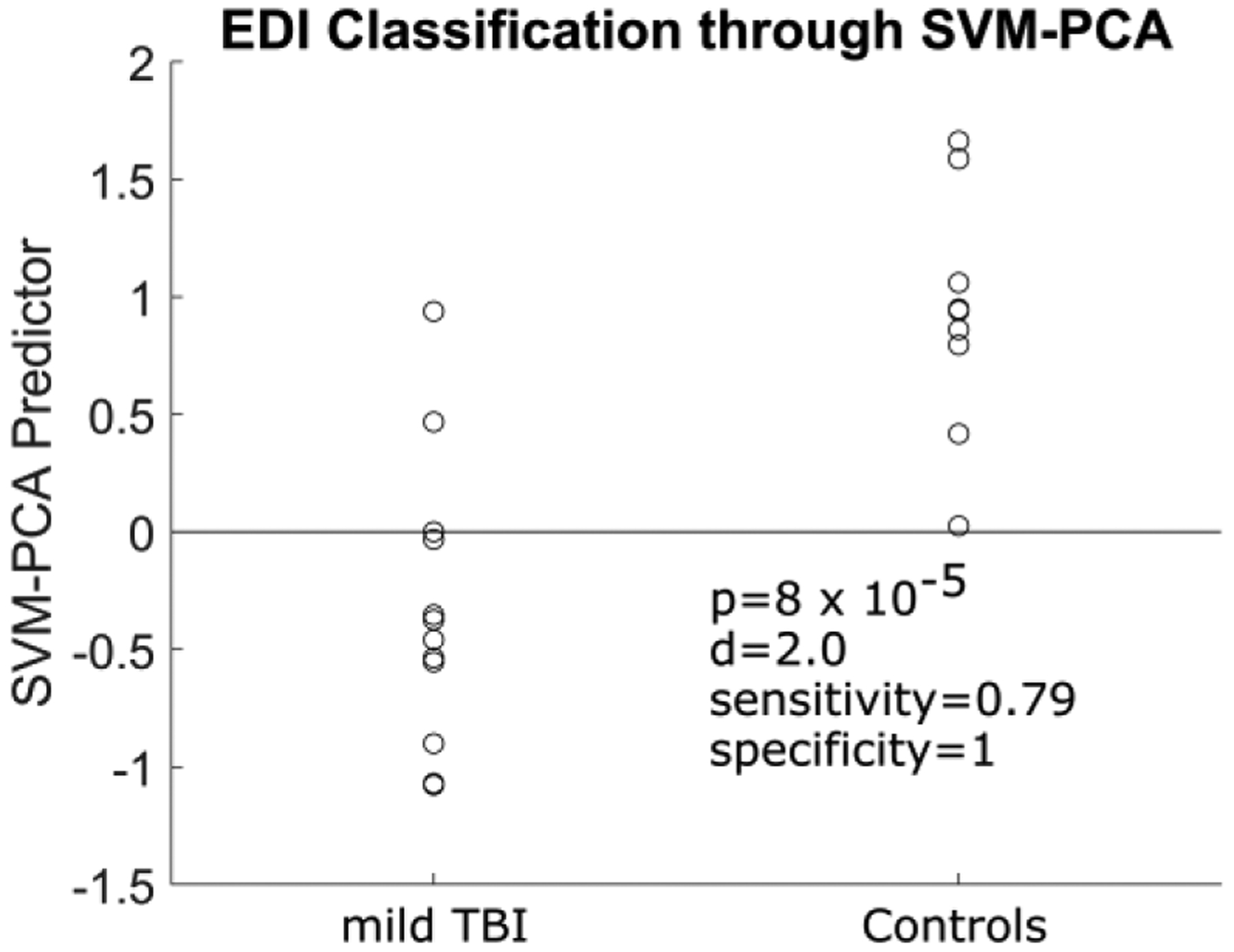
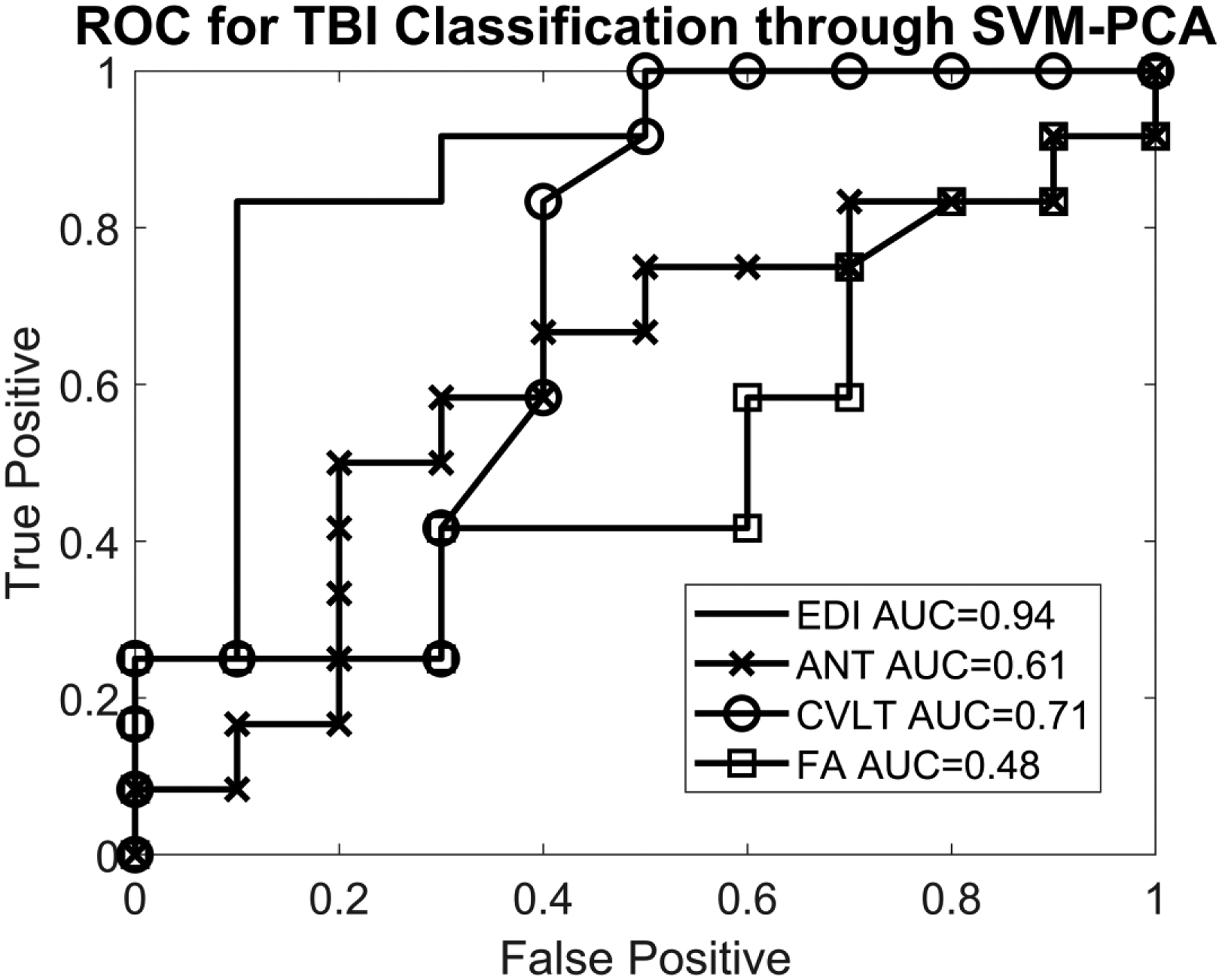
Support vector machine-principal component analysis of edge density imaging maps identified three white matter regions distinguishing pediatric mild TBI from controls. The bilateral tapetum, sagittal stratum, and callosal splenium identified mild TBI subjects with sensitivity of 79% and specificity of 100%. Accuracy from the area under the ROC curve (AUC) was 94%. Neurocognitive testing provided an AUC of 61% (CVLT) and 71% (ANT). Fractional anisotropy yielded an AUC of 48%.
In this proof-of-concept study, we show that edge density imaging is a new form of connectome mapping that provides better diagnostic delineation between pediatric mild TBI and healthy controls than DTI or neurocognitive assessments of memory or attention.
尽管急性神经功能障碍可能是短暂的,但轻度创伤性脑损伤也可能出现其他长期影响。然而,当儿科轻度创伤性脑损伤患者接受医疗护理时,常规的 CT 和磁共振成像通常不会发现异常。
确定边缘密度成像是否可以区分儿科轻度创伤性脑损伤和正常发育的对照组。
研究对象是“使用神经影像学治疗创伤性脑损伤注意力改善的治疗资源”(TRAIN-TBI)研究的一部分。我们纳入了 24 名青少年(χ=14.1 岁,σ=1.6 岁,范围 10-16 岁),其中 14 名患有轻度创伤性脑损伤(TBI),10 名正常发育的对照组。神经认知评估包括儿童版加利福尼亚语言学习测试(CVLT)和注意力网络测试(ANT)。扩散磁共振成像在 3 特斯拉(T)扫描仪上采集。利用纤维束追踪技术计算边缘密度图像。主成分分析(PCA)和支持向量机(SVM)用于探索性分析,以区分轻度 TBI 和对照组。使用两样本 t 检验和接收者操作特征(ROC)指标计算边缘密度成像、神经认知测试和来自扩散张量成像(DTI)的各向异性分数(FA)的诊断准确性。
边缘密度成像图谱的支持向量机-主成分分析确定了三个区分儿科轻度 TBI 和对照组的白质区域。双侧 tapetum、矢状层和胼胝体压部可识别轻度 TBI 患者,敏感性为 79%,特异性为 100%。ROC 曲线下面积(AUC)的准确性为 94%。神经认知测试的 AUC 分别为 61%(CVLT)和 71%(ANT)。各向异性分数的 AUC 为 48%。
在这项概念验证研究中,我们表明边缘密度成像作为一种新的连接组学映射形式,与 DTI 或记忆或注意力的神经认知评估相比,提供了更好的儿科轻度 TBI 和健康对照组之间的诊断区分。