Division of Parasitic Diseases and Malaria, Centers for Disease Control and Prevention, Atlanta, Georgia.
Foundation for Innovative New Diagnostics, Geneva, Switzerland.
Am J Trop Med Hyg. 2021 Nov 8;106(1):29-32. doi: 10.4269/ajtmh.21-0643.
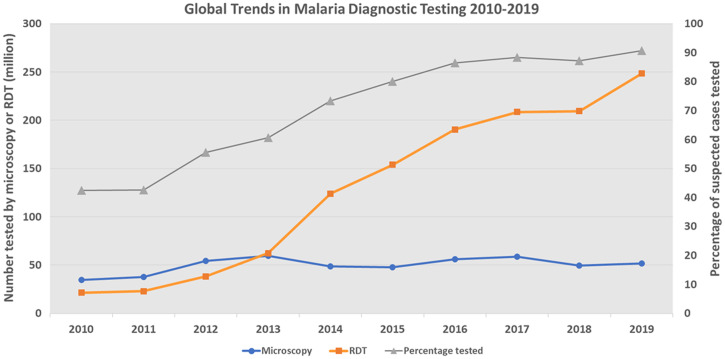
In 2010, the World Health Organization changed its guidance on malaria case management, recommending parasitological confirmation of all suspected cases before treatment with an antimalarial. This recommendation was in large part as a result of the availability of quality assured malaria rapid diagnostic tests (RDTs) that made it possible for malaria diagnosis to be performed by laboratory staff in all health facilities irrespective of the facility's place in the tiered health system. Community health workers and other non-laboratory health workers who traditionally did not perform malaria testing due to the technical and logistic demands of smear microscopy were now able to test for malaria. The use of RDTs has led to substantial increases in testing rates, improved quality of case management, as well as more accurate reporting of malaria cases. Although current RDTs have limitations, they remain one of the most important tools in contemporary malaria control. Further improvements to existing products, such as increased sensitivity for non-falciparum tests, diversification of Plasmodium falciparum antigen targets, along with strengthened health system support for current RDTs will further enhance their utility in malaria control and prevention.
2010 年,世界卫生组织改变了疟疾病例管理指南,建议在使用抗疟药物之前对所有疑似病例进行寄生虫学确认。这一建议在很大程度上是由于质量有保证的疟疾快速诊断检测(RDT)的出现,使得无论医疗机构在分层卫生系统中的位置如何,实验室工作人员都可以在所有卫生设施中进行疟疾诊断。由于涂片镜检的技术和后勤需求,传统上不进行疟疾检测的社区卫生工作者和其他非实验室卫生工作者现在能够进行疟疾检测。RDT 的使用导致检测率大幅提高,病例管理质量得到改善,疟疾病例报告更加准确。虽然目前的 RDT 有其局限性,但它们仍然是当代疟疾控制的最重要工具之一。进一步改进现有产品,例如提高非恶性疟检测的敏感性、多样化恶性疟原虫抗原靶标,以及加强对现有 RDT 的卫生系统支持,将进一步提高它们在疟疾控制和预防方面的效用。