Department of Veterinary Clinical Sciences, Faculty of Health and Medical Sciences (SUND), University of Copenhagen, Hoejbakkegaard Allé 5a, 2630, Taastrup, Denmark.
Section for Internal Medicine, Oncology and Clinical Pathology, Faculty of Health and Medical Sciences (SUND), University of Copenhagen, Dyrlaegevej 16, 1870, Frederiksberg C, Denmark.
BMC Vet Res. 2021 Nov 8;17(1):346. doi: 10.1186/s12917-021-03058-7.
Critically ill horses, such as horses with gastrointestinal (GI) disease, often suffer from hemostatic aberrations. Global hemostatic tests examining the initiation of coagulation, clot strength and fibrinolysis, such as the Calibrated Automated Thrombogram (CAT) and plasma-thromboelastography (TEG) have not been evaluated in horses. This study aimed to evaluate CAT and apply plasma-TEG in horses. Test performance of CAT was evaluated on equine platelet poor plasma with intra- and inter-assay variability (CV) and a heparin dilution curve. To examine clinical performance of both tests, group comparisons were assessed comparing healthy horses, horses with mild and severe GI disease with both CAT and plasma-TEG.
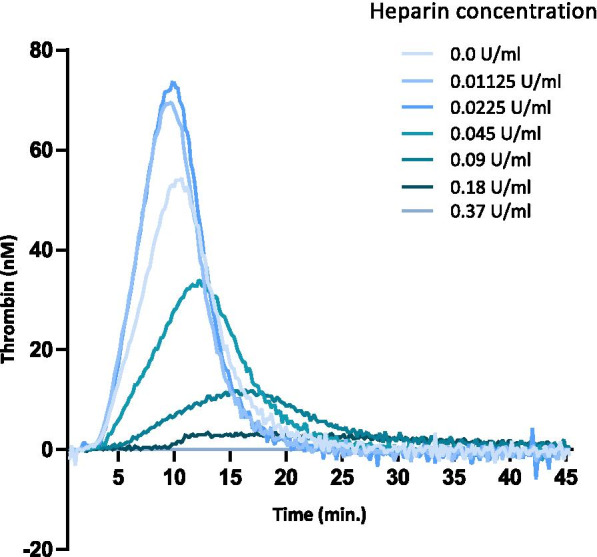
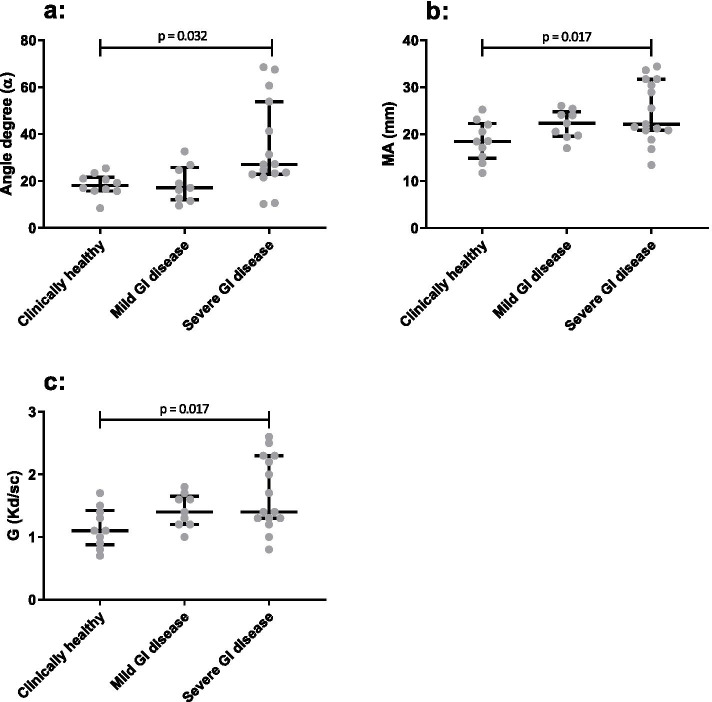
For CAT, intra- and inter-assay CVs were established for lag-time (1.7, 4.7%), endogenous thrombin potential (1.6, 4.6%), peak (2.6, 3.9%) and time to peak (ttPeak) (1.9, 3.4%). Increasing heparin concentrations led to the expected decrease in thrombin generation. In the group comparison analysis, CAT showed significant higher peak (p = 0.04) and ttPeak (p = 0.008) in the severe GI disease group compared to horses with mild GI disease and healthy horses, respectively. Plasma-TEG showed an increased angle (p = 0.032), maximum amplitude (p = 0.017) and shear elastic force (G) (p = 0.017) in the severe GI disease group compared to healthy horses.
CAT performed well in horses. Both CAT and plasma-TEG identified hemostatic aberrations in horses with severe GI disease compared to healthy horses. Further studies including more horses, are needed to fully appreciate the use of CAT and plasma-TEG in this species.
患有胃肠道 (GI) 疾病等重症的马常伴有止血异常。目前尚未对评估凝血起始、血凝块强度和纤维蛋白溶解的全血凝血检测,如 Calibrated Automated Thrombogram(CAT)和血栓弹力图(TEG),在马中进行评估。本研究旨在评估 CAT 并在马中应用血浆 TEG。采用内、外在变异系数(CV)和肝素稀释曲线评估 CAT 对马血小板缺乏血浆的检测性能。为了研究两种检测方法的临床性能,通过比较健康马、轻度和重度 GI 疾病马,评估 CAT 和血浆 TEG 的组间比较。
对于 CAT,建立了其Lag-time(1.7%、4.7%)、内源性凝血酶潜能(1.6%、4.6%)、最大振幅(2.6%、3.9%)和达峰时间(ttPeak)(1.9%、3.4%)的内、外在 CV。随着肝素浓度的增加,凝血酶生成呈预期下降。在组间比较分析中,与轻度 GI 疾病马和健康马相比,重度 GI 疾病马的 CAT 显示出显著更高的最大振幅(p=0.04)和 ttPeak(p=0.008)。与健康马相比,重度 GI 疾病马的血浆 TEG 显示出更高的角度(p=0.032)、最大振幅(p=0.017)和剪切弹性力(G)(p=0.017)。
CAT 在马中表现良好。与健康马相比,CAT 和血浆 TEG 均可识别重度 GI 疾病马的止血异常。需要进一步研究包括更多马的研究,以充分了解 CAT 和血浆 TEG 在该物种中的应用。