• 文献检索
  • 文档翻译
  • 深度研究
  • 学术资讯
  • Suppr Zotero 插件Zotero 插件
  • 邀请有礼
  • 套餐&价格
  • 历史记录
应用&插件
Suppr Zotero 插件Zotero 插件浏览器插件Mac 客户端Windows 客户端微信小程序
定价
高级版会员购买积分包购买API积分包
服务
文献检索文档翻译深度研究API 文档MCP 服务
关于我们
关于 Suppr公司介绍联系我们用户协议隐私条款
关注我们

Suppr 超能文献

核心技术专利:CN118964589B侵权必究
粤ICP备2023148730 号-1Suppr @ 2026

文献检索

告别复杂PubMed语法,用中文像聊天一样搜索,搜遍4000万医学文献。AI智能推荐,让科研检索更轻松。

立即免费搜索

文件翻译

保留排版,准确专业,支持PDF/Word/PPT等文件格式,支持 12+语言互译。

免费翻译文档

深度研究

AI帮你快速写综述,25分钟生成高质量综述,智能提取关键信息,辅助科研写作。

立即免费体验

护理专业学生将移动设备用作教育工具的障碍与促进因素:一项定性研究

Barriers and facilitators of using mobile devices as an educational tool by nursing students: a qualitative research.

作者信息

Nikpeyma Nasrin, Zolfaghari Mitra, Mohammadi Aeen

机构信息

Department of Community Health and Geriatric Nursing, School of Nursing and Midwifery, Tehran University of Medical Sciences, Tehran, Iran.

Department of eLearning in medical education, Virtual School of Tehran University of Medical Sciences, Naderi Street, Keshavarz Blvd, Tehran, Iran.

出版信息

BMC Nurs. 2021 Nov 10;20(1):226. doi: 10.1186/s12912-021-00750-9.

DOI:10.1186/s12912-021-00750-9
PMID:34753476
原文链接:https://pmc.ncbi.nlm.nih.gov/articles/PMC8579623/
Abstract

BACKGROUND

Although the use of mobile devices can facilitate the learning process, there may be barriers to using them for learning purposes. This study aimed to identify and investigate the barriers and facilitators of using mobile devices as an educational device from the perspective of nursing students.

METHODS

This qualitative descriptive study was conducted in 2020 on undergraduate nursing students of the Nursing and Midwifery Faculty, Tehran University of Medical Sciences. A total of 22 undergraduate nursing students were selected by purposive sampling with maximum variability. Inclusion criteria were Undergraduate nursing education, having mobile devices, and willingness to participate in research. Data were collected through semi-structured individual interviews for 45-75 min in the proposed environment of students until the data were saturated. Data analysis was performed manually using the framework analysis method with the steps: familiarization, identifying a thematic framework, indexing, Charting and Synthesis, Mapping, and Interpretation. Trustworthiness was determined by methods of Credibility, Dependability, Conformability, and Transferability.

RESULTS

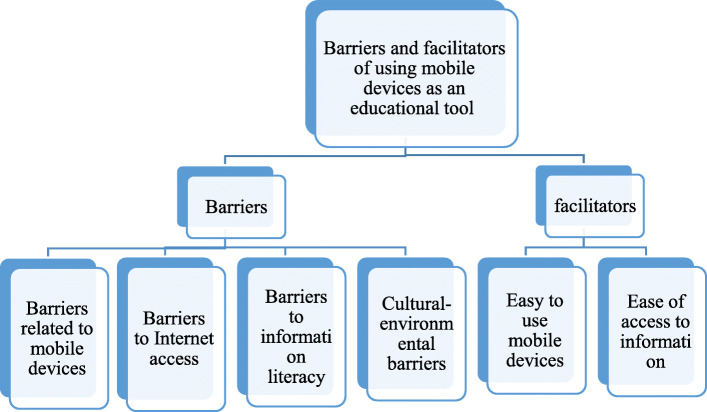
The majority of participants (45.45%) were 21 years old, 63.63% were women, and 36.36% studied in the 8th semester. Findings from the analysis of interviews showed that barriers to the use of mobile devices were classified into 4 main categories (barriers related to mobile devices, barriers related to Internet access, barriers related to information literacy, cultural-environmental barriers) and 15 subcategories, and facilitating the use of mobile devices was divided into 2 main categories (easy to use mobile devices and easy access to information) and 6 subcategories.

CONCLUSION

The results of this study help educational managers and curriculum planners to adapt to technological change, to focus on the many benefits of mobile devices as an educational tool, and to plan to overcome barriers to mobile device use, and use mobile devices to teach theoretical topics and clinical nursing skills effectively.

摘要

背景

尽管使用移动设备可以促进学习过程,但将其用于学习目的可能存在障碍。本研究旨在从护理专业学生的角度识别和调查将移动设备用作教育工具的障碍和促进因素。

方法

本定性描述性研究于2020年对德黑兰医科大学护理与助产学院的本科护理专业学生进行。通过最大变异性的目的抽样法共选取了22名本科护理专业学生。纳入标准为本科护理教育、拥有移动设备且愿意参与研究。在学生指定的环境中通过半结构化个人访谈收集数据,访谈时长为45 - 75分钟,直至数据饱和。使用框架分析法手动进行数据分析,步骤包括:熟悉、确定主题框架、索引、图表绘制与综合、映射和解释。通过可信度、可靠性、一致性和可转移性方法确定可信度。

结果

大多数参与者(45.45%)年龄为21岁,63.63%为女性,36.36%在第8学期学习。访谈分析结果表明,使用移动设备的障碍分为4个主要类别(与移动设备相关的障碍、与互联网接入相关的障碍、与信息素养相关的障碍、文化环境障碍)和15个子类别,而促进移动设备使用分为2个主要类别(移动设备易于使用和信息易于获取)和6个子类别。

结论

本研究结果有助于教育管理人员和课程规划者适应技术变革,关注移动设备作为教育工具的诸多益处,规划克服移动设备使用障碍,并利用移动设备有效教授理论主题和临床护理技能。
https://cdn.ncbi.nlm.nih.gov/pmc/blobs/c3dc/8579623/669f2b87943c/12912_2021_750_Fig1_HTML.jpg

相似文献

1
Barriers and facilitators of using mobile devices as an educational tool by nursing students: a qualitative research.护理专业学生将移动设备用作教育工具的障碍与促进因素:一项定性研究
BMC Nurs. 2021 Nov 10;20(1):226. doi: 10.1186/s12912-021-00750-9.
2
Barriers and facilitators to fulfilling the teaching assistant role from nursing students' perspective: a qualitative study.从护生视角看履行教学助理角色的障碍与促进因素:一项定性研究
BMC Nurs. 2024 Jan 12;23(1):39. doi: 10.1186/s12912-023-01645-7.
3
Exploration of the affordances of mobile devices in integrating theory and clinical practice in an undergraduate nursing programme.探索移动设备在本科护理课程中将理论与临床实践相结合方面的作用。
Curationis. 2015;38(2):e1-e10. doi: 10.4102/curationis.v38i2.1510. Epub 2015 Sep 28.
4
Student and educator experiences of maternal-child simulation-based learning: a systematic review of qualitative evidence protocol.基于母婴模拟学习的学生和教育工作者体验:定性证据协议的系统评价
JBI Database System Rev Implement Rep. 2015 Jan;13(1):14-26. doi: 10.11124/jbisrir-2015-1694.
5
Experiences of undergraduate nursing students on an authentic mobile learning enactment at a higher education institution in South Africa.南非一高等教育机构真实移动学习情境下本科护生的体验。
Nurse Educ Today. 2019 Mar;74:69-75. doi: 10.1016/j.nedt.2018.11.021. Epub 2018 Dec 11.
6
Smartphones and mobile applications (apps) in clinical nursing education: A student perspective.智能手机与移动应用程序在临床护理教育中的应用:学生视角。
Nurse Educ Today. 2018 Oct;69:172-178. doi: 10.1016/j.nedt.2018.07.013. Epub 2018 Aug 1.
7
Through the eyes of the student: Best practices in clinical facilitation.从学生视角看:临床指导的最佳实践
Curationis. 2017 Aug 28;40(1):e1-e8. doi: 10.4102/curationis.v40i1.1787.
8
Experience of nursing students about the barriers to patient education: a qualitative study in Iran.护理专业学生对患者教育障碍的体验:伊朗的一项定性研究
Korean J Med Educ. 2018 Dec;30(4):327-337. doi: 10.3946/kjme.2018.107. Epub 2018 Dec 1.
9
The Role of Students with Practical Nursing Diplomas in the Process of Undergraduate Nursing Education: A Qualitative Study.持有实用护理文凭的学生在本科护理教育过程中的作用:一项定性研究。
Iran J Nurs Midwifery Res. 2019 Dec 27;25(1):76-83. doi: 10.4103/ijnmr.IJNMR_38_19. eCollection 2020 Jan-Feb.
10
Opportunities and Challenges of E-learning for Nursing Students at the Beginning of the COVID-19 Pandemic in Iran: A Qualitative Content Analysis.伊朗新冠疫情初期护理专业学生在线学习的机遇与挑战:一项质性内容分析
Iran J Nurs Midwifery Res. 2024 Mar 26;29(2):180-186. doi: 10.4103/ijnmr.ijnmr_133_21. eCollection 2024 Mar-Apr.

引用本文的文献

1
Mobile devices for developing nursing students' professional skills: scoping review.移动设备在培养护理学生专业技能中的应用:范围综述。
Rev Lat Am Enfermagem. 2024 Sep 23;32:e4371. doi: 10.1590/1518-8345.7383.4371. eCollection 2024.
2
The Effectiveness of Mobile Applications in Improving Nursing Students' Knowledge Related to Pressure Injury Prevention.移动应用程序在提高护理专业学生预防压力性损伤相关知识方面的有效性。
Healthcare (Basel). 2024 Jun 26;12(13):1264. doi: 10.3390/healthcare12131264.
3
Dementia Education for Workforce Excellence: Evaluation of a Novel Bichronous Approach.

本文引用的文献

1
Effects of Smartphone-Based Mobile Learning in Nursing Education: A Systematic Review and Meta-analysis.基于智能手机的移动学习在护理教育中的效果:一项系统评价与荟萃分析。
Asian Nurs Res (Korean Soc Nurs Sci). 2019 Feb;13(1):20-29. doi: 10.1016/j.anr.2019.01.005. Epub 2019 Jan 16.
2
Mobile learning in medicine: an evaluation of attitudes and behaviours of medical students.移动学习在医学中的应用:对医学生态度和行为的评估。
BMC Med Educ. 2018 Jun 27;18(1):152. doi: 10.1186/s12909-018-1264-5.
3
Barriers and solutions to online learning in medical education - an integrative review.
卓越劳动力的痴呆症教育:一种新型双时同步方法的评估。
Healthcare (Basel). 2024 Mar 5;12(5):590. doi: 10.3390/healthcare12050590.
4
Including audience response systems in debriefing. A mixed study during nursing simulation-based learning.在汇报中纳入观众反应系统。一项基于护理模拟学习的混合研究。
BMC Nurs. 2023 Oct 3;22(1):353. doi: 10.1186/s12912-023-01499-z.
5
Mobile technology acceptance among undergraduate nursing students instructed by blended learning at selected educational institutions in South India.印度南部部分教育机构采用混合式学习指导本科护理专业学生对移动技术的接受情况。
J Educ Health Promot. 2023 Feb 28;12:45. doi: 10.4103/jehp.jehp_488_22. eCollection 2023.
6
Perceptions of Retired Nurses on Factors Preventing Younger Professional Nurses from Applying the Ethos of Ubuntu in Professional Care.退休护士对阻碍年轻专业护士在专业护理中践行乌班图精神的因素的看法
SAGE Open Nurs. 2022 Apr 12;8:23779608221091072. doi: 10.1177/23779608221091072. eCollection 2022 Jan-Dec.
医学教育中在线学习的障碍及解决方案——综合述评。
BMC Med Educ. 2018 Jun 7;18(1):130. doi: 10.1186/s12909-018-1240-0.
4
The Effects of an Interactive Nursing Skills Mobile Application on Nursing Students' Knowledge, Self-efficacy, and Skills Performance: A Randomized Controlled Trial.一款交互式护理技能移动应用程序对护生知识、自我效能感和技能表现的影响:一项随机对照试验
Asian Nurs Res (Korean Soc Nurs Sci). 2018 Mar;12(1):17-25. doi: 10.1016/j.anr.2018.01.001. Epub 2018 Jan 12.
5
Student Perceptions and Acceptance of Mobile Technology in an Undergraduate Nursing Program.本科护理专业学生对移动技术的认知与接受情况
Healthcare (Basel). 2017 Jul 21;5(3):35. doi: 10.3390/healthcare5030035.
6
The effect of Personal Digital Assistants in supporting the development of clinical reasoning in undergraduate nursing students: a systematic review.个人数字助理对本科护理专业学生临床推理能力发展的支持作用:一项系统综述。
JBI Libr Syst Rev. 2011;9(2):38-68. doi: 10.11124/01938924-201109020-00001.
7
Use of Smartphones With Undergraduate Nursing Students.智能手机在本科护理专业学生中的应用。
J Nurs Educ. 2016 Jul 1;55(7):411-5. doi: 10.3928/01484834-20160615-11.
8
Use of mobile devices in nursing student-nurse teacher cooperation during the clinical practicum: an integrative review.临床实习期间移动设备在护生与带教老师合作中的应用:一项综合综述
Nurse Educ Today. 2015 Mar;35(3):493-9. doi: 10.1016/j.nedt.2014.10.007. Epub 2014 Nov 4.
9
Nursing students' experience of using a personal digital assistant (PDA) in clinical practice - an intervention study.护理专业学生在临床实践中使用个人数字助理(PDA)的体验——一项干预性研究。
Nurse Educ Today. 2013 Oct;33(10):1246-51. doi: 10.1016/j.nedt.2012.08.019. Epub 2012 Sep 20.
10
The use of the Personal Digital Assistant (PDA) among personnel and students in health care: a review.医疗保健领域人员和学生使用个人数字助理(PDA)的情况综述。
J Med Internet Res. 2008 Oct 28;10(4):e31. doi: 10.2196/jmir.1038.