Department of Chemistry, Indiana University, 800 E. Kirkwood Ave, Bloomington, IN 47405-7102, USA.
Department of Molecular and Cellular Biochemistry, Indiana University, 212 S. Hawthorne Drive, Bloomington, IN 47405 USA.
Nucleic Acids Res. 2021 Dec 2;49(21):12556-12576. doi: 10.1093/nar/gkab1040.
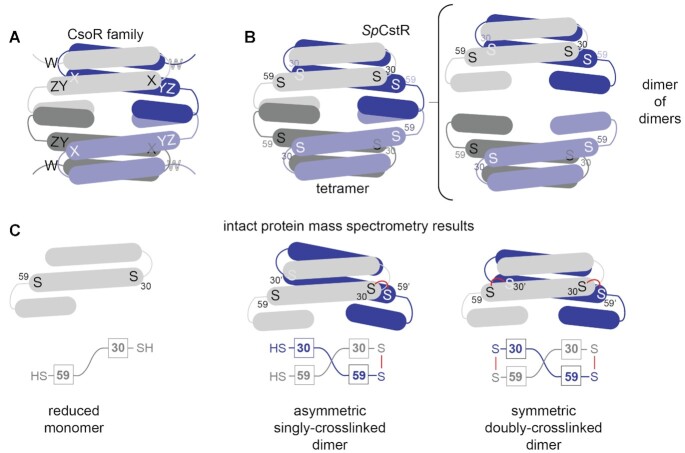
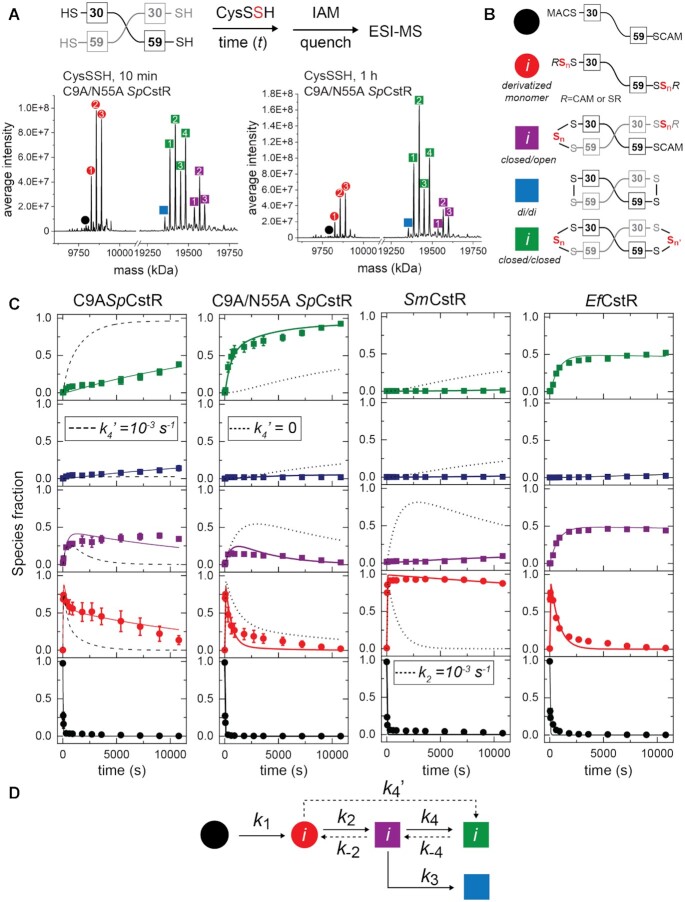
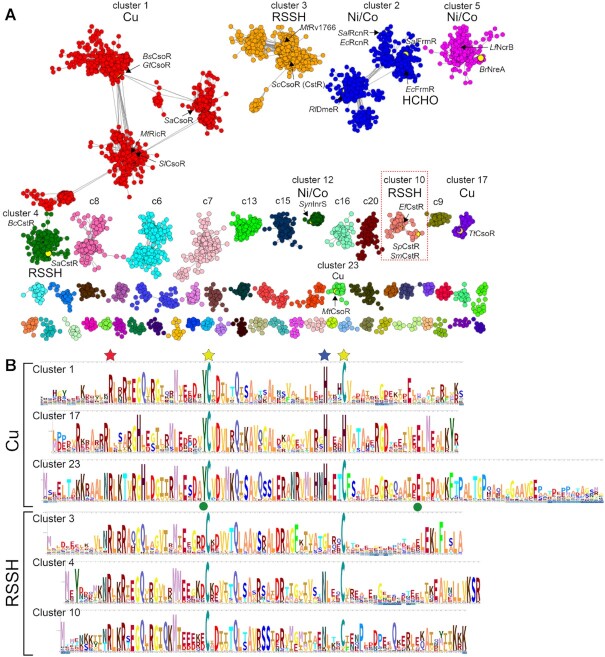
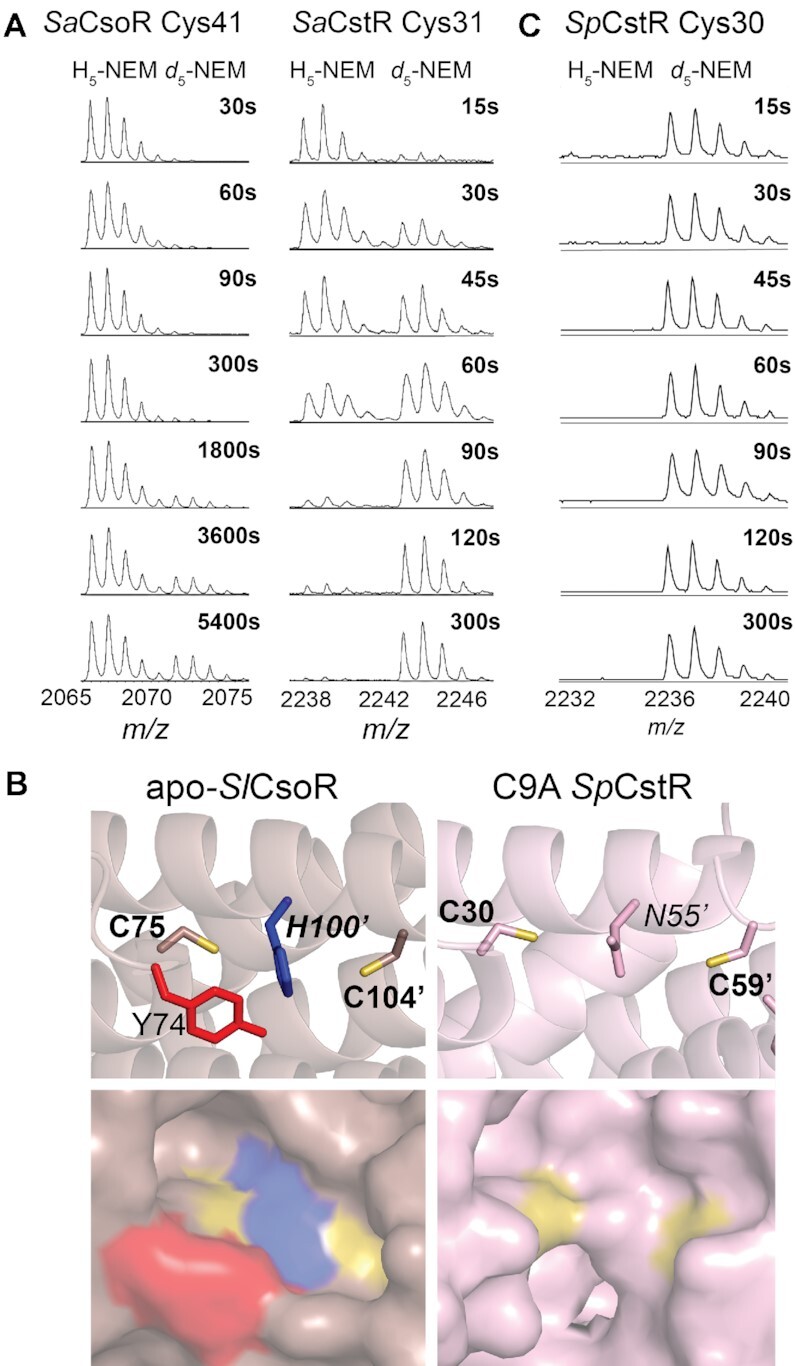
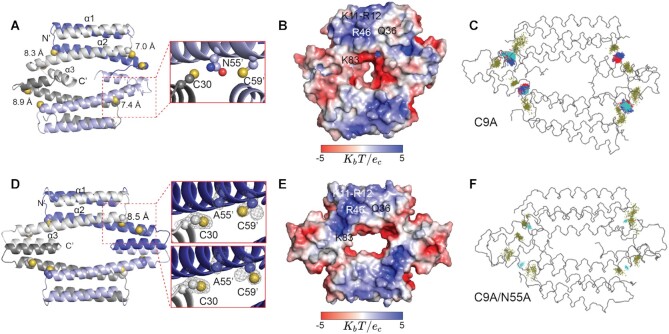
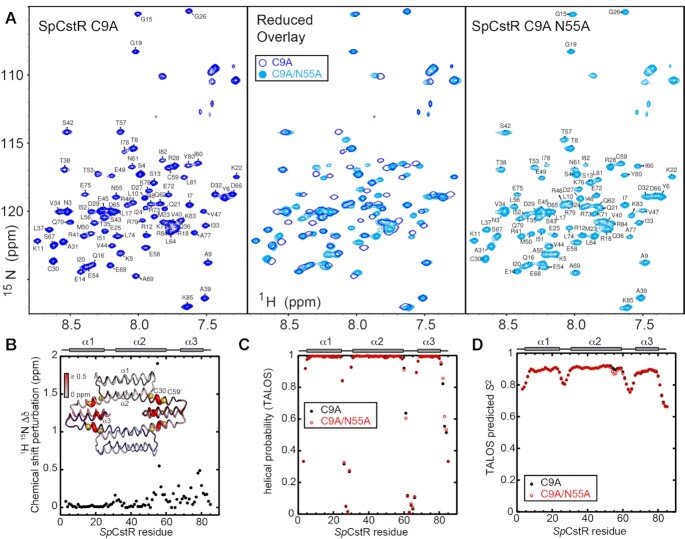
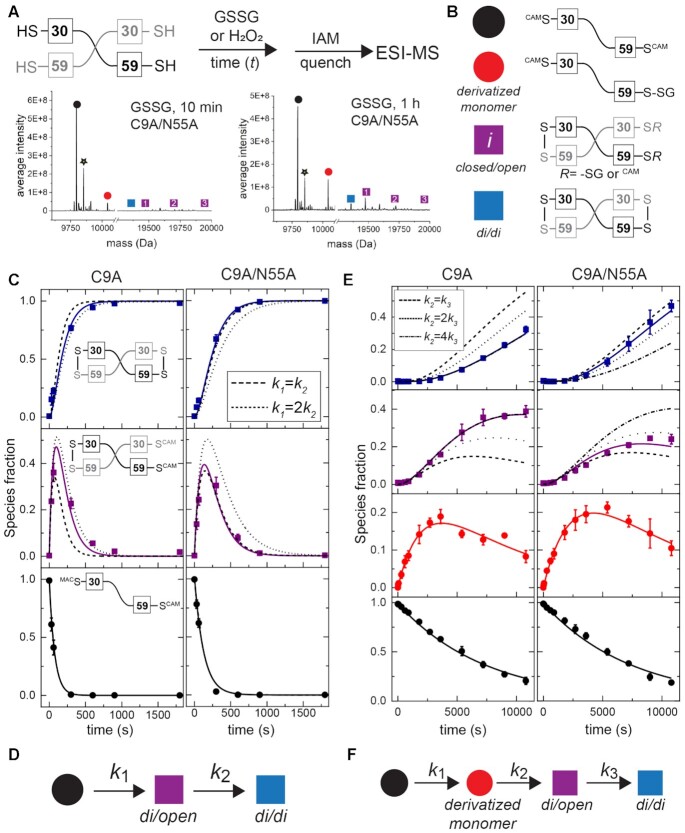
CstR is a persulfide-sensing member of the functionally diverse copper-sensitive operon repressor (CsoR) superfamily. While CstR regulates the bacterial response to hydrogen sulfide (H2S) and more oxidized reactive sulfur species (RSS) in Gram-positive pathogens, other dithiol-containing CsoR proteins respond to host derived Cu(I) toxicity, sometimes in the same bacterial cytoplasm, but without regulatory crosstalk in cells. It is not clear what prevents this crosstalk, nor the extent to which RSS sensors exhibit specificity over other oxidants. Here, we report a sequence similarity network (SSN) analysis of the entire CsoR superfamily, which together with the first crystallographic structure of a CstR and comprehensive mass spectrometry-based kinetic profiling experiments, reveal new insights into the molecular basis of RSS specificity in CstRs. We find that the more N-terminal cysteine is the attacking Cys in CstR and is far more nucleophilic than in a CsoR. Moreover, our CstR crystal structure is markedly asymmetric and chemical reactivity experiments reveal the functional impact of this asymmetry. Substitution of the Asn wedge between the resolving and the attacking thiol with Ala significantly decreases asymmetry in the crystal structure and markedly impacts the distribution of species, despite adopting the same global structure as the parent repressor. Companion NMR, SAXS and molecular dynamics simulations reveal that the structural and functional asymmetry can be traced to fast internal dynamics of the tetramer. Furthermore, this asymmetry is preserved in all CstRs and with all oxidants tested, giving rise to markedly distinct distributions of crosslinked products. Our exploration of the sequence, structural, and kinetic features that determine oxidant-specificity suggest that the product distribution upon RSS exposure is determined by internal flexibility.
CstR 是功能多样的铜敏感操纵子阻遏物(CsoR)超家族中一种过硫化物感应成员。虽然 CstR 调节革兰氏阳性病原体对硫化氢(H2S)和更氧化的活性硫物种(RSS)的细菌反应,但其他含二硫键的 CsoR 蛋白会对宿主衍生的 Cu(I)毒性做出反应,有时在同一细菌细胞质中,但在细胞中没有调节串扰。目前尚不清楚是什么阻止了这种串扰,也不清楚 RSS 传感器在多大程度上对其他氧化剂表现出特异性。在这里,我们报告了整个 CsoR 超家族的序列相似性网络(SSN)分析,该分析连同 CstR 的第一个晶体结构和基于全面质谱的动力学分析实验,揭示了 CstR 中 RSS 特异性的分子基础的新见解。我们发现,更靠近 N 端的半胱氨酸是 CstR 中的攻击半胱氨酸,比 CsoR 中的半胱氨酸更具亲核性。此外,我们的 CstR 晶体结构明显不对称,化学反应性实验揭示了这种不对称性的功能影响。用丙氨酸取代分辨硫醇和攻击硫醇之间的天冬酰胺楔形,尽管采用与亲本阻遏物相同的全局结构,但显著降低了晶体结构中的不对称性,并显著影响了物种的分布。伴随的 NMR、SAXS 和分子动力学模拟表明,结构和功能的不对称性可以追溯到四聚体的快速内部动力学。此外,这种不对称性在所有 CstR 中都存在,并且在所测试的所有氧化剂中都存在,导致交联产物的分布明显不同。我们对决定氧化剂特异性的序列、结构和动力学特征的探索表明,RSS 暴露后产物的分布取决于内部灵活性。