Division of Microbiology, Sidra Medicine, Doha, Qatar.
Weill Cornell Medical College in Qatar, Doha, Qatar.
Microbiol Spectr. 2021 Dec 22;9(3):e0112221. doi: 10.1128/Spectrum.01122-21. Epub 2021 Nov 10.
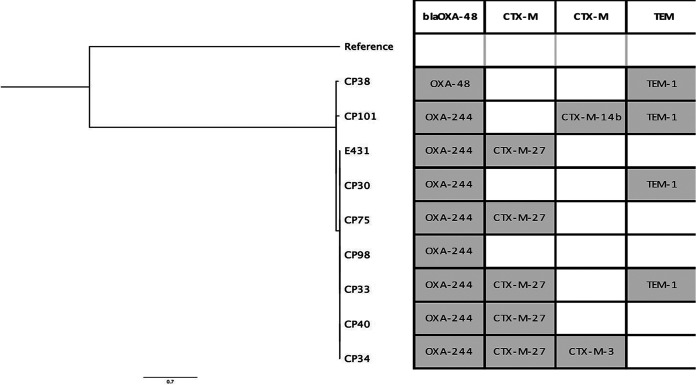
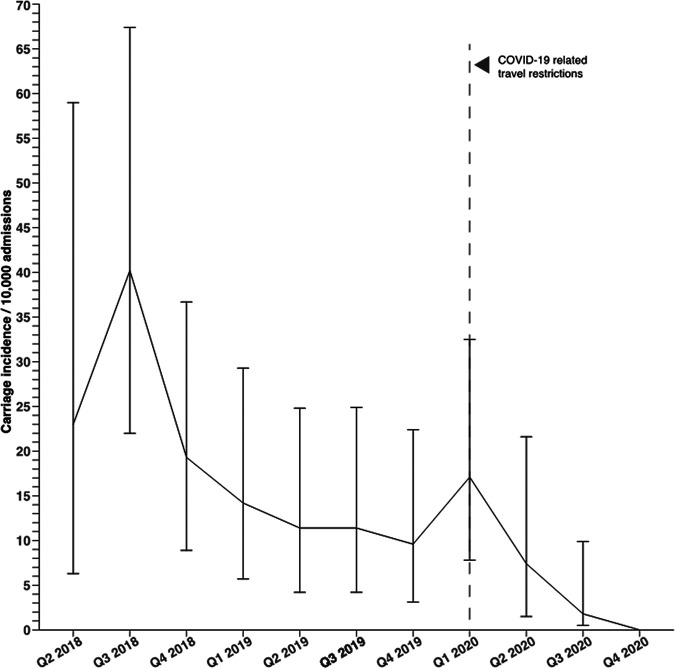
Whole-genome sequencing was used to characterize carbapenemase-producing (CPE) strains recovered from rectal screening swab samples obtained from children at a tertiary-care pediatric hospital in Qatar during a 3-year period. A total of 72 CPE isolates recovered from 61 fecal carriers were characterized. Escherichia coli (47 isolates [65.3%]) and Klebsiella pneumoniae (22 isolates [30.6%]) were the most common species identified. High levels of genetic diversity were observed for both species. These 72 isolates produced 78 carbapenemases, characterized as either NDM-type (41 enzymes [52.6%]) or OXA-48-type (37 enzymes [47.4%]). NDM-5 (24 enzymes [30.8%]), NDM-1 (15 enzymes [19.2%]), and OXA-181 (15 enzymes [19.2%]) were the most common variants detected within each type. Twenty-three NDM producers exhibited difficult-to-treat resistance, compared with only 2 of the OXA-48 producers. Multiple comorbidities were identified in 88.5% of the patients, whereas recent travel history to countries in which CPE are endemic was documented for 57.4% of the patients. All 9 -type-gene-containing E. coli sequence type 38 (ST38) strains were isolated from patients without international travel history. The mean quarterly incidence of fecal carriage decreased more than 6-fold after the implementation of coronavirus disease 2019 (COVID-19)-related international travel restrictions in Qatar in mid-March 2020. Our data suggest that NDM-type and OXA-48-type carbapenemases expressed by a large diversity of E. coli and K. pneumoniae genotypes are largely dominant in the pediatric population of Qatar. Although our data indicate successful local expansion of E. coli ST38 strains harboring genes, at least within health care settings, type and type genes appear to have been mainly introduced sporadically by asymptomatic carriers who visited or received health care in some nearby countries in which the genes are endemic. To the best of our knowledge, this is the first study addressing the molecular characteristics of CPE in a pediatric population in Qatar using whole-genome sequencing. Since several countries in the Arabian Peninsula share relatively similar demographic patterns and international links, it is plausible that the molecular characteristics of CPE in children, at least in the middle and eastern parts of the region, are similar to those observed in our study.
对卡塔尔一家三级儿童医院直肠筛查拭子样本中分离的碳青霉烯酶产生菌(CPE)进行全基因组测序,以对其进行特征分析。在 3 年期间,从 61 名粪便携带者中分离出 72 株 CPE 。鉴定出的最常见的物种为大肠埃希菌(47 株[65.3%])和肺炎克雷伯菌(22 株[30.6%])。这两个物种的遗传多样性水平都很高。这 72 株分离株产生了 78 种碳青霉烯酶,可分为 NDM 型(41 种酶[52.6%])或 OXA-48 型(37 种酶[47.4%])。检测到的每种类型中最常见的变体是 NDM-5(24 种酶[30.8%])、NDM-1(15 种酶[19.2%])和 OXA-181(15 种酶[19.2%])。与仅 2 株 OXA-48 产生菌相比,23 株 NDM 产生菌表现出治疗困难的耐药性。88.5%的患者存在多种合并症,57.4%的患者有近期前往碳青霉烯酶流行国家的旅行史。所有 9 种-型基因携带的大肠埃希菌 ST38 菌株均从无国际旅行史的患者中分离得到。2020 年 3 月中旬,卡塔尔实施与 2019 年冠状病毒病(COVID-19)相关的国际旅行限制后,粪便携带的季度发生率平均下降了 6 倍以上。我们的数据表明,由不同大肠埃希菌和肺炎克雷伯菌基因型表达的 NDM 型和 OXA-48 型碳青霉烯酶在卡塔尔儿科人群中占主导地位。尽管我们的数据表明,至少在医疗机构内,基因携带的大肠埃希菌 ST38 菌株的本地成功扩张,但类型和类型基因似乎主要是由访问或在一些附近基因流行的国家接受医疗保健的无症状携带者偶然引入的。据我们所知,这是第一项使用全基因组测序研究卡塔尔儿科人群中 CPE 的分子特征的研究。由于阿拉伯半岛的几个国家在人口统计学模式和国际联系方面相对相似,因此该地区儿童中 CPE 的分子特征至少在该地区的中东部地区与我们的研究观察到的特征相似是合理的。