Department of Political Science, Harpur College of Arts and Sciences, Binghamton University, Binghamton, New York.
Department of Politics, College of Social Sciences and International Studies, University of Exeter, Exeter, United Kingdom.
Am J Prev Med. 2022 Mar;62(3):433-437. doi: 10.1016/j.amepre.2021.09.003. Epub 2021 Oct 11.
This study connects the aggregate strength of public health policies taken in response to the COVID-19 pandemic in the U.S. states to the governors' party affiliations and to state-level outcomes. Understanding the relationship between politics and public health measures can better prepare American communities for what to expect from their governments in a future crisis and encourage advocacy for delegating public health decisions to medical professionals.
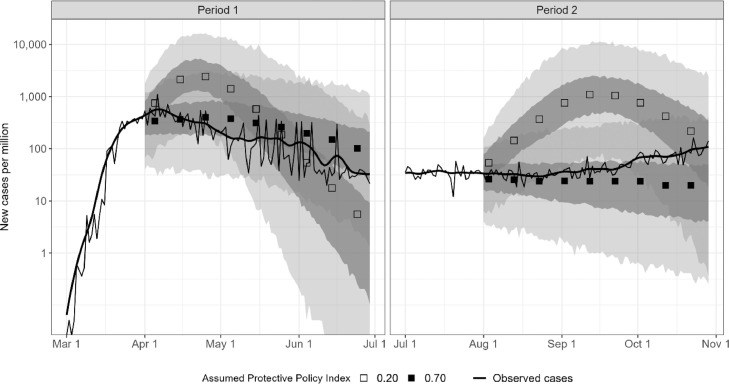
The public health Protective Policy Index captures the strength of policy response to COVID-19 at the state level. The authors estimated a Bayesian model that links the rate of disease spread to Protective Policy Index. The model also accounted for the possible state-specific undercounting of cases and controls for state population density, poverty, number of physicians, cardiovascular disease, asthma, smoking, obesity, age, racial composition, and urbanization. A Bayesian linear model with natural splines of time was employed to link the dynamics of Protective Policy Index to governors' party affiliations.
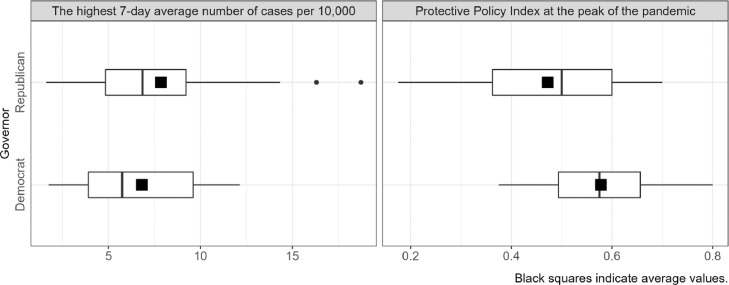
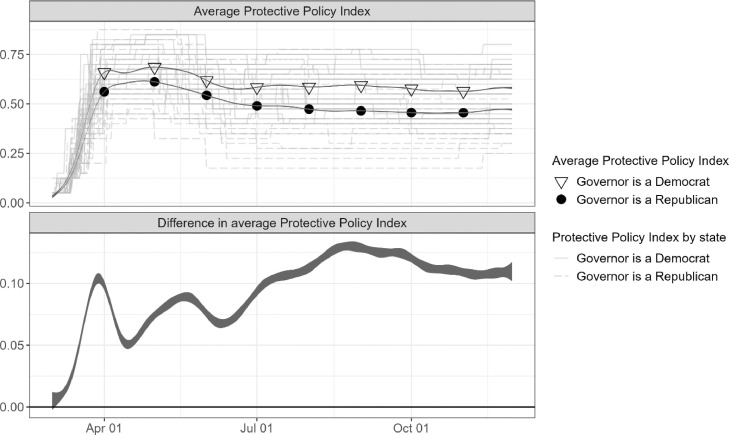
A 10-percentage point decrease in Protective Policy Index was associated with an 8% increase in the expected number of new cases. Between late March and November 2020 and at the state-specific peaks of the pandemic, the Protective Policy Index in the states with Democratic governors was about 10‒percentage points higher than in the states with Republican governors.
Public health measures were stricter in the Democrat-led states, and stricter public health measures were associated with a slower growth of COVID-19 cases. The apparent politicization of public health measures suggests that public health decision making by health professionals rather than by political incumbents could be beneficial.
本研究将美国各州应对 COVID-19 大流行的公共卫生政策的总体力度与州长的党派关系和州级结果联系起来。了解政治与公共卫生措施之间的关系,可以让美国社区更好地为未来的危机做好准备,期待政府采取什么措施,并鼓励将公共卫生决策委托给医疗专业人员。
公共卫生保护政策指数(Public Health Protective Policy Index)捕捉了州一级应对 COVID-19 的政策力度。作者估计了一个贝叶斯模型,将疾病传播率与保护政策指数联系起来。该模型还考虑了病例和对照的州特定漏报情况,并控制了州人口密度、贫困、医生人数、心血管疾病、哮喘、吸烟、肥胖、年龄、种族构成和城市化水平。采用具有自然样条时间的贝叶斯线性模型将保护政策指数的动态与州长的党派关系联系起来。
保护政策指数下降 10 个百分点,预计新病例数增加 8%。在 2020 年 3 月下旬至 11 月期间,以及大流行的各州特定高峰期,民主党领导的州的保护政策指数比共和党领导的州高出约 10 个百分点。
在民主党领导的州,公共卫生措施更为严格,更严格的公共卫生措施与 COVID-19 病例的增长速度较慢有关。公共卫生措施明显的政治化表明,由卫生专业人员而不是政治当权者做出公共卫生决策可能是有益的。