Dornsife School of Public Health, Drexel University, Philadelphia, Pennsylvania.
JAMA Netw Open. 2021 Nov 1;4(11):e2133857. doi: 10.1001/jamanetworkopen.2021.33857.
Disparities in medical home provisions, including receipt of family-centered care (FCC), have persisted for Latinx youths in the US.
To examine the association between maternal-clinician ethnic concordance and receipt of FCC among US-born Latinx youths.
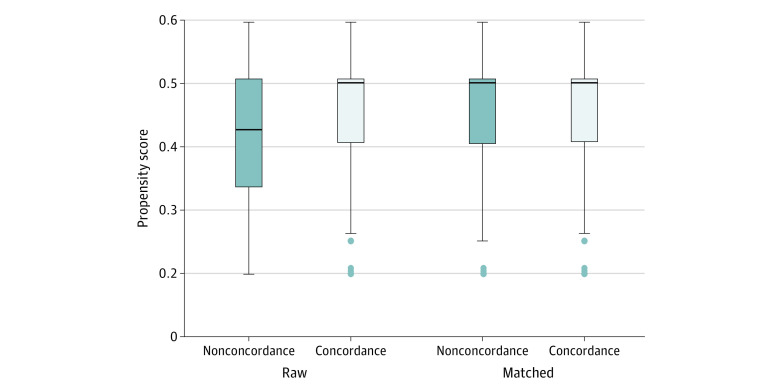
DESIGN, SETTING, AND PARTICIPANTS: A cross-sectional secondary analysis of data from the Medical Expenditure Panel Survey from January 1, 2010, to December 31, 2017, was conducted. Data analysis was performed from January 6 to February 3, 2020. Latinx youths (age, ≤17 years) born in the US who had a usual source of care and used care in the past year, their Latina mothers (age, 18-64 years), and youths' health care clinician characteristics (eg, race, ethnicity, and sex) were evaluated using χ2 tests and propensity-score matching methods.
Maternal reports on whether their youths' clinician listened carefully to the parent, explained things in a way the parent could understand, showed respect, and spent enough time with the patient.
There were 2515 US-born Latinx youths with linked maternal characteristics during the study period; 51.67% (95% CI, 48.87%-54.45%) of the youths were male, mean (SD) age was 8.48 (0.17) years (30.86% [95% CI, 28.39%-33.44%] were between ages 5 and 9 years), 61.53% (95% CI, 57.15%-65.74%) had public insurance coverage, and 39.89% (95% CI, 32.33%-47.89%) had mothers who were ethnically concordant with the youths' medical care clinician. We found that for youths with maternal-clinician ethnic concordance, the probabilities of reporting FCC were significantly higher than they would have been in the absence of concordance: that the medical care clinician listened carefully to the parent (average treatment effect on the treated [ATET], 5.44%; 95% CI, 2.14%-8.74%), explained things in a way the parent could understand (ATET, 4.82%; 95% CI, 1.60%-8.03%), showed respect for what the parent had to say (ATET, 5.51%; 95% CI, 2.58%-8.45%), and spent enough time with the patient (ATET, 5.28%; 95% CI, 1.68%-8.88%).
Given the increase of Latinx populations and the simultaneous shortage of underrepresented minority health care clinicians, the findings of this study suggest that increasing the number of clinicians from underrepresented minority backgrounds and ethnic-concordant parental-clinician relationships may help reduce disparities in receipt of medical home provision among US-born Latinx youths.
在美国,拉丁裔青年在医疗之家的规定方面存在差异,包括获得以家庭为中心的护理(FCC)。
研究美国出生的拉丁裔青年中母亲与临床医生的种族一致性与接受 FCC 之间的关系。
设计、地点和参与者:对 2010 年 1 月 1 日至 2017 年 12 月 31 日期间医疗支出面板调查数据的横断面二次分析,数据分析于 2020 年 1 月 6 日至 2 月 3 日进行。评估了拉丁裔青年(年龄≤17 岁)的常规护理来源和过去一年的护理使用情况、他们的拉丁裔母亲(年龄 18-64 岁)以及青年保健临床医生的特征(例如种族、族裔和性别)使用卡方检验和倾向评分匹配方法。
母亲报告他们的孩子的临床医生是否认真听取父母的意见、以父母能理解的方式解释事情、表现出尊重并与患者充分相处。
在研究期间,有 2515 名有相关母亲特征的美国出生的拉丁裔青年;51.67%(95%CI,48.87%-54.45%)的青年为男性,平均(SD)年龄为 8.48(0.17)岁(30.86%[95%CI,28.39%-33.44%]在 5 至 9 岁之间),61.53%(95%CI,57.15%-65.74%)有公共保险覆盖,39.89%(95%CI,32.33%-47.89%)的母亲与青年医疗保健临床医生的种族一致。我们发现,对于与临床医生种族一致的青年,报告 FCC 的可能性明显高于没有一致时的可能性:临床医生认真听取父母的意见(平均治疗效果(ATTET),5.44%;95%CI,2.14%-8.74%),以父母能理解的方式解释事情(ATTET,4.82%;95%CI,1.60%-8.03%),对父母的意见表示尊重(ATTET,5.51%;95%CI,2.58%-8.45%),并与患者充分相处(ATTET,5.28%;95%CI,1.68%-8.88%)。
鉴于拉丁裔人口的增加和代表性不足的少数族裔医疗保健临床医生的同时短缺,本研究的结果表明,增加来自代表性不足的少数族裔背景的临床医生数量和父母与临床医生的种族一致性关系可能有助于减少美国出生的拉丁裔青年在获得医疗之家服务方面的差异。