State Key Laboratory of Integrated Management of Pest Insects and Rodents, Institute of Zoology, Chinese Academy of Sciences, 100101, Beijing, China.
CAS Center for Excellence in Biotic Interactions, University of Chinese Academy of Sciences, 100101, Beijing, China.
Signal Transduct Target Ther. 2021 Nov 10;6(1):389. doi: 10.1038/s41392-021-00797-9.
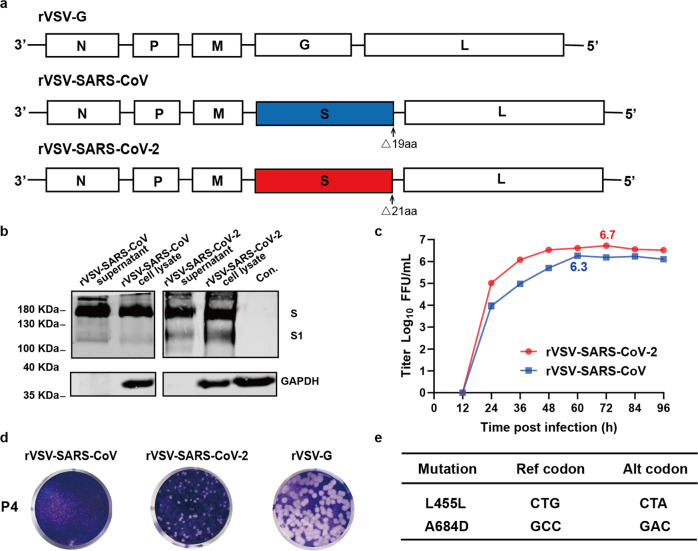
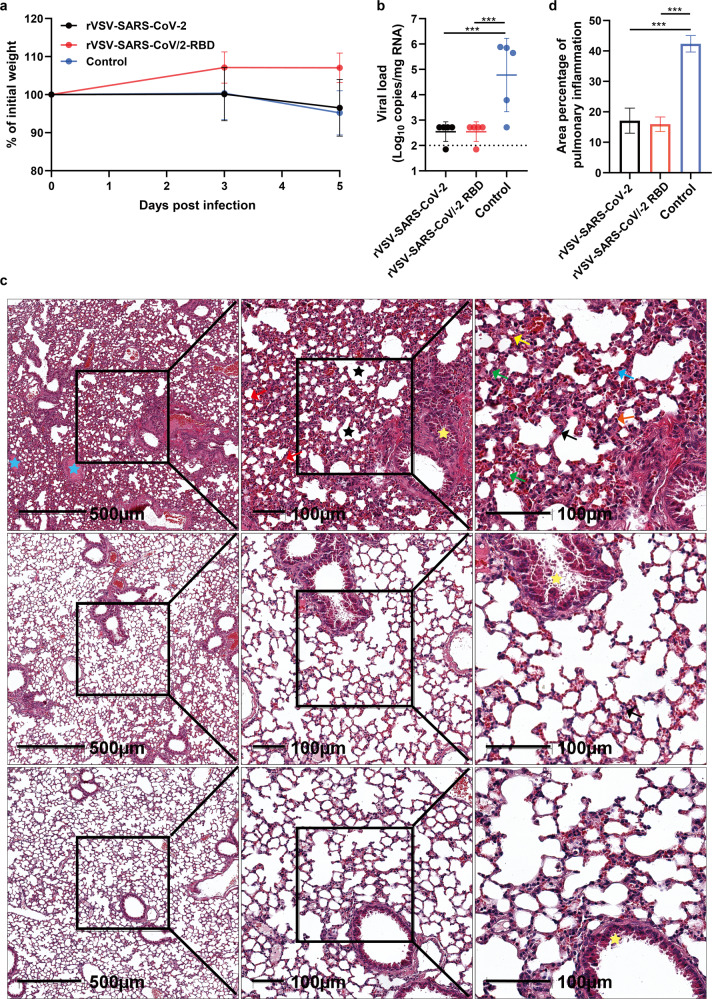
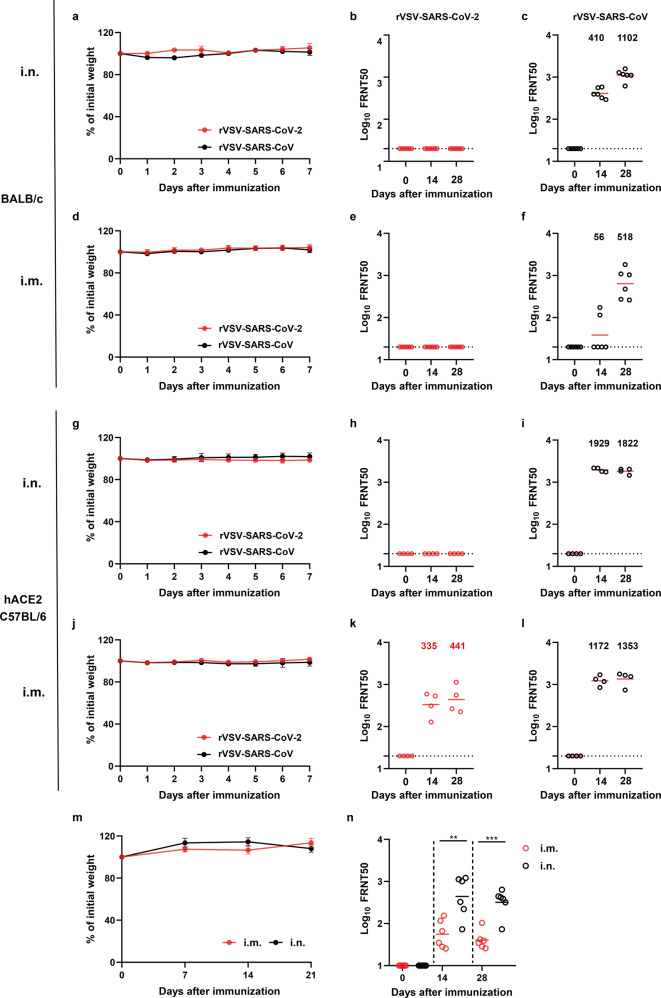
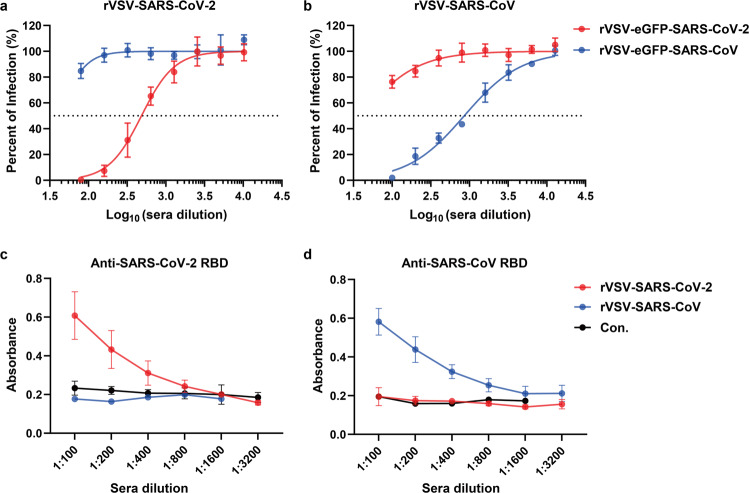
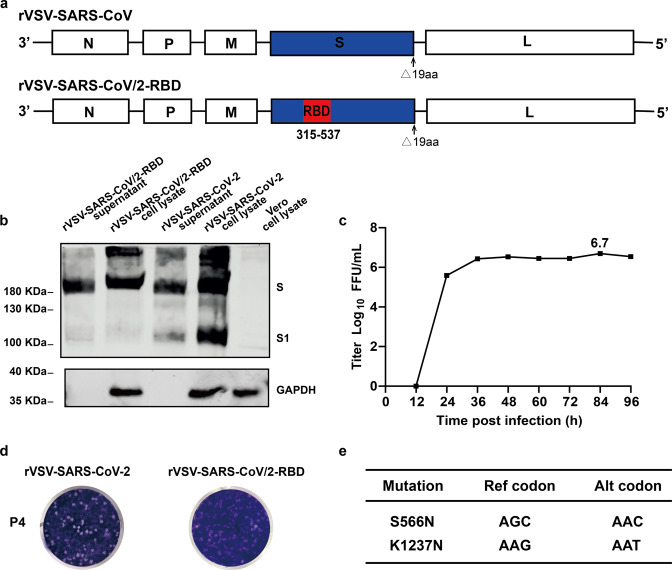
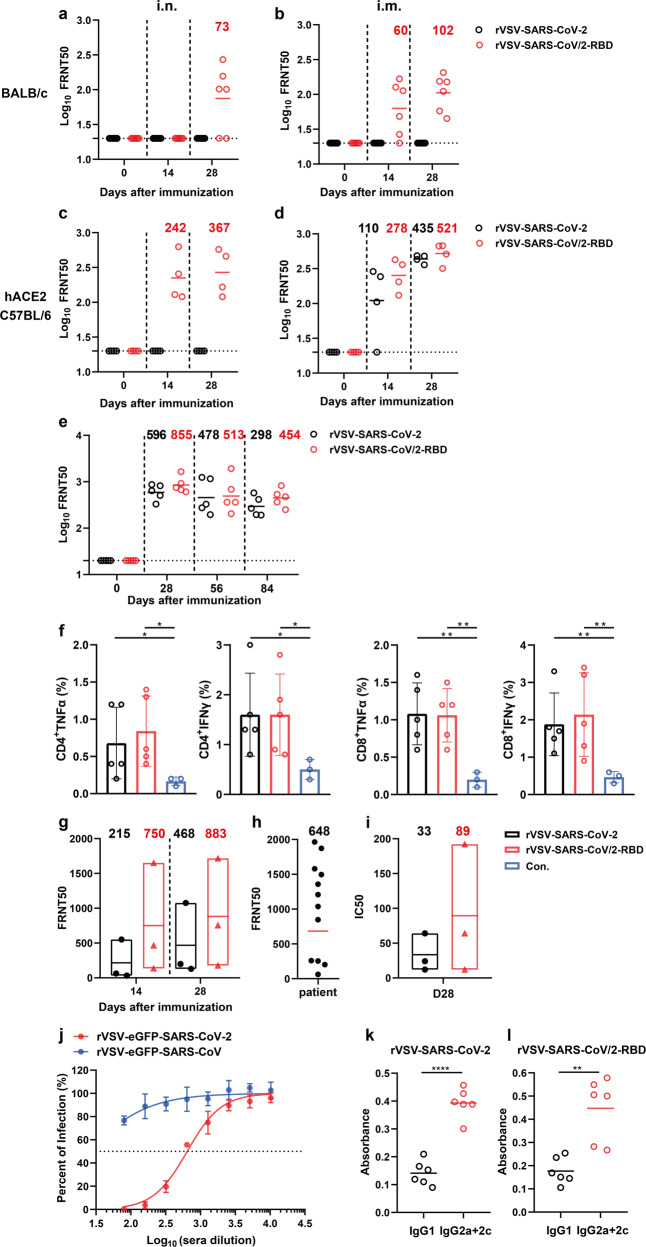
SARS-CoV-2 and SARS-CoV are genetically related coronavirus and share the same cellular receptor ACE2. By replacing the VSV glycoprotein with the spikes (S) of SARS-CoV-2 and SARS-CoV, we generated two replication-competent recombinant viruses, rVSV-SARS-CoV-2 and rVSV-SARS-CoV. Using wild-type and human ACE2 (hACE2) knock-in mouse models, we found a single dose of rVSV-SARS-CoV could elicit strong humoral immune response via both intranasal (i.n.) and intramuscular (i.m.) routes. Despite the high genetic similarity between SARS-CoV-2 and SARS-CoV, no obvious cross-neutralizing activity was observed in the immunized mice sera. In macaques, neutralizing antibody (NAb) titers induced by one i.n. dose of rVSV-SARS-CoV-2 were eight-fold higher than those by a single i.m. dose. Thus, our data indicates that rVSV-SARS-CoV-2 might be suitable for i.n. administration instead of the traditional i.m. immunization in human. Because rVSV-SARS-CoV elicited significantly stronger NAb responses than rVSV-SARS-CoV-2 in a route-independent manner, we generated a chimeric antigen by replacing the receptor binding domain (RBD) of SARS-CoV S with that from the SARS-CoV-2. rVSV expressing the chimera (rVSV-SARS-CoV/2-RBD) induced significantly increased NAbs against SARS-CoV-2 in mice and macaques than rVSV-SARS-CoV-2, with a safe Th1-biased response. Serum immunized with rVSV-SARS-CoV/2-RBD showed no cross-reactivity with SARS-CoV. hACE2 mice receiving a single i.m. dose of either rVSV-SARS-CoV-2 or rVSV-SARS-CoV/2-RBD were fully protected against SARS-CoV-2 challenge without obvious lesions in the lungs. Our results suggest that transplantation of SARS-CoV-2 RBD into the S protein of SARS-CoV might be a promising antigen design for COVID-19 vaccines.
SARS-CoV-2 和 SARS-CoV 是具有遗传相关性的冠状病毒,它们共享相同的细胞受体 ACE2。通过用 SARS-CoV-2 和 SARS-CoV 的刺突(S)蛋白替换 VSV 糖蛋白,我们生成了两种复制完全的重组病毒,rVSV-SARS-CoV-2 和 rVSV-SARS-CoV。使用野生型和人 ACE2(hACE2)敲入小鼠模型,我们发现 rVSV-SARS-CoV 单次剂量通过鼻腔(i.n.)和肌肉内(i.m.)途径都能引发强烈的体液免疫反应。尽管 SARS-CoV-2 和 SARS-CoV 之间具有很高的遗传相似性,但在免疫小鼠血清中未观察到明显的交叉中和活性。在猕猴中,rVSV-SARS-CoV-2 通过单次鼻腔内(i.n.)剂量诱导的中和抗体(NAb)滴度比单次肌肉内(i.m.)剂量高 8 倍。因此,我们的数据表明,rVSV-SARS-CoV-2 可能适合通过鼻腔内给药,而不是传统的肌肉内免疫接种用于人类。由于 rVSV-SARS-CoV 以非依赖性途径引起的 NAb 反应明显强于 rVSV-SARS-CoV-2,我们通过用 SARS-CoV-2 的 RBD 替换 SARS-CoV S 的受体结合域(RBD)生成了一种嵌合抗原。表达嵌合抗原的 rVSV(rVSV-SARS-CoV/2-RBD)在小鼠和猕猴中引起针对 SARS-CoV-2 的 NAb 显著增加,比 rVSV-SARS-CoV-2 具有更安全的 Th1 偏向性反应。用 rVSV-SARS-CoV/2-RBD 免疫的血清与 SARS-CoV 无交叉反应。接受 rVSV-SARS-CoV-2 或 rVSV-SARS-CoV/2-RBD 单次肌肉内剂量免疫的 hACE2 小鼠完全免受 SARS-CoV-2 攻击,肺部无明显病变。我们的结果表明,将 SARS-CoV-2 的 RBD 移植到 SARS-CoV 的 S 蛋白中可能是 COVID-19 疫苗的一种有前途的抗原设计。