Kunze Sebastian, Tănase Liviu C, Prieto Mauricio J, Grosse Philipp, Scholten Fabian, de Souza Caldas Lucas, van Vörden Dennis, Schmidt Thomas, Cuenya Beatriz Roldan
Department of Interface Science, Fritz-Haber Institute of the Max Planck Society 14195 Berlin Germany
Department of Physics, Ruhr-University Bochum 44780 Bochum Germany.
Chem Sci. 2021 Oct 18;12(42):14241-14253. doi: 10.1039/d1sc04861a. eCollection 2021 Nov 3.
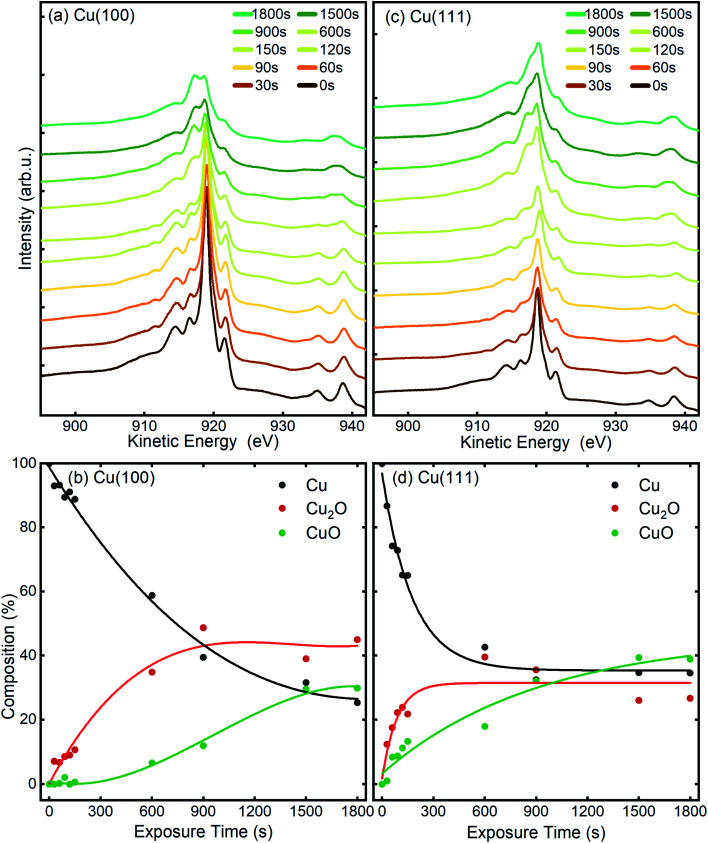
Oxidized copper surfaces have attracted significant attention in recent years due to their unique catalytic properties, including their enhanced hydrocarbon selectivity during the electrochemical reduction of CO. Although oxygen plasma has been used to create highly active copper oxide electrodes for CORR, how such treatment alters the copper surface is still poorly understood. Here, we study the oxidation of Cu(100) and Cu(111) surfaces by sequential exposure to a low-pressure oxygen plasma at room temperature. We used scanning tunnelling microscopy (STM), low energy electron microscopy (LEEM), X-ray photoelectron spectroscopy (XPS), near edge X-ray absorption fine structure spectroscopy (NEXAFS) and low energy electron diffraction (LEED) for the comprehensive characterization of the resulting oxide films. O-plasma exposure initially induces the growth of 3-dimensional oxide islands surrounded by an O-covered Cu surface. With ongoing plasma exposure, the islands coalesce and form a closed oxide film. Utilizing spectroscopy, we traced the evolution of metallic Cu, CuO and CuO species upon oxygen plasma exposure and found a dependence of the surface structure and chemical state on the substrate's orientation. On Cu(100) the oxide islands grow with a lower rate than on the (111) surface. Furthermore, while on Cu(100) only CuO is formed during the initial growth phase, both CuO and CuO species are simultaneously generated on Cu(111). Finally, prolonged oxygen plasma exposure results in a sandwiched film structure with CuO at the surface and CuO at the interface to the metallic support. A stable CuO(111) surface orientation is identified in both cases, aligned to the Cu(111) support, but with two coexisting rotational domains on Cu(100). These findings illustrate the possibility of tailoring the oxidation state, structure and morphology of metallic surfaces for a wide range of applications through oxygen plasma treatments.
近年来,氧化铜表面因其独特的催化性能而备受关注,包括在二氧化碳电化学还原过程中增强的烃类选择性。尽管氧等离子体已被用于制备用于二氧化碳还原反应(CORR)的高活性氧化铜电极,但这种处理如何改变铜表面仍知之甚少。在此,我们通过在室温下依次暴露于低压氧等离子体来研究Cu(100)和Cu(111)表面的氧化过程。我们使用扫描隧道显微镜(STM)、低能电子显微镜(LEEM)、X射线光电子能谱(XPS)、近边X射线吸收精细结构光谱(NEXAFS)和低能电子衍射(LEED)对所得氧化膜进行全面表征。氧等离子体暴露最初会诱导三维氧化岛的生长,其周围是被氧覆盖的铜表面。随着等离子体持续暴露,这些岛会合并并形成封闭的氧化膜。利用光谱学,我们追踪了氧等离子体暴露后金属铜、氧化铜和氧化亚铜物种的演变,发现表面结构和化学状态取决于基底的取向。在Cu(100)上,氧化岛的生长速率低于(111)表面。此外,在初始生长阶段,Cu(100)上仅形成氧化铜,而在Cu(111)上同时生成氧化铜和氧化亚铜物种。最后,长时间的氧等离子体暴露导致形成一种夹心膜结构,表面为氧化铜,与金属载体的界面处为氧化亚铜。在这两种情况下都确定了稳定的CuO(111)表面取向,与Cu(111)载体对齐,但在Cu(100)上有两个共存的旋转畴。这些发现表明,通过氧等离子体处理可以为广泛的应用定制金属表面的氧化态、结构和形貌。