
循环骨祖细胞水平较高与老年人较高的骨矿物质密度和瘦体重相关:一项横断面研究。
Higher Levels of Circulating Osteoprogenitor Cells Are Associated With Higher Bone Mineral Density and Lean Mass in Older Adults: A Cross-Sectional Study.
作者信息
Feehan Jack, Smith Cassandra, Tripodi Nicholas, Degabrielle Elizabeth, Al Saedi Ahmed, Vogrin Sara, Duque Gustavo, Levinger Itamar
机构信息
Department of Medicine - Western Health The University of Melbourne Melbourne VIC Australia.
Australian Institute for Musculoskeletal Science (AIMSS), Western Health The University of Melbourne and Victoria University Melbourne VIC Australia.
出版信息
JBMR Plus. 2021 Oct 17;5(11):e10561. doi: 10.1002/jbm4.10561. eCollection 2021 Nov.
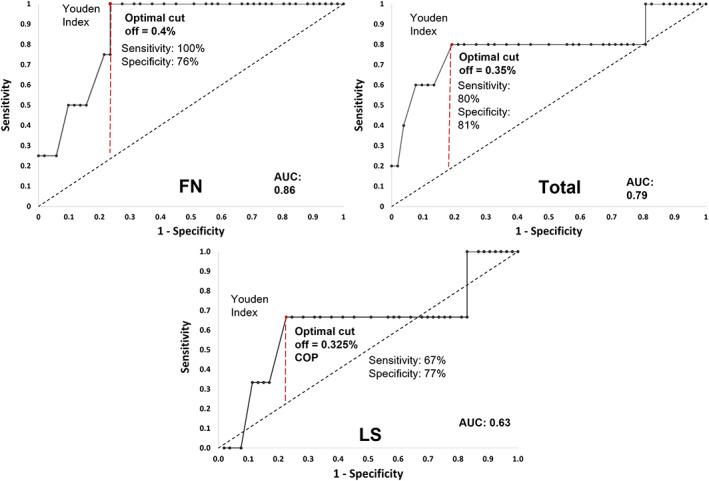
Circulating osteo progenitor (COP) cells are a heterogeneous population of cells that circulate within the peripheral blood with characteristics of the bone marrow mesenchymal stem and progenitor pool. Little is known about the behavior of this cell population in humans. The aim of this study was to identify whether a relationship exists between COP cells (as a percentage of the peripheral blood monocytic cells) and musculoskeletal morphometry and to identify if COP have potential clinical utility as a biomarker for osteoporosis. We recruited 57 older adults (median age: 69 years; IQR: 65, 75 years) living independently in the community and performed cross-sectional analysis to identify associations between the percentage of COP cells and body composition parameters, and through receiver operating characteristic analysis, we evaluated their ability to act as a biomarker of osteoporosis. COP cells were moderately associated with whole-body bone mineral density (BMD) ( = 0.323, = 0.014) and bone mineral content (BMC) ( = 0.387, = 0.003), neck of femur BMD ( = 0.473, < 0.001), and BMC ( = 0.461, < 0.001) as well as appendicular lean mass (ALM) ( = 0.038) and male sex ( = 0.044) in univariable analysis. In multivariable analysis controlling for age, gender, height, and weight, COP cells remained strongly associated with neck of femur BMD ( = 0.001) and content ( = 0.003). COP cells were also a good predictor of osteoporosis (dual-energy X-ray absorptiometry [DXA] -score < -2.5) at the neck of femur (cutoff: 0.4%; sensitivity: 100%; specificity 79%) and total body (cutoff: 0.35%; sensitivity: 80%; specificity: 81%). This study shows strong relationships between bone parameters and COP cell number and male sex. They also have potential as a biomarker of osteoporosis, which may provide a new tool for advanced detection and screening in clinical settings. Future larger evaluation studies should verify the cutoffs for biomarker use, and further explore the relationship between COP cells and muscle. © 2021 The Authors. published by Wiley Periodicals LLC on behalf of American Society for Bone and Mineral Research.
循环骨祖细胞(COP)是一类异质性细胞群体,在外周血中循环,具有骨髓间充质干细胞和祖细胞库的特征。人们对该细胞群体在人类中的行为了解甚少。本研究的目的是确定COP细胞(在外周血单核细胞中的百分比)与肌肉骨骼形态测量之间是否存在关联,并确定COP是否具有作为骨质疏松症生物标志物的潜在临床应用价值。我们招募了57名独立生活在社区中的老年人(中位年龄:69岁;四分位间距:65,75岁),并进行横断面分析以确定COP细胞百分比与身体成分参数之间的关联,通过受试者工作特征分析,我们评估了它们作为骨质疏松症生物标志物的能力。在单变量分析中,COP细胞与全身骨密度(BMD)(r = 0.323,P = 0.014)、骨矿物质含量(BMC)(r = 0.387,P = 0.003)、股骨颈BMD(r = 0.473,P < 0.001)和BMC(r = 0.461,P < 0.001)以及四肢瘦体重(ALM)(r = 0.038)和男性性别(r = 0.044)存在中度关联。在控制年龄、性别、身高和体重的多变量分析中,COP细胞与股骨颈BMD(P = 0.001)和含量(P = 0.003)仍密切相关。COP细胞也是股骨颈(截断值:0.4%;敏感性:100%;特异性79%)和全身(截断值:0.35%;敏感性:80%;特异性:81%)骨质疏松症(双能X线吸收法[DXA] -评分 < -2.5)的良好预测指标。本研究表明骨参数与COP细胞数量和男性性别之间存在密切关系。它们也有作为骨质疏松症生物标志物的潜力,这可能为临床环境中的早期检测和筛查提供一种新工具。未来更大规模的评估研究应验证生物标志物使用的截断值,并进一步探索COP细胞与肌肉之间的关系。© 2021作者。由Wiley Periodicals LLC代表美国骨与矿物质研究学会出版。

 Zotero 插件