Department of Psychological & Brain Sciences, Washington University in St. Louis, St. Louis, MO 63130, USA.
Department of Psychiatry, Washington University School of Medicine, St. Louis, MO 63110, USA.
Psychol Med. 2023 Apr;53(6):2409-2417. doi: 10.1017/S0033291721004281. Epub 2021 Nov 12.
Deficits in goal-directed behavior (i.e. behavior conducted to achieve a specific goal or outcome) are core to schizophrenia, difficult to treat, and associated with poor functional outcomes. Factors such as negative symptoms, effort-cost decision-making, cognition, and functional skills have all been associated with goal-directed behavior in schizophrenia as indexed by clinical interviews or laboratory-based tasks. However, little work has examined whether these factors relate to the real-world pursuit of goal-directed activities in this population.
This study aimed to fill this gap by using Ecological Momentary Assessment (four survey prompts per day for 1 week) to test hypotheses about symptom, effort allocation, cognitive, and functional measures associated with planned and completed goal-directed behavior in the daily lives of 63 individuals with schizophrenia.
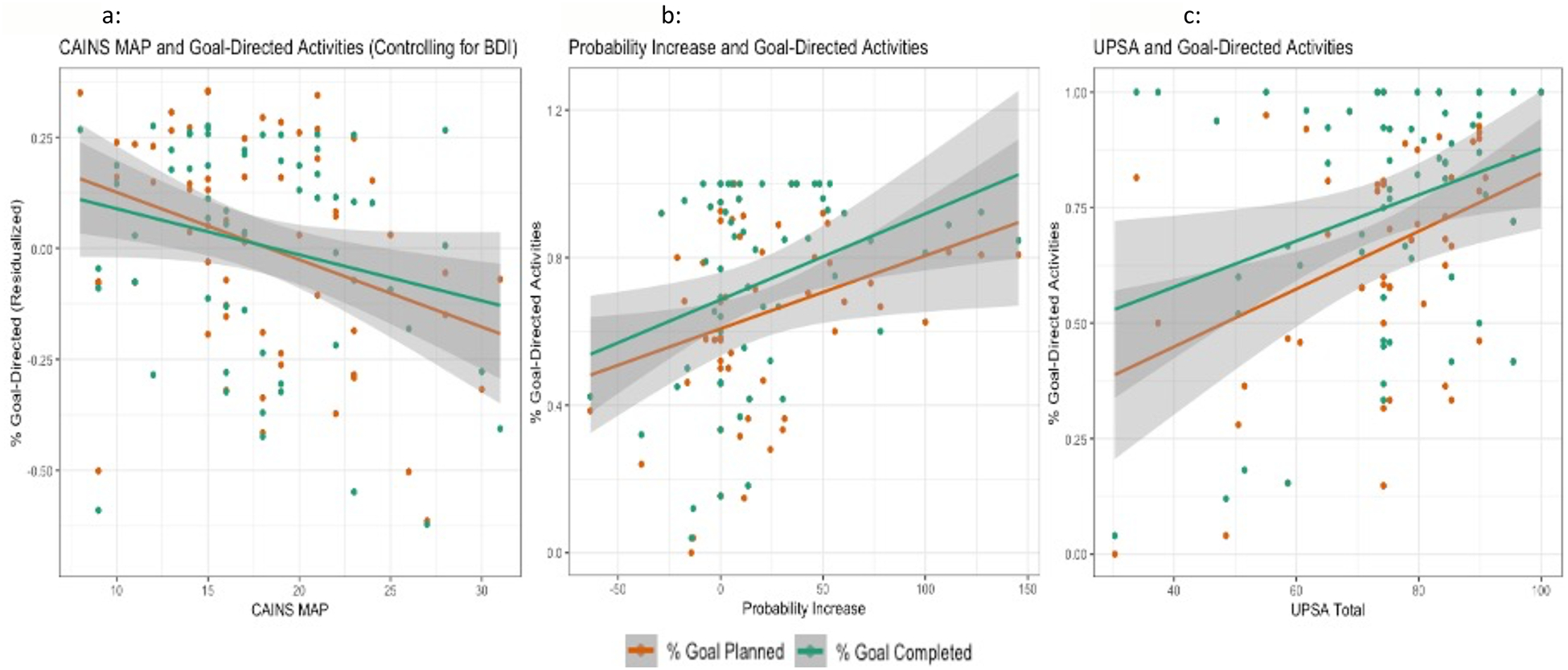
Individuals with schizophrenia completed more goal-directed activities than they planned [(62) = -4.01, < 0.001]. Motivation and pleasure (i.e. experiential) negative symptoms, controlling for depressive symptoms, negatively related to planned goal-directed behavior [odds ratio (OR) 0.92, 0.005]. Increased effort expenditure for high probability rewards (planned: OR 1.01, 0.034, completed: OR 1.01, 0.034) along with performance on a daily functional skills task (planned: OR 1.04, 0.002, completed: OR 1.03, 0.047) negatively related to both planned and completed goal-directed activity.
Our results present correlates of real-world goal-directed behavior that largely align with impaired ability to make future estimations in schizophrenia. This insight could help identify targeted treatments for the elusive motivated behavior deficits in this population.
目标导向行为(即旨在实现特定目标或结果的行为)缺陷是精神分裂症的核心特征,难以治疗,并与较差的功能结果相关。负面症状、努力成本决策、认知和功能技能等因素都与精神分裂症患者的目标导向行为有关,这些行为通过临床访谈或实验室任务进行评估。然而,很少有研究探讨这些因素是否与该人群在现实生活中追求目标导向活动有关。
本研究旨在通过使用生态瞬时评估(每天四次调查提示,持续一周)来测试与计划和完成精神分裂症患者日常生活中的目标导向活动相关的症状、努力分配、认知和功能测量的假设,以此填补这一空白。
精神分裂症患者实际完成的目标导向活动比计划的要多[(62)=-4.01, < 0.001]。动机和愉悦(即体验)负性症状,在控制抑郁症状后,与计划的目标导向行为呈负相关[比值比(OR)0.92, < 0.005]。对高概率奖励的努力支出增加(计划:OR 1.01, < 0.034,完成:OR 1.01, < 0.034)以及日常功能技能任务的表现(计划:OR 1.04, < 0.002,完成:OR 1.03, < 0.047)与计划和完成的目标导向活动均呈负相关。
我们的研究结果提供了与现实世界目标导向行为相关的指标,这些指标在很大程度上与精神分裂症患者未来预测能力受损一致。这一见解可以帮助确定针对该人群中难以捉摸的动机行为缺陷的靶向治疗方法。