From the Department of Neurology (M.B., F.S., F.Z., S.B.), Focus Program Translational Neuroscience (FTN) and Immunotherapy (FZI), Rhine Main Neuroscience Network (rmn2), University Medical Center of the Johannes Gutenberg University Mainz; Institute of Biochemistry (M.B.), University Medicine Berlin-Charité, Germany; and Experimental & Clinical Research Center (ECRC) A Joint Cooperation of Charité Medical Faculty and Max-Delbrueck-Center for Molecular Medicine (MDC) (M.B.).
Neurol Neuroimmunol Neuroinflamm. 2021 Nov 11;9(1). doi: 10.1212/NXI.0000000000001102. Print 2022 Jan.
Adapted ketogenic diet (AKD) and caloric restriction (CR) have been suggested as alternative therapeutic strategies for multiple sclerosis (MS), but information on their impact on neuroaxonal damage is lacking. Thus, we explored the impact of diets on serum neurofilament light chain (sNfL) levels in patients with relapsing-remitting MS.
We retrospectively evaluated a prospective randomized controlled trial of 60 patients with MS who were on a common diet or ketogenic diet or fasting. We examined sNfL levels of 40 participants at baseline and at the end of the study after 6 months using single molecule array assay.
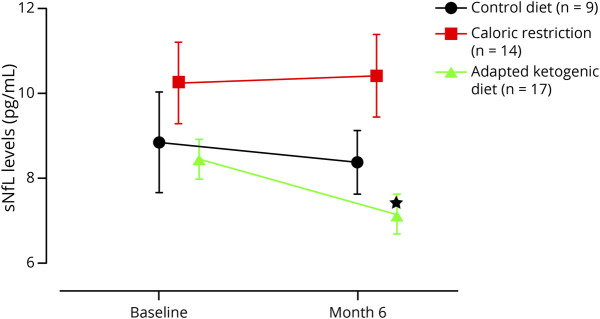
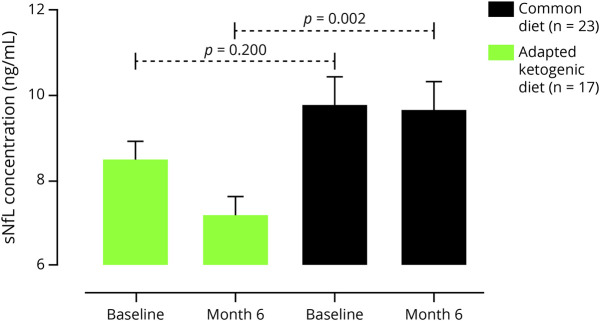
sNfL levels were investigated in 9 controls, 14 participants on CR, and 17 participants on AKD. Correlation analysis showed an association of sNfL with age and disease duration; an association was also found between sNfL and the Multiple Sclerosis Functional Composite. AKD significantly reduced sNfL levels at 6 months compared with the common diet group ( = 0.001).
For clinical or study use, consider that AKD may incline sNfL levels independent of relapse activity up to 3 months after initiation. At 6 months, AKD, which complements current therapies, reduced sNfL levels, therefore suggesting potential neuroprotective effects in MS. A single cycle of seven-day fasting did not affect sNfL. AKD may be an addition to the armamentarium to help clinicians support patients with MS in a personalized manner with tailored diet strategies.
Clinical trial registration number NCT01538355.
已提出适应性生酮饮食(AKD)和热量限制(CR)作为多发性硬化症(MS)的替代治疗策略,但关于它们对神经轴突损伤影响的信息尚缺乏。因此,我们探讨了饮食对复发缓解型 MS 患者血清神经丝轻链(sNfL)水平的影响。
我们回顾性评估了一项前瞻性随机对照试验,纳入了 60 例接受常规饮食、生酮饮食或禁食的 MS 患者。我们使用单分子阵列法检测了 40 例参与者在基线和 6 个月研究结束时的 sNfL 水平。
我们调查了 9 例对照者、14 例 CR 组和 17 例 AKD 组的 sNfL 水平。相关性分析显示 sNfL 与年龄和疾病持续时间有关;sNfL 还与多发性硬化功能综合评分相关。与常规饮食组相比,AKD 组在 6 个月时 sNfL 水平显著降低( = 0.001)。
对于临床或研究应用,需要考虑到 AKD 可能会独立于疾病复发活动,在启动后 3 个月内使 sNfL 水平降低。在 6 个月时,AKD 与当前疗法相结合降低了 sNfL 水平,因此提示其可能对 MS 具有神经保护作用。7 天禁食周期对 sNfL 没有影响。AKD 可能是一种附加的治疗方法,帮助临床医生以个性化的方式支持 MS 患者,采用量身定制的饮食策略。
临床试验注册号 NCT01538355。