Ortí Jose Enrique de la Rubia, Cuerda-Ballester María, Sanchis-Sanchis Claudia Emmanuela, Lajara Romance Jose María, Navarro-Illana Esther, García Pardo María Pilar
Department of Nursing, Catholic University of Valencia San Vicente Mártir, Valencia, Spain.
Doctoral School, Catholic University of Valencia San Vicente Mártir, Valencia, Spain.
Front Nutr. 2023 Aug 25;10:1227431. doi: 10.3389/fnut.2023.1227431. eCollection 2023.
Multiple sclerosis (MS) is a neurodegenerative disorder. Individuals with MS frequently present symptoms such as functional disability, obesity, and anxiety and depression. Axonal demyelination can be observed and implies alterations in mitochondrial activity and increased inflammation associated with disruptions in glutamate neurotransmitter activity. In this context, the ketogenic diet (KD), which promotes the production of ketone bodies in the blood [mainly β-hydroxybutyrate (βHB)], is a non-pharmacological therapeutic alternative that has shown promising results in peripheral obesity reduction and central inflammation reduction. However, the association of this type of diet with emotional symptoms through the modulation of glutamate activity in MS individuals remains unknown.
To provide an update on the topic and discuss the potential impact of KD on anxiety and depression through the modulation of glutamate activity in subjects with MS.
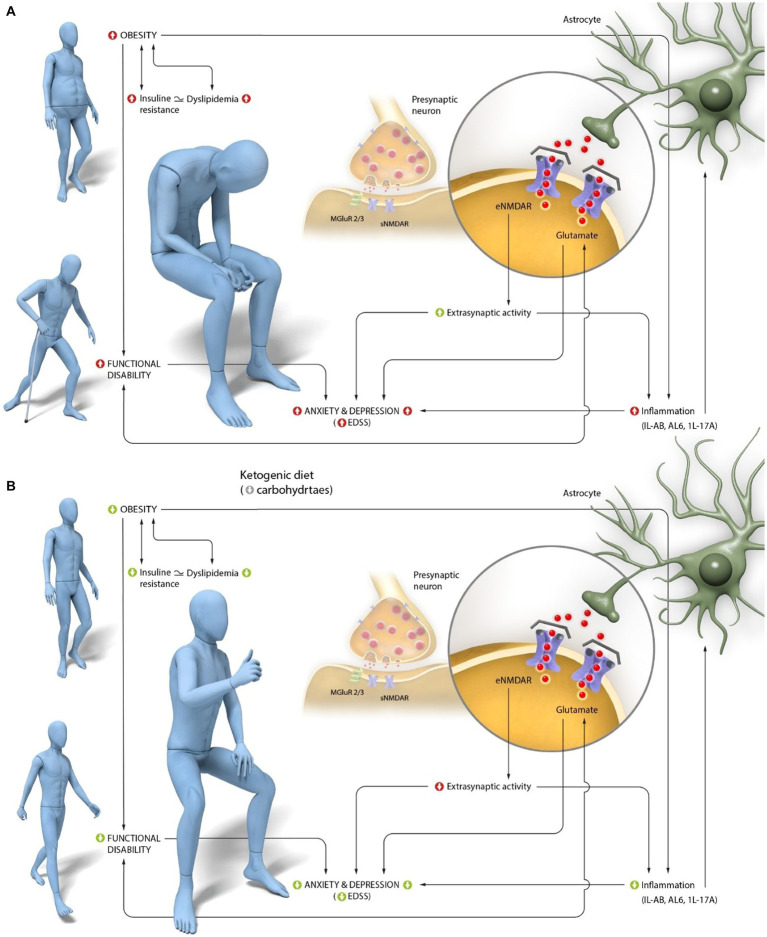
The main findings suggest that the KD, as a source of ketone bodies in the blood, improves glutamate activity by reducing obesity, which is associated with insulin resistance and dyslipidemia, promoting central inflammation (particularly through an increase in interleukins IL-1β, IL-6, and IL-17). This improvement would imply a decrease in extrasynaptic glutamate activity, which has been linked to functional disability and the presence of emotional disorders such as anxiety and depression.
多发性硬化症(MS)是一种神经退行性疾病。MS患者经常出现功能残疾、肥胖以及焦虑和抑郁等症状。可以观察到轴突脱髓鞘现象,这意味着线粒体活性发生改变,且与谷氨酸神经递质活性紊乱相关的炎症增加。在此背景下,生酮饮食(KD)可促进血液中酮体的产生[主要是β-羟基丁酸(βHB)],是一种非药物治疗选择,已在减轻外周肥胖和减轻中枢炎症方面显示出有前景的结果。然而,这种饮食类型通过调节MS患者的谷氨酸活性与情绪症状之间的关联仍不清楚。
提供该主题的最新信息,并讨论KD通过调节MS患者的谷氨酸活性对焦虑和抑郁的潜在影响。
主要研究结果表明,KD作为血液中酮体的来源,通过减轻与胰岛素抵抗和血脂异常相关的肥胖来改善谷氨酸活性,而肥胖会促进中枢炎症(特别是通过白细胞介素IL-1β、IL-6和IL-17的增加)。这种改善意味着突触外谷氨酸活性降低,而突触外谷氨酸活性与功能残疾以及焦虑和抑郁等情绪障碍的存在有关。