Wang Pan, Zhang Guiyang, Yu Zu-Guo, Huang Guohua
School of Electrical Engineering, Shaoyang University, Shaoyang, China.
Key Laboratory of Intelligent Computing and Information Processing of Ministry of Education and Hunan Key Laboratory for Computation and Simulation in Science and Engineering, Xiangtan University, Xiangtan, China.
Front Genet. 2021 Oct 26;12:752732. doi: 10.3389/fgene.2021.752732. eCollection 2021.
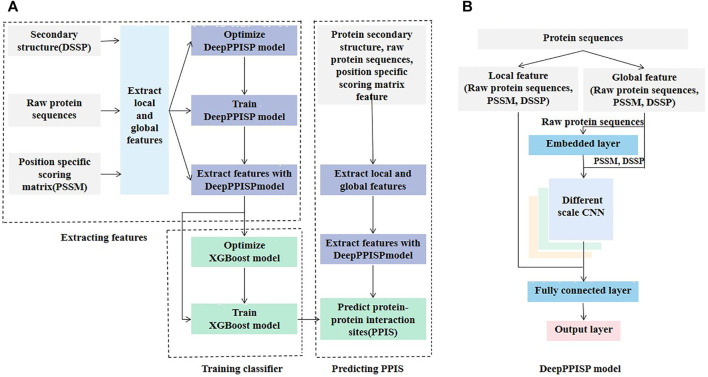
Knowledge about protein-protein interactions is beneficial in understanding cellular mechanisms. Protein-protein interactions are usually determined according to their protein-protein interaction sites. Due to the limitations of current techniques, it is still a challenging task to detect protein-protein interaction sites. In this article, we presented a method based on deep learning and XGBoost (called DeepPPISP-XGB) for predicting protein-protein interaction sites. The deep learning model served as a feature extractor to remove redundant information from protein sequences. The Extreme Gradient Boosting algorithm was used to construct a classifier for predicting protein-protein interaction sites. The DeepPPISP-XGB achieved the following results: area under the receiver operating characteristic curve of 0.681, a recall of 0.624, and area under the precision-recall curve of 0.339, being competitive with the state-of-the-art methods. We also validated the positive role of global features in predicting protein-protein interaction sites.
了解蛋白质-蛋白质相互作用有助于理解细胞机制。蛋白质-蛋白质相互作用通常根据其蛋白质-蛋白质相互作用位点来确定。由于当前技术的局限性,检测蛋白质-蛋白质相互作用位点仍然是一项具有挑战性的任务。在本文中,我们提出了一种基于深度学习和XGBoost的方法(称为DeepPPISP-XGB)来预测蛋白质-蛋白质相互作用位点。深度学习模型作为特征提取器,用于去除蛋白质序列中的冗余信息。采用极端梯度提升算法构建预测蛋白质-蛋白质相互作用位点的分类器。DeepPPISP-XGB取得了以下结果:受试者工作特征曲线下面积为0.681,召回率为0.624,精确率-召回率曲线下面积为0.339,与现有最先进方法具有竞争力。我们还验证了全局特征在预测蛋白质-蛋白质相互作用位点中的积极作用。