Akbari Mohamad Reza, Khorrami-Nejad Masoud, Kangari Haleh, Baghban Alireza Akbarzadeh, Raeesdana Kiana, Ranjbar-Pazooki Mahsa
Translational Ophthalmology Research Center, Farabi Eye Hospital, Tehran University of Medical Sciences, Tehran, Iran.
School of Rehabilitation, Tehran University of Medical Sciences, Tehran, Iran.
J Curr Ophthalmol. 2021 Oct 22;33(3):336-341. doi: 10.4103/joco.joco_60_20. eCollection 2021 Jul-Sep.
To evaluate the correlation between the angle of deviation in different gazes and the amount of head tilt in patients with congenital unilateral superior oblique muscle palsy (SOP).
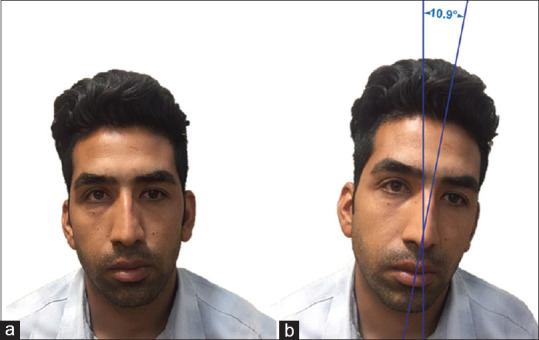
This case series study was performed on 20 consecutive SOP patients with head tilt. Based on the Bielschowsky three-step test, the angle of deviation was measured in different gazes. Furthermore, the hypertropia difference between the two lateral gazes (gaze difference) and the two head tilt sides (bilateral head tilt difference) was calculated. For measuring head tilt, close-up pictures from 40 cm with a habitual abnormal head position were captured and analyzed by the Corel Draw X7 software.
The mean age of patients was 13 ± 9 years (range, 2.5-31 years). The mean angle of hypertropia in ipsilateral and contralateral head tilt was 24.5 Δ ± 7.1 Δ and 6.5 Δ ± 4.2 Δ, respectively ( < 0.001), and in ipsilateral and contralateral lateral gaze positions, it was 8.2 Δ ± 5.5 Δ and 22.5 Δ ± 6.1 Δ, respectively ( < 0.001). The mean of bilateral head tilt hypertropia difference was 18 Δ ± 5.3 Δ and gaze hypertropia difference was 14.3 Δ ± 6.16 Δ. There was a positive correlation between bilateral head tilt hypertropia difference and the amount of head tilt ( = 0.609, = 0.371, = 0.004, the amount of head tilt = 0.39 × [Bilateral head tilt hypertropia difference] +1.77). The amount of head tilt also had a positive correlation with the gaze hypertropia difference ( = 0.492, = 0.242, = 0.028, the amount of head tilt = 0.27 × [gaze hypertropia difference] +4.81).
In SOP patients, the amount of head tilt had a positive correlation with bilateral head tilt hypertropia difference and also gaze hypertropia difference.
评估先天性单侧上斜肌麻痹(SOP)患者不同注视方向的偏斜角度与头部倾斜程度之间的相关性。
对20例连续的伴有头部倾斜的SOP患者进行了该病例系列研究。基于Bielschowsky三步试验,测量不同注视方向的偏斜角度。此外,计算双眼外侧注视(注视差异)和双侧头部倾斜(双侧头部倾斜差异)之间的上斜视差异。为测量头部倾斜,拍摄距离40 cm的习惯性异常头部位置的特写照片,并通过Corel Draw X7软件进行分析。
患者的平均年龄为13±9岁(范围2.5 - 31岁)。同侧和对侧头部倾斜时上斜视的平均角度分别为24.5Δ±7.1Δ和6.5Δ±4.2Δ(<0.001),同侧和对侧外侧注视位置时分别为8.2Δ±5.5Δ和22.5Δ±6.1Δ(<0.001)。双侧头部倾斜上斜视差异的平均值为18Δ±5.3Δ,注视上斜视差异为14.3Δ±6.16Δ。双侧头部倾斜上斜视差异与头部倾斜程度呈正相关(=0.609,=0.371,=0.004,头部倾斜程度 = 0.39×[双侧头部倾斜上斜视差异]+1.77)。头部倾斜程度与注视上斜视差异也呈正相关(=0.492,=0.242,=0.028,头部倾斜程度 = 0.27×[注视上斜视差异]+4.81)。
在SOP患者中,头部倾斜程度与双侧头部倾斜上斜视差异以及注视上斜视差异均呈正相关。