Frank Elena, Zhao Zhuo, Fang Yu, Rotenstein Lisa S, Sen Srijan, Guille Constance
Michigan Neuroscience Institute, University of Michigan, Ann Arbor.
Department of Medicine, Brigham and Women's Hospital, Boston, Massachusetts.
JAMA Netw Open. 2021 Nov 1;4(11):e2134315. doi: 10.1001/jamanetworkopen.2021.34315.
The COVID-19 pandemic has placed increased strain on health care workers and disrupted childcare and schooling arrangements in unprecedented ways. As substantial gender inequalities existed in medicine before the pandemic, physician mothers may be at particular risk for adverse professional and psychological consequences.
To assess gender differences in work-family factors and mental health among physician parents during the COVID-19 pandemic.
DESIGN, SETTING, AND PARTICIPANTS: This prospective cohort study included 276 US physicians enrolled in the Intern Health Study since their first year of residency training. Physicians who had participated in the primary study as interns during the 2007 to 2008 and 2008 to 2009 academic years and opted into a secondary longitudinal follow-up study were invited to complete an online survey in August 2018 and August 2020.
Work-family experience included 3 single-item questions and the Work and Family Conflict Scale, and mental health symptoms included the Patient Health Questionnaire-9 (PHQ-9) and Generalized Anxiety Disorder-7 scale.
The primary outcomes were work-to-family and family-to-work conflict and depressive symptoms and anxiety symptoms during August 2020. Depressive symptoms between 2018 (before the COVID-19 pandemic) and 2020 (during the COVID-19 pandemic) were compared by gender.
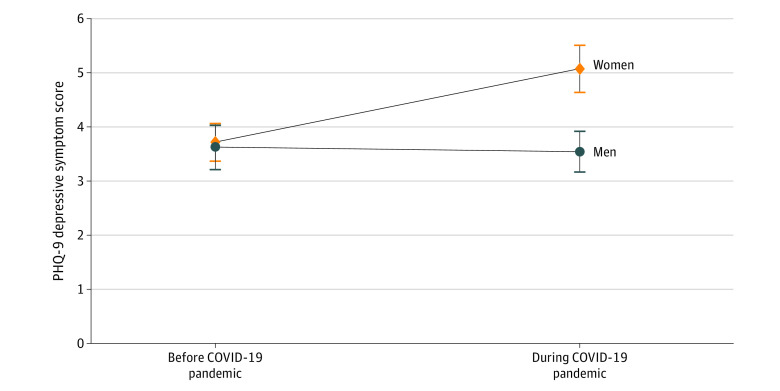
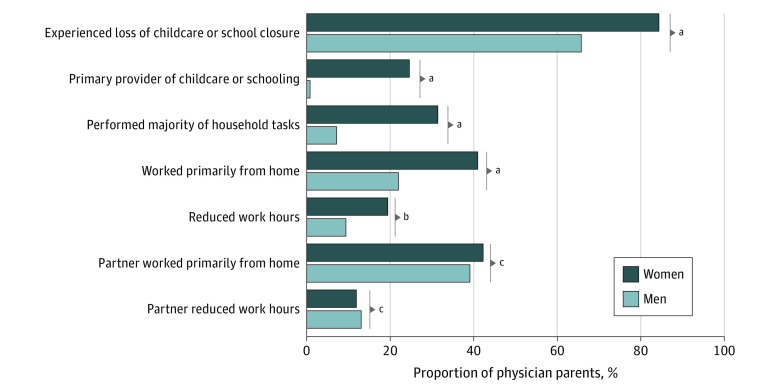
Among 215 physician parents who completed the August 2020 survey, 114 (53.0%) were female and the weighted mean (SD) age was 40.1 (3.57) years. Among physician parents, women were more likely to be responsible for childcare or schooling (24.6% [95% CI, 19.0%-30.2%] vs 0.8% [95% CI, 0.01%-2.1%]; P < .001) and household tasks (31.4% [95% CI, 25.4%-37.4%] vs 7.2% [95% CI, 3.5%-10.9%]; P < .001) during the pandemic compared with men. Women were also more likely than men to work primarily from home (40.9% [95% CI, 35.1%-46.8%] vs 22.0% [95% CI, 17.2%-26.8%]; P < .001) and reduce their work hours (19.4% [95% CI, 14.7%-24.1%] vs 9.4% [95% CI, 6.0%-12.8%]; P = .007). Women experienced greater work-to-family conflict (β = 2.79; 95% CI, 1.00 to 4.59; P = .03), family-to-work conflict (β = 3.09; 95% CI, 1.18-4.99; P = .02), and depressive (β = 1.76; 95% CI, 0.56-2.95; P = .046) and anxiety (β = 2.87; 95% CI, 1.49-4.26; P < .001) symptoms compared with men. We observed a difference between women and men in depressive symptoms during the COVID-19 pandemic (mean [SD] PHQ-9 score: 5.05 [6.64] vs 3.52 [5.75]; P = .009) that was not present before the pandemic (mean [SD] PHQ-9 score: 3.69 [5.26] vs 3.60 [6.30]; P = .86).
This study found significant gender disparities in work and family experiences and mental health symptoms among physician parents during the COVID-19 pandemic, which may translate to increased risk for suicide, medical errors, and lower quality of patient care for physician mothers. Institutional and public policy solutions are needed to mitigate the potential adverse consequences for women's careers and well-being.
新冠疫情给医护人员带来了更大压力,以前所未有的方式扰乱了儿童保育和学校教育安排。由于疫情之前医学领域存在严重的性别不平等,医生母亲可能尤其面临职业和心理方面的不良后果风险。
评估新冠疫情期间医生父母在工作与家庭因素及心理健康方面的性别差异。
设计、背景和参与者:这项前瞻性队列研究纳入了自住院医师培训第一年起就参加实习健康研究的276名美国医生。邀请在2007至2008学年及2008至2009学年作为实习生参与了主要研究并选择加入二次纵向随访研究的医生,于2018年8月和2020年8月完成一项在线调查。
工作与家庭经历包括3个单项问题和工作与家庭冲突量表,心理健康症状包括患者健康问卷-9(PHQ-9)和广泛性焦虑障碍-7量表。
主要结局是2020年8月期间的工作对家庭和家庭对工作的冲突以及抑郁症状和焦虑症状。比较了2018年(新冠疫情之前)和2020年(新冠疫情期间)按性别划分的抑郁症状。
在完成2020年8月调查的215名医生父母中,114名(53.0%)为女性,加权平均(标准差)年龄为40.1(3.57)岁。在医生父母中,与男性相比,女性在疫情期间更有可能负责儿童保育或学校教育(24.6% [95%置信区间,19.0%-30.2%] 对0.8% [95%置信区间,0.01%-2.1%];P <.001)以及家务(31.4% [95%置信区间,25.4%-37.4%] 对7.2% [95%置信区间,3.5%-10.9%];P <.001)。与男性相比,女性也更有可能主要在家工作(40.9% [95%置信区间,35.1%-46.8%] 对22.0% [95%置信区间,17.2%-26.8%];P <.001)并减少工作时间(19.4% [95%置信区间,14.7%-24.1%] 对9.4% [95%置信区间,6.0%-12.8%];P =.007)。与男性相比,女性经历了更大的工作对家庭冲突(β = 2.79;95%置信区间,1.00至4.59;P =.03)、家庭对工作冲突(β = 3.09;95%置信区间,1.18 - 4.99;P =.02)以及抑郁(β = 1.76;95%置信区间,0.56 - 2.95;P =.046)和焦虑(β = 2.87;95%置信区间,1.49 - 4.26;P <.001)症状。我们观察到在新冠疫情期间女性和男性在抑郁症状方面存在差异(平均[标准差]PHQ - 9得分:5.05 [6.64] 对3.52 [5.75];P =.009),而在疫情之前不存在这种差异(平均[标准差]PHQ - 9得分:3.69 [5.26] 对3.60 [6.30];P =.86)。
本研究发现新冠疫情期间医生父母在工作和家庭经历以及心理健康症状方面存在显著的性别差异,这可能转化为医生母亲自杀、医疗差错风险增加以及患者护理质量降低。需要制度和公共政策解决方案来减轻对女性职业和福祉的潜在不利影响