School of Nursing and Graduate Institute of Nursing, China Medical University, Taichung, Taiwan.
Department of Health Services Administration, China Medical University, Taichung, Taiwan.
PLoS One. 2021 Nov 12;16(11):e0259047. doi: 10.1371/journal.pone.0259047. eCollection 2021.
Dysmenorrhea is among the most common type of gynecological problem, affecting young women across the globe. This study assessed the comparative risk of stroke associated with the use of nonsteroidal anti-inflammatory drugs (NSAIDs) and non-NSAIDs in women with dysmenorrhea while taking into account the following factors such as age, history of pregnancy, NSAIDs uses and its duration of use, and selected comorbidities.
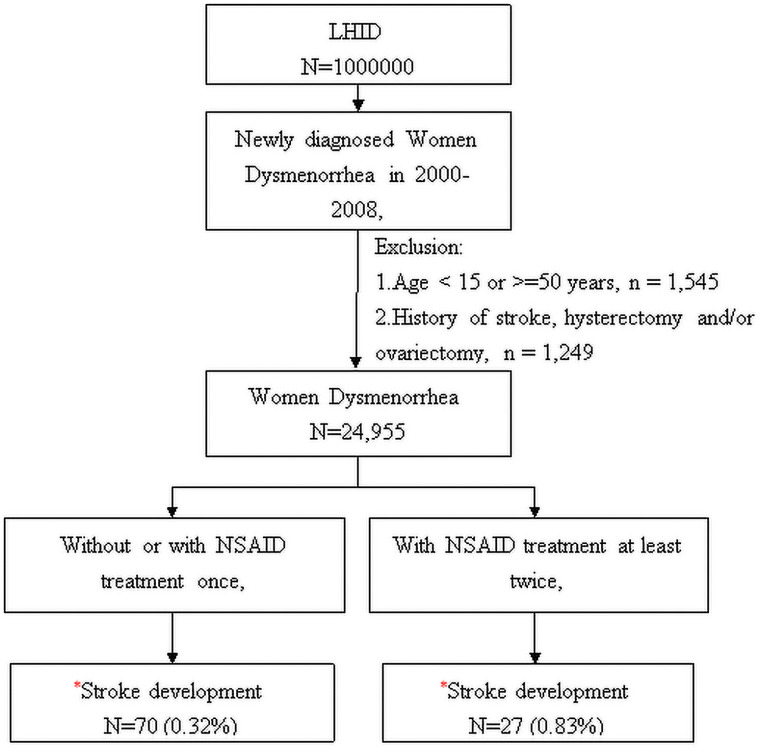
We used a quantitative research approach based on a comparative case-control study design. The study data was selected from the Longitudinal Health Insurance Database (LHID) 2000, of the Taiwan National Health Research Institutes. Among the estimated 23.4 million insured Taiwanese, who were covered by the Taiwan health insurance system, in the 2000 registry of beneficiaries, one million individuals were randomly selected from the database. A total of 24,955 females suffering from dysmenorrhea were selected for the study. Out of those 3238 (13%) participated in the study group and 21,717 (87%) were randomly distributed into the controls group. Women in the age range, 15-49 years, who did not have any history of stroke, hysterectomy, and/or ovariectomy, were included in the study. A comparative proportional distribution analysis was used for data analysis.
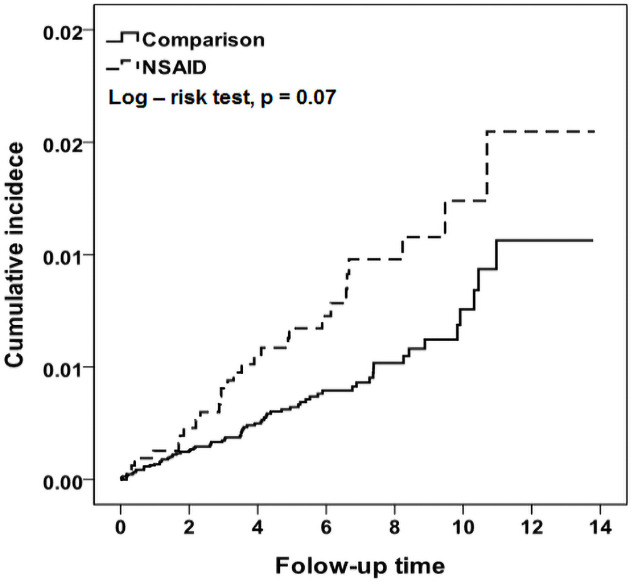
Age and use of NSAIDs and its duration of usage were factors associated with an increased incidence of stroke. The stroke incidence rate was 12.77 per 10,000 person-years, and 1.83-fold higher in NSAIDs use cohort than in comparisons with adjusted hazard ratio (aHR) of 1.47 (95% CI = 0.93-2.32). Among women with dysmenorrhea use of NSAIDs, the stroke incidence increased to 2.29-fold (aHR 95% CI = 1.36-3.84) in those use for ≧24 days per month and to 0.51-fold (aHR 95% CI = 0.13-2.10) in those use for 6-12 days per month.
Women with dysmenorrhea who use NSAIDs have a higher risk of stroke. Especially young women, the risk of stroke is further increased, and the longer the medication, the higher the risk of stroke. Every woman with symptoms of dysmenorrhea deserves specialized outpatient treatment and care.
痛经是最常见的妇科问题之一,影响着全球的年轻女性。本研究评估了在考虑年龄、妊娠史、非甾体抗炎药(NSAIDs)使用及其使用时间以及选定的合并症等因素的情况下,痛经女性使用 NSAIDs 和非 NSAIDs 与卒中风险的相关性。
我们采用了基于病例对照研究设计的定量研究方法。本研究的数据来自于台湾国家卫生研究院的纵向健康保险数据库(LHID)2000 年的数据。在台湾健康保险系统覆盖的约 2340 万被保险人中,从数据库中随机抽取了 100 万人作为研究对象。共有 24955 名患有痛经的女性被纳入研究。其中 3238 人(13%)参加了研究组,21717 人(87%)被随机分配到对照组。年龄在 15-49 岁之间、无卒中、子宫切除术和/或卵巢切除术史的女性被纳入研究。采用比例分布比较分析进行数据分析。
年龄、NSAIDs 的使用及其使用时间是与卒中发生率增加相关的因素。卒中发生率为每 10000 人年 12.77 例,NSAIDs 使用队列的发生率比对照组高 1.83 倍,调整后的危险比(aHR)为 1.47(95%CI=0.93-2.32)。在患有痛经且使用 NSAIDs 的女性中,每月使用 NSAIDs 时间≧24 天的女性卒中发生率增加 2.29 倍(aHR 95%CI=1.36-3.84),每月使用 6-12 天的女性卒中发生率降低 0.51 倍(aHR 95%CI=0.13-2.10)。
患有痛经的女性使用 NSAIDs 会增加卒中风险。尤其是年轻女性,卒中风险进一步增加,且用药时间越长,卒中风险越高。每个有痛经症状的女性都应接受专门的门诊治疗和护理。