Birmingham Women's and Children's NHS Foundation Trust, Birmingham, United Kingdom.
Birmingham Medical School, Birmingham, United Kingdom.
Eur J Obstet Gynecol Reprod Biol. 2021 Dec;267:120-128. doi: 10.1016/j.ejogrb.2021.10.007. Epub 2021 Oct 20.
Clinical trials evaluating pharmacological and non-pharmacological treatment of COVID-19, either excluded pregnant women or included very few women. Unlike the numerous systematic reviews on prevalence, symptoms and adverse outcomes of COVID-19 in pregnancy, there are very few on the effects of treatment on maternal and neonatal outcomes in pregnancy. We undertook a systematic review of all published and unpublished studies on the effects of pharmacological and non-pharmacological interventions for COVID-19 on maternal and neonatal pregnancy outcomes.
We performed a systematic literature search of the following databases: Medline, Embase, Cochrane database, WHO (World Health Organization) COVID-19 database, China National Knowledge Infrastructure (CNKI), and Wanfang databases from 1 December 2019 to 1 December 2020.
Studies were only included if they involved pregnant or postnatal women who were exposed to pregnancy specific interventions like the mode of delivery and type of anaesthesia, pharmacological or non-pharmacological interventions.
We first screened the titles and abstracts of studies and then assessed the full text of the selected studies in detail for eligibility. Data on study design, population, type of screening for COVID-19, country, hospital, country status (high or low and middle income), treatment given (mode of delivery, type of anaesthesia, type of pharmacological and non-pharmacological treatment was extracted. The pre-defined maternal outcomes we collected were mode of delivery (vaginal or by caesarean section), severe or critical COVID-19 (as defined by the authors), symptomatic COVID-19, maternal death, maternal hospital admission, ICU admission, mechanical ventilation, ECMO and maternal pneumonia. The pre-defined neonatal outcomes we extracted were preterm birth (<37 weeks), stillbirth, neonatal death, NICU admission, neonatal COVID-19 positive, neonatal acidosis (pH < 7.0) and Apgar scores (<8 after 5 min). Study quality assessment was performed.
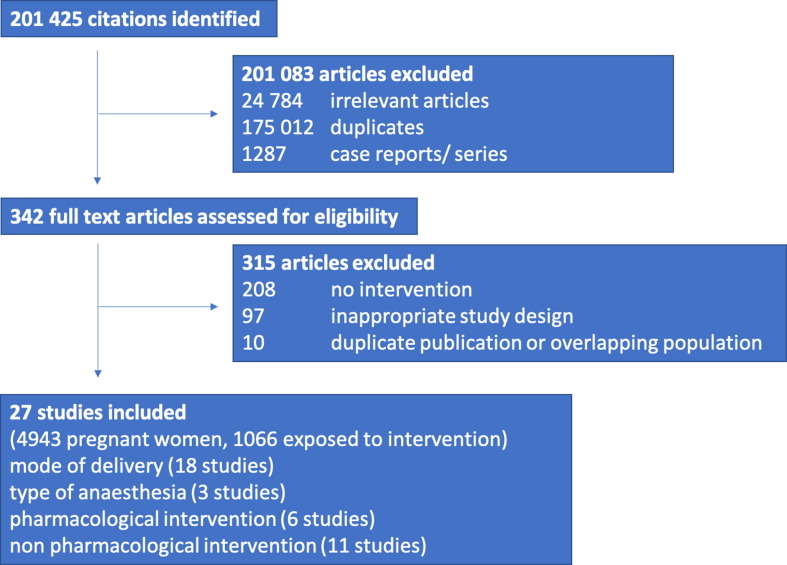
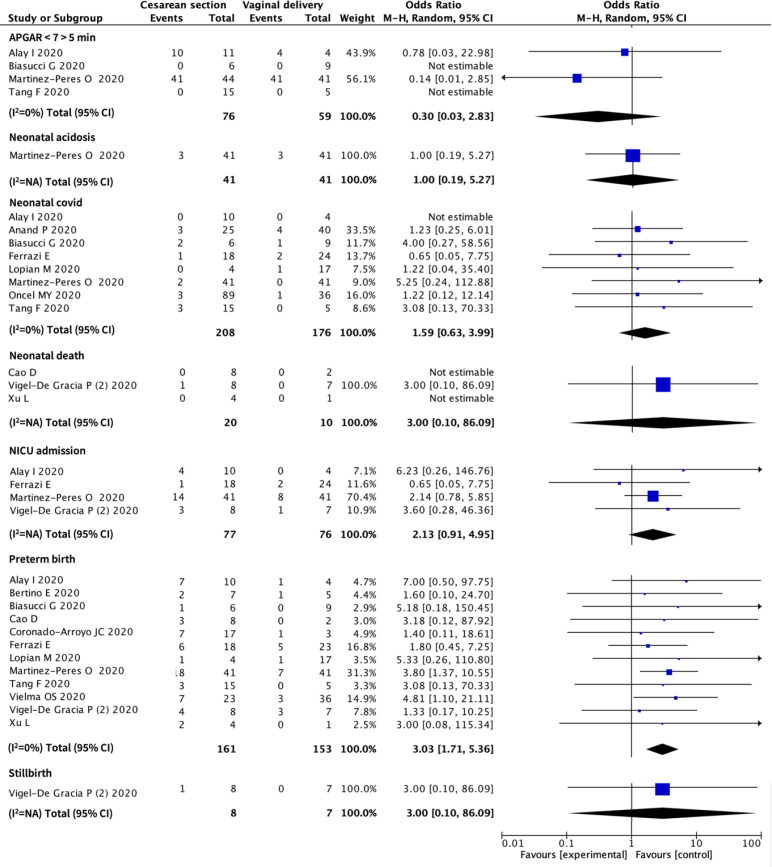
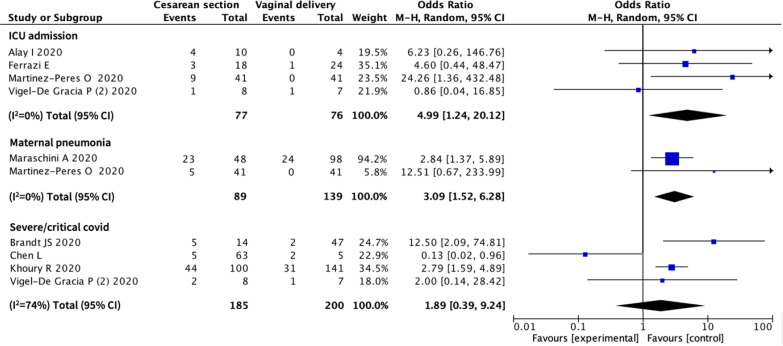
From a total of 342 potential eligible studies, we included 27 studies in our systematic review, including 4943 pregnant women (appendix 3). Sixteen studies had a retrospective cohort design and 11 a prospective cohort design. There were no randomised controlled trials. There was a significant association between caesarean section and admission to ICU (OR 4.99, 95% CI 1.24 to 20.12; 4 studies, 153 women, I = 0%), and diagnosis of maternal COVID-19 pneumonia as defined by study authors (OR 3.09, 95% CI 1.52 to 6.28; 2 studies, 228 women, I = 0%). Women who had a preterm birth were more likely to have the baby via caesarean section (OR 3.03, 95% CI 1.71 to 5.36, 12 studies; 314 women, I = 0%). For pharmacological and non-pharmacological we provided estimates of the expected rates of outcomes in women exposed to various treatment of COVID-19. Comparative data for pregnant women, in particular for treatments proven to be effective in the general population, however, is lacking to provide clinically meaningful interpretation.
We found associations for pregnancy specific interventions, like mode of delivery and outcomes of the disease, but there were too few data on pharmacological and non-pharmacological treatments in pregnant women with COVID-19. We report the rates of complications found in the literature. We encourage researchers to include pregnant women in their trials and report the data on pregnant women separately.
评估 COVID-19 药物和非药物治疗的临床试验要么排除了孕妇,要么只纳入了极少数孕妇。与大量关于 COVID-19 在妊娠期间的患病率、症状和不良结局的系统评价不同,关于治疗对妊娠期间母婴结局影响的系统评价很少。我们对所有已发表和未发表的关于 COVID-19 药物和非药物干预对母婴妊娠结局影响的研究进行了系统评价。
我们对以下数据库进行了系统文献检索:Medline、Embase、Cochrane 数据库、世界卫生组织(WHO)COVID-19 数据库、中国国家知识基础设施(CNKI)和万方数据库,检索时间为 2019 年 12 月 1 日至 2020 年 12 月 1 日。
只有纳入了暴露于妊娠特异性干预(如分娩方式和麻醉类型)、药物或非药物干预的孕妇或产后妇女的研究才符合入选标准。
我们首先筛选了研究的标题和摘要,然后详细评估了入选研究的全文,以确定其是否符合入选标准。我们提取了研究设计、人群、COVID-19 筛查类型、国家、医院、国家(高收入、中低收入)、所给予的治疗(分娩方式、麻醉类型、药物和非药物治疗类型)等数据。我们收集的预设母婴结局包括分娩方式(阴道分娩或剖宫产)、严重或危急 COVID-19(由作者定义)、有症状 COVID-19、孕产妇死亡、孕产妇住院、重症监护病房入院、机械通气、体外膜肺氧合和孕产妇肺炎。我们提取的预设新生儿结局包括早产(<37 周)、死胎、新生儿死亡、新生儿重症监护病房入院、新生儿 COVID-19 阳性、新生儿酸中毒(pH<7.0)和 Apgar 评分(5 分钟后<8)。我们进行了研究质量评估。
从总共 342 项潜在合格研究中,我们纳入了 27 项系统评价研究,共纳入了 4943 名孕妇(附录 3)。16 项研究为回顾性队列设计,11 项为前瞻性队列设计。没有随机对照试验。剖宫产与 ICU 入院(OR 4.99,95%CI 1.24-20.12;4 项研究,153 名妇女,I²=0%)和研究作者定义的母体 COVID-19 肺炎诊断(OR 3.09,95%CI 1.52-6.28;2 项研究,228 名妇女,I²=0%)之间存在显著关联。早产的妇女更有可能通过剖宫产分娩(OR 3.03,95%CI 1.71-5.36,12 项研究;314 名妇女,I²=0%)。对于药物和非药物治疗,我们提供了暴露于各种 COVID-19 治疗的妇女预期结局发生率的估计。然而,缺乏针对 COVID-19 孕妇的药物和非药物治疗的比较数据,无法提供具有临床意义的解释。
我们发现了与妊娠特异性干预相关的结果,如分娩方式和疾病结局,但关于 COVID-19 孕妇的药物和非药物治疗的数据太少。我们报告了文献中发现的并发症发生率。我们鼓励研究人员在试验中纳入孕妇,并单独报告孕妇的数据。