Ptaszkowska Lucyna, Gorecka Justyna, Paprocka-Borowicz Malgorzata, Walewicz Karolina, Jarzab Slawomir, Majewska-Pulsakowska Marta, Gorka-Dynysiewicz Joanna, Jenczura Anna, Ptaszkowski Kuba
Institute of Health Science, University of Opole, Katowicka 68, 45-060 Opole, Poland.
Department of Physiotherapy, Wroclaw Medical University, Grunwaldzka 2, 50-355 Wroclaw, Poland.
J Clin Med. 2021 Oct 28;10(21):5043. doi: 10.3390/jcm10215043.
Rectus abdominis diastasis (RAD) is an excessive divarication of the rectus abdominis muscle with concurrent stretching and thinning of the linea alba, which occurs due to mechanical and functional disturbances in the anterior abdominal wall and the whole body. The primary objective of this study is a palpation assessment of RAD in postpartum women before and after the application of KT tapes and a subsequent comparison of the results with those from a sham intervention group.
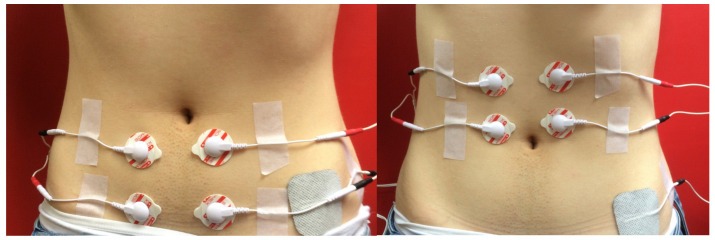
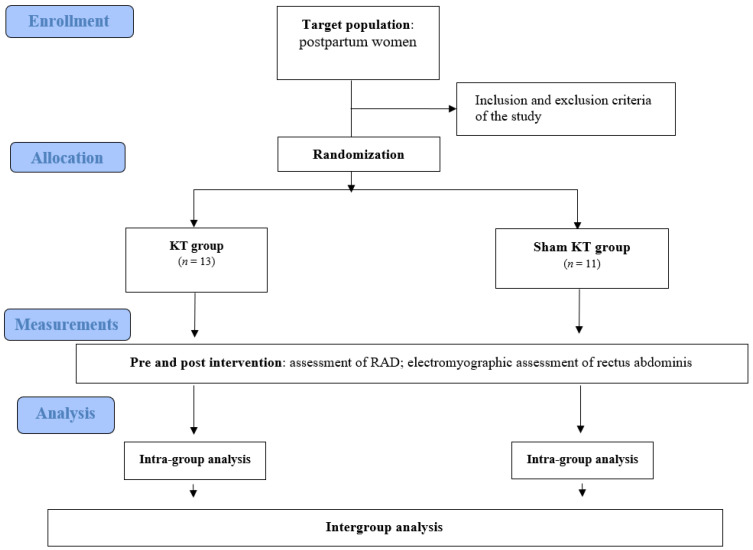
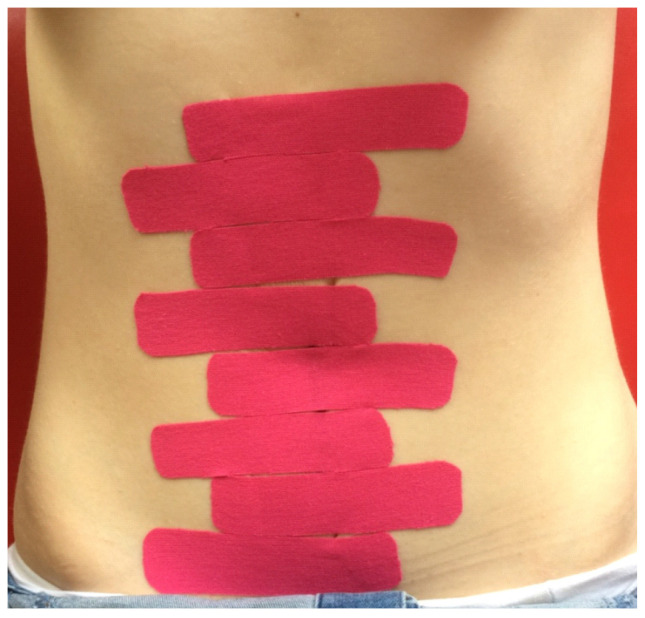
A randomized clinical trial was conducted in the Physical Therapy Department at Wroclaw Medical University. The participants were randomly assigned to one of two groups: the KT group (intervention), in which KT tapes were applied (48 h intervention) and the sham KT group (control, sham intervention), in which non-stretch tapes were used (cloth surgical tape, 48 h intervention). In all participants, a palpation assessment of RAD was conducted and the inter-recti distance was measured using a digital caliper at three sites: at the umbilicus and 4.5 cm above and below it. Measurements were taken before and after the intervention.
The gathered results show a statistically significant reduction in rectus abdominis diastasis at each of the observed sites after the application of KT tapes in the intervention group ( < 0.05). In the intergroup comparison, a statistically significantly lower RAD (at umbilicus) was found after the intervention ( = 0.005) in KT group.
the application of KT tapes using the corrective technique can contribute to reducing RAD in women up to 12 months after delivery.
腹直肌分离(RAD)是指腹直肌过度分开,同时白线伸展变薄,这是由于前腹壁和全身的机械及功能紊乱所致。本研究的主要目的是对产后妇女在应用肌内效贴布前后进行腹直肌分离的触诊评估,并将结果与假干预组进行比较。
在弗罗茨瓦夫医科大学物理治疗科进行了一项随机临床试验。参与者被随机分为两组:肌内效贴布组(干预组),应用肌内效贴布(干预48小时);假肌内效贴布组(对照组,假干预),使用无弹性的贴布(布质手术贴布,干预48小时)。对所有参与者进行腹直肌分离的触诊评估,并使用数字卡尺在三个部位测量腹直肌间距:脐部以及脐上和脐下4.5厘米处。在干预前后进行测量。
收集的结果显示,干预组应用肌内效贴布后,在每个观察部位的腹直肌分离均有统计学意义的降低(<0.05)。在组间比较中,肌内效贴布组干预后(=0.005)在脐部的腹直肌分离明显更低。
采用矫正技术应用肌内效贴布有助于减少产后12个月内妇女的腹直肌分离。